
 100% FREE ACCESS
7th Standard CBSE Syllabus & Materials
7th Standard CBSE
CBSE 7th Social Science Theme E - Understanding Market - New Sample Question Papers Study Material - QB365 Set A
NEW7th Standard CBSE
CBSE 7th Social Science Theme E - From Barter to Money - New Sample Question Papers Study Material - QB365 Set A
NEW7th Standard CBSE
CBSE 7th Social Science Theme D - The Constitution of India- An Introduction - New Sample Question Papers Study Material - QB365 Set A
NEW7th Standard CBSE
CBSE 7th Social Science Theme D - From the Rulers to the Ruled : Types of Governments - New Sample Question Papers Study Material - QB365 Set A
NEW7th Standard CBSE
CBSE 7th Social Science Theme B - The Age of Reorganisation - New Sample Question Papers Study Material - QB365 Set A
NEW7th Standard CBSE
CBSE 7th Social Science Theme B - The Rise of Empires - New Sample Question Papers Study Material - QB365 Set A

Published on: 31/10/2025
Download CBSE Class 7th Standard CBSE Mathematics question papers, sample papers, important questions, and previous year solved papers in PDF format. Get free study materials, NCERT solutions, and exam preparation resources for Class 7th Standard CBSE Mathematics
Questions + Answers key
Take MCQ Mathematics Test
1.
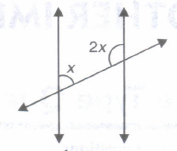
Find the value of x in each of the following figures, if 1|| m.
2.
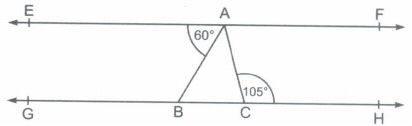
In the following figure, EF II GH, \(\angle \)EAB =60° and \(\angle \)ACH = 105°.
Determine
(i) \(\angle \)CAF and
(ii) \(\angle \)BAC.
3.
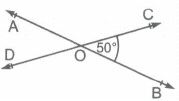
In the adjoining figure, the lines \(\overleftrightarrow { AB } \) and \(\overleftrightarrow { CD } \) intersect at O.If \(\angle \)COB = 50°, find the measures of the other three angles.
4.
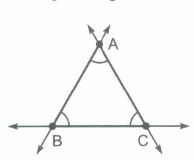
Find the measure of the angles made by the intersecting lines at the vertices of an equilateral triangle.
5.
Can two lines intersect in more than one point? Think about it.
6.
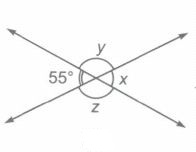
Find the value of the angles x, y and z in each of the following:
7.
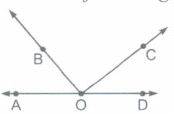
In the given figure, are the following adjacent angles?
(a) \(\angle \)AOB and \(\angle \)EOC
(b) \(\angle \)BOD and \(\angle \)BOC
Justify your answer.
8.
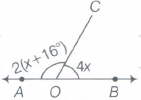
In the given figure, find the value of 3x (approx.)
9.
Find an angle whose supplement is \(\frac { 1 }{ 3 } \) of it.
10.
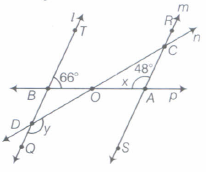
In the given figure, two parallel lines l and m are cut by two transversals n and p. Find the value of x and y.
11.
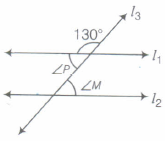
In the following figure, find the value of \(\angle \)M.
12.
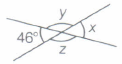
Find the value of the angles x, y and z, in the following figure.
13.
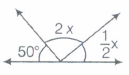
In the following figure, find the angles 2x and \(\frac { 1 }{ 2 } x.\)
14.
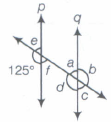
In the given figure, p II q. Find the unknown angles.
15.
Draw any rectangle and find the measures of angles at the four vertices made by the intersecting lines.
1.
x + 2x = 180° (Co-interior angle)
3x = 180°
x = 60°
2.
(i) Since EF " GR and AC is a transversal.
∴ \(\angle \)CAF + \(\angle \)ACR = 180°
=> \(\angle \)CAF + 105° = 180°
=> \(\angle \)CAF = (180° - 105°) = 75°
(ii)∵ FE || GR and AC is a transversal.
:. \(\angle \)EAC = \(\angle \)ACR [Alternate angles]
=> \(\angle \)EAC = 105°
=> \(\angle \)BAC + LEAB = 105°
=> \(\angle \)BAC + 60° = 105°
=> \(\angle \)BAC = 105° - 60° = 45°
Thus, \(\angle \)CAF = 75° and \(\angle \)BAC = 45°
3.
∵ \(\angle \)COB = 50° [Given]
∴ \(\angle \)AOD = 50° [Vertically opposite angles]
Now, \(\angle \)AOC and \(\angle \)COB form a linear pair.
Thus, \(\angle \)AOC + \(\angle \)COB = 180°
=> \(\angle \)AOC + 50° = 180°
=> \(\angle \)AOC = 180° - 50° = 130°
Also, \(\angle \)AOC and \(\angle \)BOD are vertically opposite angles.
∴ \(\angle \)BOD = \(\angle \)AOC = 130°
Thus, the required measures of the remaining
three angles are:\(\begin{matrix} \angle AOD={ 50 }^{ o } \\ \angle AOC=130^{ o } \\ \angle BOD=130^{ o } \end{matrix} \)}
4.
Points of intersection are A, B and C.
Measure of LA = 60°
Measure of LB = 60°
Measure of LC = 60°
5.
No, two lines cannot intersect in more than one point.
6.
Since x and 55° are vertically opposite angles
∴ x = 55°
Again, 55° + Y = 180° [Linear pair]
or y = 180° - 55°
or y = 125°
Since z and yare vertically opposite angles,
∴ z = 125° [∵ y = 125°J
Thus, x = 55°, y = 125°, Z = 125o
7.
(a) Yes, \(\angle \)AOB and \(\angle \)BOC are adjacent angles, because they have common vertex 0 and their outer arms (\(\overrightarrow { OA } \) and \(\overrightarrow { OC } \)) are on either side of the common arm OB.
(b) No, because \(\angle \)BOC is a part of \(\angle \)BOD.
8.
74°
9.
135°
10.
Given, l || m, n and p are transversals, \(\angle \)TBO = 66°.
\(\therefore\) \(\angle \)TBO + \(\angle \)x = 180°
[\(\therefore\) l || mm and cointerior angles has a sum of 180°]
\(\Rightarrow\) \(\angle \)x =180° - 66°=114°
\(\because\) \(\angle \)OCA= \(\angle \)BDO
[alternate angles formed by transversal mare equal]
\(\because\)\(\angle \)OCA= 48°
So, \(\because\)BDO = 48°
\(\because\) \(\angle \)BDO + \(\angle \)QDO =180° [linear pair]
\(\Rightarrow\) 48° + \(\angle \)y =180° \(\Rightarrow\) \(\angle \)y =180° - 48°=132°
So, 70° + 40° + \(\angle \)EFD = 180°
\(\Rightarrow
\) 110° + \(\angle \)EFD =180°
\(\Rightarrow
\) \(\angle \)EFD=180°-110° \(\Rightarrow\) \(\angle \)EFD =70°
11.
Since, lines l1 and l2 are parallel to each other.
where l3 is transversal
\(\therefore\) \(\angle \) P and \(\angle \)130° form a linear pair angles.
So, \(\angle \)P+130°=180°
\(\Rightarrow\) \(\angle \)P = 180° - 130°
\(\Rightarrow\) \(\angle \)P = 50°
Also, \(\angle \)P and \(\angle \)M, alternate interior angles.
\(\angle \)M=\(\angle \)P=50°
12.
Since, angles 46° and x are vertically opposite angles.
So, x = 46°
\(\because\) Angles x and y form a linear pair angles.
\(\therefore\) x+y=180° and x = 46°
So, 46°+y=180° \(\Rightarrow\) y = 180°-46°
\(\Rightarrow\) y = 134°
Now, angles y and z are vertically opposite angles.
So, y = z = 134°
13.
Since, anglesSo, 50° and \(\left( 2x+\frac { 1 }{ 2 } x \right) \) form a linear pair angles.
So, \(50°+2x+\frac { 1 }{ 2 } x=180°\Rightarrow \frac { { 100 }^{ ° }+4x+x }{ 2 } =180°\)
\(\Rightarrow \quad 100°+5x=360°\Rightarrow 5x=360°-100\)
\(\Rightarrow \quad 5x=260°\Rightarrow \quad x=\frac { 260 }{ 5 } =52°\Rightarrow x=52°\)
So, 2x=2\(\times\)52°=104°
and \(\frac { 1 }{ 2 } x=\frac { 1 }{ 2 } \times 52°=26°\)
14.
Given, p II q
\(\angle \)e + 125° = 180° [by linear pair]
\(\Rightarrow\) \(\angle \)e = 180° -125° \(\Rightarrow\)\(\angle \)e = 55°
\(\therefore\) \(\angle \)f = \(\angle \)e = 55° [vertically opposite angles]
Since, p II q and t is a transversal.
\(\therefore\) \(\angle \)a = \(\angle \)f = 55° [alternate interior angles]
\(\angle \)d = 125° [corresponding angles]
\(\angle \)c = \(\angle \)a = 55° [vertically opposite angles]
and \(\angle \)b = \(\angle \)d = 125° [vertically opposite angles]
Hence, \(\angle \)a = 55°, \(\angle \)b = 125°, \(\angle \)c = 55°, \(\angle \)d = 125°, \(\angle \)e = 55° and \(\angle \)f = 55°.
15.
Let ABCD be the rectangle.
ABCD is a parallelogram with \(\angle \)A = 90°.
We have, \(\angle \)C = \(\angle \)A = 90°
[opposite angles of a parallelogram are equal]
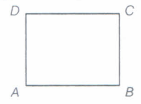
Again, \(\angle \)A + \(\angle \)B= 180°
[\(\because\) \(\angle \)A and \(\angle \)B are adjacent angles of a parallelogram]
\(\Rightarrow\) 90° + \(\angle \)B= 180° \(\Rightarrow\) \(\angle \)B= 180° - 90° = 90°
\(\therefore\) \(\angle \)D = \(\angle \)B= 90°
[\(\because\) opposite angles of a parallelogram are equal]
Hence, \(\angle \)A = \(\angle \)B = \(\angle \)C = \(\angle \)D = 90°

7th Standard CBSE Syllabus & Materials
7th Standard CBSE
CBSE 7th Social Science Theme B - New Beginnings : Cities and States - New Sample Question Papers Study Material - QB365 Set A
NEW7th Standard CBSE
CBSE 7th Social Science Theme A - Climates of India - New Sample Question Papers Study Material - QB365 Set A
NEW7th Standard CBSE
CBSE 7th Social Science Theme A - Geographical Diversity of India - New Sample Question Papers Study Material - QB365 Set A
NEW7th Standard CBSE
CBSE 7th Science Earth, Moon and the Sun - New Sample Question Papers Study Material - QB365 Set A



NCERT Books

Syllabus

Exam Pattern

Sample Question Papers

Previous year Question Papers

Important Notes

MCQ Practice test

NCERT Exemplers

Case study Questions

Image Based Questions

Passage based Questions

HOT Questions

Value Based Questions

Model Questions Papers
NCERT ( Book Back ) Questions

Assertion and Reason
Important Questions And Answers

CBSE 7th Standard CBSE Subjects
CBSE Standards


