
 100% FREE ACCESS
7th Standard CBSE Syllabus & Materials
7th Standard CBSE
CBSE 7th Social Science Theme E - Understanding Market - New Sample Question Papers Study Material - QB365 Set A
NEW7th Standard CBSE
CBSE 7th Social Science Theme E - From Barter to Money - New Sample Question Papers Study Material - QB365 Set A
NEW7th Standard CBSE
CBSE 7th Social Science Theme D - The Constitution of India- An Introduction - New Sample Question Papers Study Material - QB365 Set A
NEW7th Standard CBSE
CBSE 7th Social Science Theme D - From the Rulers to the Ruled : Types of Governments - New Sample Question Papers Study Material - QB365 Set A
NEW7th Standard CBSE
CBSE 7th Social Science Theme B - The Age of Reorganisation - New Sample Question Papers Study Material - QB365 Set A
NEW7th Standard CBSE
CBSE 7th Social Science Theme B - The Rise of Empires - New Sample Question Papers Study Material - QB365 Set A

Published on: 31/10/2025
Download CBSE Class 7th Standard CBSE Mathematics question papers, sample papers, important questions, and previous year solved papers in PDF format. Get free study materials, NCERT solutions, and exam preparation resources for Class 7th Standard CBSE Mathematics
Questions + Answers key
Take MCQ Mathematics Test
1.
If area of a rectangle is 600 m2 and length is 30 m. Find its width.
2.
Find the area of a circle, whose circumference is 44 cm.
3.
Find the area of each of the following triangle.
.png)
4.
In a parallelogram ABCD, AB = 7.2 cm and the perpendicular from C on AB is 4.5 cm.
5.
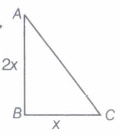
Area of a right-angled triangle is 16 sq cm. Find the lengths of AB and BC, if one leg of triangle is twice of the other.
6.
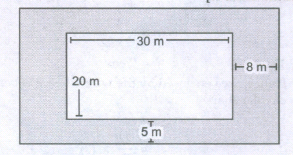
A rectangular shaped swimming 3pool with dimensions 30 m x 20 m has 5 m wide cemented path along its length and 8 m wide path along its width (as shown in fig). Find the cost of cementing the path at the rate of Rs. 200 per m2.
7.
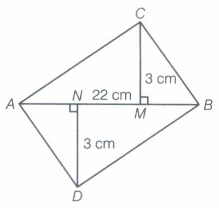
Find the area of the quadrilateral ABCD. Here, AC = 22 cm, BM = 3 cm, DN = 3 cm and BM \(\bot\) AC, DN \(\bot\) AC
8.
What will be the area of the largest square that can be cut out of a circle of radius 10 cm?
100 cm2
200 cm2
300 cm2
400 cm2
9.
If the sides of a parallelogram are increased to twice of its original lengths, how much will the perimeter of the new parallelogram?
1.5 times
2 times
3 times
4 times
10.
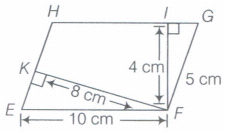
In the following figure, EFGH is a parallelogram, altitudes FK and FI are 8 cm and 4 cm respectively. If EF = 10 cm, then the area of EFGH is
20 cm2
32 cm2
40 cm2
80 cm2
11.
A wire is bent to form a square of side 22 cm. If the wire is rebent to form a circle, its radius is
22 cm
14 cm
11 cm
7 cm
12.
Find the length of a parallelogram, whose area is 246 cm2 and base is 20 cm2.
123 cm
13.2 cm
12.3 cm
1.32 cm
13.
What is the area of a circle whose diameter is 1 cm?
14.
The perimeter of a square is 20 cm. What is the length of its side?
15.
The side of an equilateral triangle is 5 cm. What is its perimeter?
16.
Find area of a square of side 8 cm.
17.
The circumference of two circles are in the ratio 5 : 6. Find the ratio of their radius.
18.
The circumference of two circles are in the ratio 5 : 6. Find the ratio of their areas.
19.
The area of a rhombus is 96 cm2. If one of its diagonals is 12 em, then find the perimeter of the rhombus.
20.
Two cross roads, each of width 3 m, run at right angles through the centre of a rectangular park of length 70 m and breadth 45 m and parallel to its sides. Find the area of the roads. Also find the cost of constructing the roads at the rate of Rs.110 per m2.
1.
\(\therefore\) Area of a rectangle = Length x Width
\(\Rightarrow\) 600 = 30 x Width \(\Rightarrow\) Width = \(\frac{600}{30}=\frac{60}{3}\) = 20 m.
2.
Circumference of the circle = 44 cm [given]
\(\therefore\) Circumference of a circle = 2\(\pi r\)
\(\therefore 2\pi r=44\Rightarrow \pi r =\frac{44}{2}=22\Rightarrow \pi r =22\Rightarrow r=22\times \frac{7}{22}\) = 7 cm.
Then, area of the Circle = \(\pi r^2=\frac{22}{7}\times 7\times 7\) = 154 cm2.
3.
Given, base of a triangle = 5 cm
and height of a triangle = 3.2 cm
\(\therefore\) Area of a triangle = \(\frac{1}{2}\times\) Base \(\times\) Height
= \(\frac{1}{2}\times\) 5 \(\times\) 3.2 = \(\frac{1}{2}\times\) 16 = 8 cm2.
4.
Given, base of the parallelogram ABCD, AB = 7.2 em
and length of perpendieular from C on AB = 4.5 em
\(\therefore\) Area of the parallelogram = Base x Height
= 7.2 x 4.5 = 32.4 cm2.
5.
Given, area of a triangle is 16 cm 2 in which AB = 2x, BC = x, \(\Rightarrow\) Area of a triangle = \(\frac{1}{2}\) x BC x AC
\(\Rightarrow\) 16 = \(\frac{1}{2}\times x\times2x\Rightarrow 16=x^2\Rightarrow x=4\)
So, BC = 4 cm, AB = 2 x 4 = 8 cm.
6.
Area covered by swimming pool
=30 m x 20 m
= 600m2.
Length of outer rectangle = (30 + 8 + 8) m = 46 m
and its breadth = (20 + 5 + 5) m = 30 m
So, the area of outer rectangle
= 46 m x 30 m = 1380 m2
Area of cemented path = Area of outer rectangle - Area of swimming pool
= (1380 - 600) m2 = 780 m2
Cost of cementing 1 m2 path = Rs. 200
So, total cost of cementing the path
= 780 x Rs.200
= Rs.1,56,000
7.
Given, ABCD is a quadrilateral in which AC = 22 cm, BM = 3 cm, DN = 3 cm and BM \(\bot\) AC, DN \(\bot\) AC.
\(\therefore\) Area of \(\Delta\)ABC = \(\frac{1}{2}\times\) AC x BM [\(\therefore\) Area of triangle = \(\frac{1}{2}\times\)Base x Height]
= \(\frac{1}{2}\times\)22 x 3 = \(\frac{66}{2}\) cm2 = 33 cm2
and area of \(\Delta\)ABD = \(\frac{1}{2}\times\)AB x DN = \(\frac{1}{2}\times\)22 x 3
= \(\frac{66}{2}\) cm2 = 33 cm2
Area of quadrilateral ABCD = Area of \(\Delta\)ABC + Area of \(\Delta\)ACD
= 33 + 33 = 66 cm2
Hence, the area of quadrilateral ABCD is 66 cm2.
8.
(b)
200 cm2
9.
(b)
2 times
10.
(c)
40 cm2
11.
(b)
14 cm
12.
(c)
12.3 cm
13.
()
\(\frac{11}{4}\)cm2
14.
()
5 cm
15.
()
15 cm
16.
()
Area = 8 x 8 = 64cm2
17.
()
\(\frac { 2\pi r }{ 2\pi R } \)=\(\frac { 5 }{ 6 } \)
\(\Rightarrow \frac { r }{ R } =\frac { 5 }{ 6 } \)
\(\therefore \) ratio is 5 : 6
18.
Let the radii of the given circles be r1 and r2. Let their circumference be 'C1' and 'C2' respectively.
\(\therefore\)C1 = 2\(\pi\)r1 and C2 = 2\(\pi\)r2
Since, C1 : C2 = 5 : 6
\(\therefore\)(2\(\pi\)r1):(2\(\pi\)r2)=5:6
\(\Rightarrow\)\(\frac { 2\pi r_{ 1 } }{ 2\pi r_{ 2 } } =\frac { 5 }{ 6 } \Rightarrow \frac { { r }_{ 1 } }{ { r }_{ 2 } } =\frac { 5 }{ 6 } \)
Now, let the area of the given circles be A1 and A2
\(\therefore\)A1 = \(\pi\)r12 and A2 = \(\pi\)r22
\(\Rightarrow\)\(\frac { { A }_{ 1 } }{ A_{ 2 } } =\frac { { { \pi r }_{ 1 } }^{ 2 } }{ { { \pi r }_{ 2 } }^{ 2 } } =\frac { { { r }_{ 1 } }^{ 2 } }{ { { r }_{ 2 } }^{ 2 } } \Rightarrow \frac { A_{ 1 } }{ A_{ 2 } } =\left( \frac { { { r }_{ 1 } } }{ { { r }_{ 2 } } } \right) ^{ 2 }\)
\(\Rightarrow\)\(\frac { { A }_{ 1 } }{ A_{ 2 } } =\left( \frac { 5 }{ 6 } \right) ^{ 2 }=\frac { 25 }{ 36 } \Rightarrow \)A1:A2
= 25:36
Thus, the areas of the two given circles are in the ratio 25 : 36.
19.
ABCD is the rhombus such that its diagonals AC and BD intersect at O. Here BD = 12 cm.
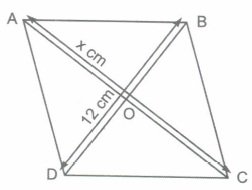
Suppose AC = x cm.
Since, the area of a rhombus =\(\frac{1}{2}\)\(\times\)[Product of 2 its diagonals]
\(\therefore\)Area of the rhombus ABCD =\(\frac{1}{2}\)\(\times\) 12 \(\times\) x cm2
2 But the area of the rhombus ABCD = 96 cm2
\(\Rightarrow\)\(\frac{1}{2}\)\(\times\)12 \(\times\) x = 96
\(\Rightarrow\)x=\(\frac{96\times2}{12}\)cm \(\Rightarrow\)x=8\(\times\)2cm
\(\Rightarrow\) x=16 cm
Since, the diagonals of a rhombus, bisect each other at right angles.
\(\therefore\)\(\angle \)COD = 90°, OC =\(\frac{1}{2}\)\(\times\) 16 cm=8 cm
and Od=\(\frac{1}{2}\)\(\times\) 12 cm =6 cm
Now, in right \(\Delta\)COD, we have
\(\Rightarrow\)OD2 + OC2 = CD2 \(\Rightarrow\) 62 + 82 = CD2
\(\Rightarrow\)36 + 64 = CD2 \(\Rightarrow\)100 = CD2
\(\Rightarrow\) 102 = CD2 \(\Rightarrow\) CD = 10 cm.
Since, all the sides of rhombus are equal and perimeter of a rhombus = 4 x Side.
\(\therefore\) Perimeter ofthe rhombus = 4 x 10 em = 40 cm
20.
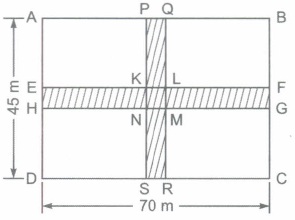
Here, Length of the rectangular park = 70 m
Breadth of the rectangular park = 45 m
The cross paths are shown by EFGH and PQRS in the figure.
Now, PQ =3 m and PS = 45 m
EH = 3 m and EF = 70 m
KL = 3 m and KN = 3 m
Now, area of the path = [Area of rectangle PQRS] + [Area of rectangle EFGH]- [Area of square KLMN]
= [PS x PQ] + [EF x EH] - [KL x KN]
= [45 x 3] m2 + [70 x 3] m2 - [3 x 3] m2
= 135 m2 + 210 m2 - 9 m2 = 336 m2
Now, cost of constructing the path = Rs. 110 x 336 = Rs. 36960.
Note: While finding the area of cross roads, the area of the middle square (here, KLMN) is taken twice
which is to be subtracted once.

7th Standard CBSE Syllabus & Materials
7th Standard CBSE
CBSE 7th Social Science Theme B - New Beginnings : Cities and States - New Sample Question Papers Study Material - QB365 Set A
NEW7th Standard CBSE
CBSE 7th Social Science Theme A - Climates of India - New Sample Question Papers Study Material - QB365 Set A
NEW7th Standard CBSE
CBSE 7th Social Science Theme A - Geographical Diversity of India - New Sample Question Papers Study Material - QB365 Set A
NEW7th Standard CBSE
CBSE 7th Science Earth, Moon and the Sun - New Sample Question Papers Study Material - QB365 Set A



NCERT Books

Syllabus

Exam Pattern

Sample Question Papers

Previous year Question Papers

Important Notes

MCQ Practice test

NCERT Exemplers

Case study Questions

Image Based Questions

Passage based Questions

HOT Questions

Value Based Questions

Model Questions Papers
NCERT ( Book Back ) Questions

Assertion and Reason
Important Questions And Answers

CBSE 7th Standard CBSE Subjects
CBSE Standards


