
 100% FREE ACCESS
7th Standard CBSE Syllabus & Materials
7th Standard CBSE
CBSE 7th Social Science Theme E - Understanding Market - New Sample Question Papers Study Material - QB365 Set A
NEW7th Standard CBSE
CBSE 7th Social Science Theme E - From Barter to Money - New Sample Question Papers Study Material - QB365 Set A
NEW7th Standard CBSE
CBSE 7th Social Science Theme D - The Constitution of India- An Introduction - New Sample Question Papers Study Material - QB365 Set A
NEW7th Standard CBSE
CBSE 7th Social Science Theme D - From the Rulers to the Ruled : Types of Governments - New Sample Question Papers Study Material - QB365 Set A
NEW7th Standard CBSE
CBSE 7th Social Science Theme B - The Age of Reorganisation - New Sample Question Papers Study Material - QB365 Set A
NEW7th Standard CBSE
CBSE 7th Social Science Theme B - The Rise of Empires - New Sample Question Papers Study Material - QB365 Set A

Published on: 31/10/2025
Download CBSE Class 7th Standard CBSE Mathematics question papers, sample papers, important questions, and previous year solved papers in PDF format. Get free study materials, NCERT solutions, and exam preparation resources for Class 7th Standard CBSE Mathematics
Questions + Answers key
Take MCQ Mathematics Test
1.
The adjacent sides of a parallelogram are 25 cm and 40 cm and the altitude drawn on the longer side is 15 cm. Then, what is the area of the parallelogram?
2.
Find the area of each of the following triangle.
.png)
3.
Find the area of each of the following parallelogram.
.png)
4.
Find the area of the following parallelograms:
.png)
5.
From the following rectangles of length 6 cm and breadth 4 cm is composed of congruent polygons. Find the area of each polygon.
q.png)
6.
Yogesh walks to school every day. His school is located 500 m from his house. What is the total distance walked by Yogesh in 5 days?
7.
The length of a rectangle is 1cm more than its breadth. The diagonal is 29 cm. Find the area of the rectangle.
8.
How much plastic sheet do you need to cover a rectangular swimming pool?
9.
What is the length of a wire required to fence a rectangular flower bed?
10.
Find the area of the following rectangle whose Length = 15 cm and breadth= 8 cm.
11.
If the circumference of a circular sheet is 154 m, find its radius. Also, find the area of the sheet. (Take \(\pi=\frac{22}{7}\) )
12.
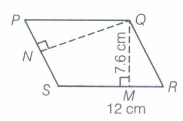
PQRS is a parallelogram (in the given figure). OM is the height from 0 to SR and ON is the height from 0 to PS.If SR= 12 cm and OM = 7.6 cm. Find QN, if PS = 8 cm.
13.
Find the missing values.
| S.No | Base | Height | Area of the parallelogram |
| (a) | 20 cm | 246 cm2 | |
| (b) | 15 cm | 154.5 cm2 | |
| (c) | 8.4 cm | 48.72 cm2 | |
| (d) | 15.6 cm | 16.38 cm2 |
14.
Consider the following parallelogram:
q.png)
Find the areas of the parallelograms by counting the squares enclosed within the figures and also find the perimeters by measuring the sides.
Complete the following table:
| Parallelogram | Base | Height | Area | Perimeter |
| (a) | 5 units | 3 units | 5 x 3 = 15 sq units |
15.
Find the area of a square park whose perimeter is 320m.
16.
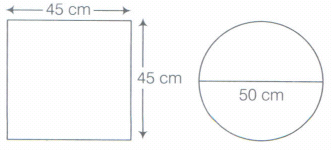
Pizza Factory has come out with two kinds of pizzas. A square pizza of side 45 cm costs Rs 150 and a circular pizza of diameter 50 cm cost Rs 160. Which pizza is a better deal?
17.
A wall of a room is of dimensions 5 m x 4m. lt has a window of dimensions 1.5 m x 1 m and a door of dimensions 2.25 m x 1 m. Find the area of the wall, which is to be painted.
18.
What will be the area of the largest square that can be cut out of a circle of radius 10 cm?
100 cm2
200 cm2
300 cm2
400 cm2
19.
If radius of a circle is increased to twice its original length, how much will the area of the circle increase?
1.4 times
2 times
3 times
4 times
20.
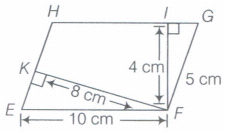
In the following figure, EFGH is a parallelogram, altitudes FK and FI are 8 cm and 4 cm respectively. If EF = 10 cm, then the area of EFGH is
20 cm2
32 cm2
40 cm2
80 cm2
21.
Area of a rectangle and the area of a circle are equal. If the dimensions of the rectangle are 14 cm x 11 cm, then radius of the circle is
21 cm
10.5 cm
14 cm
7 cm
22.
Find the length of a parallelogram, whose area is 246 cm2 and base is 20 cm2.
123 cm
13.2 cm
12.3 cm
1.32 cm
1.
600 cm2
2.
Given, base of a triangle = 3 cm
and height of a triangle = 2 cm
\(\therefore\) Area of a triangle = \(\frac{1}{2}\times\) Base \(\times\) Height
= \(\frac{1}{2}\times\) 3 \(\times\) 2 = \(\frac{1}{2}\times\) 6 = 3 cm2.
3.
Given, base of a parallelogram = 5 cm
and height of a parallelogram = 3 cm
\(\therefore\) Area of a parallelogram = Base x Height
= 5 x 3 = 15 cm2.
4.
Here, base = 8 cm and height = 3.5 cm
\(\therefore\) Area of the parallelogram = Base X Height
= 8 x 3.5 = 28 cm2.
5.
Given, length of rectangle = 6 cm
and breadth of rectangle = 4 cm
\(\therefore\) Area of a rectangle = Length X Breadth = 6 x 4 = 24 cm.
From the given figure, it is clear that rectangle is divided into 4 congruent polygons.
\(\therefore\) Area of each polygon = \(\frac{1}{4}\times\) Area of a rectangle
= \(\frac{1}{4}\times\) 24 = 6 cm2.
6.
2500 m.
7.
420 cm2
8.
We need to find the area of rectangular swimming pool to cover it with plastic sheer.
9.
We need to find the perimeter of a rectangular flower bed, which gives the required length of the wire required to fence a rectangular flower bed.
10.
Given, length = 15 cm and breadth = 8 cm
\(\therefore\) Area of a rectangle = Length x Breadth = 15 x 8 = 120 cm2
Hence, area of rectangle is 120 cm2.
11.
Given, circumference of a circular sheet = 154 m
\(\Rightarrow 2\pi r=154\Rightarrow 2\times \frac{22}{7}\times r=154\Rightarrow r=\frac{154\times 7}{2\times 22}=\frac{49}{2}\)m
Now, area of the circular sheet = \(\pi r^2\)
= \(\frac{22}{7}\times \frac{49}{2}\times \frac{49}{5}=\frac{154\times 49}{4}=\frac{7546}{4}\)= 1886.5 m2.
Hence, the radius and area of the circular sheet are 49/2 m and 1886.5 m2, respectively.
12.
If base (PS) = 8 cm and height = QN, then
Area of the parallelogram = 91.2 cm2
[since, parallelogram is same in position]
\(\Rightarrow\) PS x QN = 91.2 \(\Rightarrow\) 8 x QN = 91.2
\(\therefore\) QN = \(\frac{91.2}{8}\) = 11.4 cm.
13.
(a) Given, base of the parallelogram = 20 cm and area of the parallelogram = 246 cm2
We know that area of the parallelogram = Base x Height
\(\therefore\) Base x Height = 246 \(\Rightarrow\) 20 x Height = 246
\(\Rightarrow\) Height = \(\frac{246}{20}\) = 12.3 cm
Hence, the height of the parallelogram is 12.3 cm.
(b) Given, height of the parallelogram = 15 cm and area of the parallelogram = 154.5 cm2
We know that, area of the parallelogram = Base x Height
\(\therefore\) Base x Height = 154.5 \(\Rightarrow\) Base x 15 = 154.5
\(\Rightarrow\) Base = \(\frac{154.5}{15}\) = 10.3 cm
Hence, the base of the parallelogram is 10.3 cm.
(c) Given, height of the parallelogram = 8.4 cm and area of the parallelogram = 48.72 cm2
We know that, area of the parallelogram = Base x Height
\(\therefore\) Base x Height = 48.72 \(\Rightarrow\) Base x 8.4 = 48.72
\(\Rightarrow\) Base = \(\frac{48.72}{8.4}\) = 5.8 cm
Hence, the base of the parallelogram is 5.8 cm.
(d) Given, base of the parallelogram = 15.6 cm and area of the parallelogram = 16.38 cm2
We know that, area of the parallelogram = Base x Height
\(\therefore\) Base x Height = 16.38 \(\Rightarrow\) 15.6 x Height = 16.38
\(\Rightarrow\) Height = \(\frac{16.38}{15.6}\) = 1.05 cm
Hence, the height of the parallelogram is 1.05 cm.
On putting the missing values, the complete table is
| S.No | Base | Height | Area of the parallelogram |
| (a) | 20 cm | 12.3 cm | 246 cm2 |
| (b) | 10.3 cm | 15 cm | 154.5 cm2 |
| (c) | 5.8 cm | 8.4 cm | 48.72 cm2 |
| (d) | 15.6 cm | 1.05 cm | 16.38 cm2 |
14.
Firstly, on counting the squares enclosed within the figures of the parallelogram, we find in each case these are 15 in numbers. So, the area of each parallelogram = 15 sq units, base = 5 units and height = 3 units in each case. Now, draw a perpendicular DM to the base AB or produced AB (if necessary) in each figure as shown below:
s.png)
For figure (a), in \(\Delta\)AMD, by using Pythagoras theorem,
AD = \(\sqrt{MG^2+AM^2}\)
= \(\sqrt{3^2+1^2}=\sqrt{9+1}=\sqrt{10}\) units
\(\therefore\) Perimeter = 2(AD + AB) = 2(\(\sqrt{10}\) + 5) units.
Hence, the required complete table is as follows:
| Parallelogram | Base | Height | Area | Perimeter |
| (a) | 5 units | 3 units | 5 x 3 = 15 sq units | 2(\(\sqrt{10}\) + 5) units |
15.
We know that, perimeter of a square park = 4 x Side
Given, perimeter of a square park = 320 m
Now, 4 x Side = 320
\(\Rightarrow\) \(side=\frac{320}{4}=80m\)
Area of a square park = Side x Side = 80 x 80
= 6400 m2
Hence, the area of a square park is 6400 m2.
16.
\(\therefore\) Side of square pizza = 45 cm
\(\therefore\) Area of a square pizza = (Side)2
= (45)2 = 2025 cm2
Diameter of circular pizza = 50 cm
Radius = \(\frac{50}{2}\) = 25 cm.
\(\therefore\) Area of a circle = \(\pi r^2\)
\(\therefore\) Area of the circular pizza = \(\pi r^2\)
= \(\frac{22}{7}\times 25\times 25=\frac{22}{7}\times 625\)
= \(\frac{13750}{7}\) = 1964.28 cm2
Price of 1 cm square pizaa = \(\frac{2025}{150}\) = Rs 135
Price of 1 cm circular pizaa = \(\frac{1964.29}{160}\) = Rs 12.27
Hence, the circular pizza is a better deal.
17.
A wall of a room is of dimensions 5 m x 4 m.
Length of the room = 5 m
Breadth of the room = 4 m
\(\therefore\) Area of the room = 5 x 4= 20 m2
Length of the window = 1.5 m
Breadth of the window = 1 m
\(\therefore\) Area of the window = 1.5 x 1 = 1.5 m2
Length of the door = 2.25 m
Breadth of the door = 1 m
\(\therefore\) Area of the door = 2.25 x 1 = 2.25 m2
The area of the wall to be painted = Area of the room - Area of the window - Area of the door
= 20 - 1.5 - 2.25
= 20 - 3.75 = 16.25 m2.
18.
(b)
200 cm2
19.
(d)
4 times
20.
(c)
40 cm2
21.
(d)
7 cm
22.
(c)
12.3 cm

7th Standard CBSE Syllabus & Materials
7th Standard CBSE
CBSE 7th Social Science Theme B - New Beginnings : Cities and States - New Sample Question Papers Study Material - QB365 Set A
NEW7th Standard CBSE
CBSE 7th Social Science Theme A - Climates of India - New Sample Question Papers Study Material - QB365 Set A
NEW7th Standard CBSE
CBSE 7th Social Science Theme A - Geographical Diversity of India - New Sample Question Papers Study Material - QB365 Set A
NEW7th Standard CBSE
CBSE 7th Science Earth, Moon and the Sun - New Sample Question Papers Study Material - QB365 Set A



NCERT Books

Syllabus

Exam Pattern

Sample Question Papers

Previous year Question Papers

Important Notes

MCQ Practice test

NCERT Exemplers

Case study Questions

Image Based Questions

Passage based Questions

HOT Questions

Value Based Questions

Model Questions Papers
NCERT ( Book Back ) Questions

Assertion and Reason
Important Questions And Answers

CBSE 7th Standard CBSE Subjects
CBSE Standards


