
 100% FREE ACCESS
7th Standard CBSE Syllabus & Materials
7th Standard CBSE
CBSE 7th Social Science Theme E - Understanding Market - New Sample Question Papers Study Material - QB365 Set A
NEW7th Standard CBSE
CBSE 7th Social Science Theme E - From Barter to Money - New Sample Question Papers Study Material - QB365 Set A
NEW7th Standard CBSE
CBSE 7th Social Science Theme D - The Constitution of India- An Introduction - New Sample Question Papers Study Material - QB365 Set A
NEW7th Standard CBSE
CBSE 7th Social Science Theme D - From the Rulers to the Ruled : Types of Governments - New Sample Question Papers Study Material - QB365 Set A
NEW7th Standard CBSE
CBSE 7th Social Science Theme B - The Age of Reorganisation - New Sample Question Papers Study Material - QB365 Set A
NEW7th Standard CBSE
CBSE 7th Social Science Theme B - The Rise of Empires - New Sample Question Papers Study Material - QB365 Set A

Published on: 31/10/2025
Download CBSE Class 7th Standard CBSE Mathematics question papers, sample papers, important questions, and previous year solved papers in PDF format. Get free study materials, NCERT solutions, and exam preparation resources for Class 7th Standard CBSE Mathematics
Questions + Answers key
Take MCQ Mathematics Test
1.
Construct ΔPQR, if PQ = 5 cm, m \(\angle PQR\) = 105° and m \(\angle QRP\) = 40° (Hint: Recall angle-sum property of a triangle).
2.
Construct an isosceles triangle in which the length of each of its equal sides is 6 cm. and the angle between them is 110°.
3.
Draw an isosceles triangle with each of equal sides of length 3 cm and the angle between them as 45°.
4.
A state traffic police wants to make a traffic signal board in the shape of an equilateral triangle of side 5 m to make the people aware of the traffic rules. Construct this traffic signal board by taking each as 5 cm (instead of m). What value is depicted here?
5.
Construct a \(\triangle ABC\) in which AC = 4 cm, \(\angle A=75^0,\angle C=60^0\).
6.
Construct a \(\triangle ABC\) in which AB = 2 cm, BC = 4.5 cm and AC = 4cm.
7.
Draw \(\triangle PQR\) with PQ= 4 cm, QR = 3.5 cm and PR = 4 cm. What type of triangle is this?
8.
Construct an equilateral triangle of side 5.5 cm.
9.
Construct \(\triangle XYZ\) in which XY = 4.5 cm. yz = 5 cm and ZX = 6 cm.
10.
Construct an isosceles right angled ΔABC, where m ㄥACB = 90° and AC = 6 cm.
1.
PQ = 5 cm, \(\angle PQR\) =105°, \(\angle QRP\) = 40°
\(\therefore\) 105° + 40° + \(\angle QPR\) = 180°
\(\therefore\) 145° + \(\angle QPR\) = 180°
\(\angle QPR\) = 180° - 145°
\(\angle QPR\) = 35°
(a) Draw a line segment PQ of 5 em.
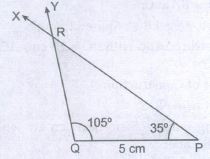
(b) From point P draw an angle of 35°, such that \(\angle QPX\) = 35°
PQR is required triangle.
2.
Steps of Construction:
(a) Draw a line XY. Take a point A on the line.
(b) Taking radius 6 cm draw an arc which cuts the line at B.
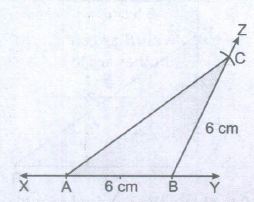
(c) From B draw an angle of 110° i.e., \(\angle ABZ\) = 110°
(d) From point B draw an arc of radius 6 cm which cuts the line BZ at C.
(e) Join AC to get the required triangle.
3.
Steps of construction
Step I Firstly, we draw a rough sketch of triangle with given measures marked on it.
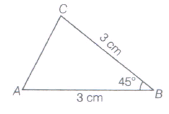
Step II Draw a line segment AB of length 3 cm.
Step III Draw an angle of 45° on point B and produce it to ray Y.
Step IV With B as centre, draw an arc of 3 cm which intersects ray BYat C.
Step V Join AC.
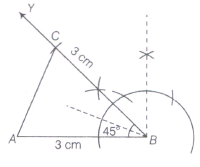
Thus, \(\triangle ABC\) is the required isosceles triangle.
4.
Steps of construction
(i) Draw a line segment AB = 5 cm.
(ii) Draw an arc of radius 5 cm from point A.
(iii) Now, draw another arc of radius 5 cm from point B to cut previous arc at C.
(iv) Join A to C and B to C.
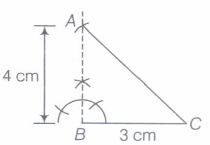
Hence, \(\triangle ABC\) is the required triangle. The value depicted here is to make the people aware of traffic rules for safety measures.
5.
Steps of construction
(i) Draw a line AC= 4 cm.
(ii) Construct \(\angle XAC=75^0\) at A.
(iii) Also, construct \(\angle YCA=60^0\)at C.
(iv) Ray X and ray Y cut each other at point B.
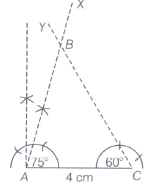
Hence, \(\triangle ABC\) is the required triangle, having \(\angle A=75^0,\angle C=60^0\) and AC = 4 cm.
6.
Steps of construction
(i) Draw a line BC = 4.5 cm.
(ii) With centre B and radius 2 cm draw an arc.
(iii) With centre C and radius 4 cm draw an arc which cuts the previous arc at A.
(iv) Join AB and AC.
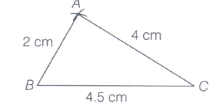
Hence, \(\triangle ABC\) is the required triangle in which AB= 2 cm, BC= 4.5 cm and AC= 4 cm.
7.
Given, three sides of \(\triangle PQR\) are PQ = 4 cm, QR = 35 cm and PR = 4cm.
To construct a triangle with given sides, we use the following steps:
Steps of construction
Step I Firstly, we draw a rough sketch with given measures marked on it.
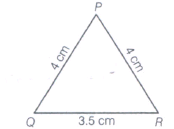
Step II Draw a line segment QR = 35 cm.

Step III With Q as centre and radius 4 cm, draw an arc.
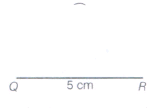
Step IV Now, with R as centre and radius 4 cm, draw another arc intersecting the previous arc at P.
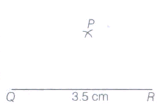
Step V Join PQ and PR.
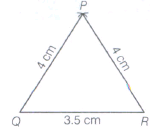
Thus, \(\triangle PQR\) is the required triangle.
Here, PQ = PR = 4 cm, i.e. two sides of \(\triangle PQR\) are equal.
Therefore, \(\triangle PQR\) is an isosceles triangle.
8.
Given, length of each side of an equilateral triangle is 5.5 cm.
To construct an equilateral triangle, we use the following steps:
Steps of construction
Step I Firstly, we draw a rough sketch with gIven measures marked on it.
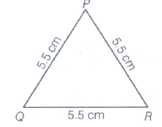
Step II Draw a line segment QR = 55 cm.

Step III With Q as centre and radius 5.5 cm, draw an arc.
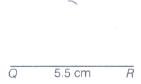
Step IV Now, with R as centre and radius 5.5 cm, draw another arc to cut the previous arc at P.
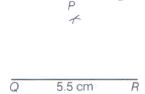
Step V Join PQ and PR.
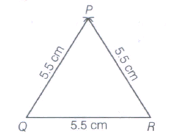
Thus, \(\triangle PQR\) is the required equilateral triangle.
9.
Given, three sides of \(\triangle XYZ\) are XY = 4.5 cm, yz = 5 cm and ZX=6 cm.
To construct this triangle, we use the following steps:
Steps of construction
Step I Firstly, we draw a rough sketch of triangle with given measures marked on it.
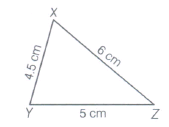
Step II Draw a line segment yz of length 5 cm, i.e. yz = 5 cm.

Step III With Y as centre and radius 45 cm, draw an arc.
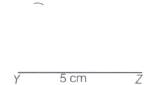
Step IV With Z as centre and radius 6 cm, draw another arc to cut the previous arc at X.
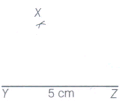
step V Join XY and ZX.
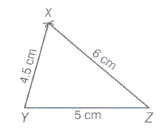
Hence, \(\triangle XYZ\) is the required triangle.
10.
Given, an isoscelesright angled ΔABC in which
m ㄥACB =90°
and AC = BC =6 cm
∵ In an isoscelesright angled triangle, two sides, i.e. base and height will be equal.
To construct a triangle with these two sides and one right angle, we use the following steps:
Steps of construction
Step I Firstly, we draw a rough sketch of triangle with given measures marked on it.
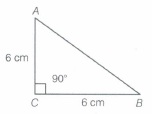
Step II Draw a line segment BC = 6 cm.
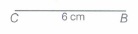
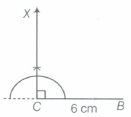
Step III At point C, draw CX 丄 BC.
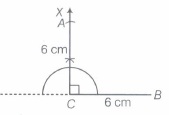
Step IV With C as centre and radius 6 cm, draw an arc to intersect ray CX at A.
Step V Join AB .
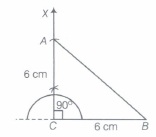
Thus, ΔABC is the required isosceles right angled triangle.

7th Standard CBSE Syllabus & Materials
7th Standard CBSE
CBSE 7th Social Science Theme B - New Beginnings : Cities and States - New Sample Question Papers Study Material - QB365 Set A
NEW7th Standard CBSE
CBSE 7th Social Science Theme A - Climates of India - New Sample Question Papers Study Material - QB365 Set A
NEW7th Standard CBSE
CBSE 7th Social Science Theme A - Geographical Diversity of India - New Sample Question Papers Study Material - QB365 Set A
NEW7th Standard CBSE
CBSE 7th Science Earth, Moon and the Sun - New Sample Question Papers Study Material - QB365 Set A



NCERT Books

Syllabus

Exam Pattern

Sample Question Papers

Previous year Question Papers

Important Notes

MCQ Practice test

NCERT Exemplers

Case study Questions

Image Based Questions

Passage based Questions

HOT Questions

Value Based Questions

Model Questions Papers
NCERT ( Book Back ) Questions

Assertion and Reason
Important Questions And Answers

CBSE 7th Standard CBSE Subjects
CBSE Standards


