
 100% FREE ACCESS
7th Standard CBSE Syllabus & Materials
7th Standard CBSE
CBSE 7th Social Science Theme E - Understanding Market - New Sample Question Papers Study Material - QB365 Set A
NEW7th Standard CBSE
CBSE 7th Social Science Theme E - From Barter to Money - New Sample Question Papers Study Material - QB365 Set A
NEW7th Standard CBSE
CBSE 7th Social Science Theme D - The Constitution of India- An Introduction - New Sample Question Papers Study Material - QB365 Set A
NEW7th Standard CBSE
CBSE 7th Social Science Theme D - From the Rulers to the Ruled : Types of Governments - New Sample Question Papers Study Material - QB365 Set A
NEW7th Standard CBSE
CBSE 7th Social Science Theme B - The Age of Reorganisation - New Sample Question Papers Study Material - QB365 Set A
NEW7th Standard CBSE
CBSE 7th Social Science Theme B - The Rise of Empires - New Sample Question Papers Study Material - QB365 Set A

Published on: 31/10/2025
Download CBSE Class 7th Standard CBSE Mathematics question papers, sample papers, important questions, and previous year solved papers in PDF format. Get free study materials, NCERT solutions, and exam preparation resources for Class 7th Standard CBSE Mathematics
Questions + Answers key
Take MCQ Mathematics Test
1.
Construct \(\triangle\) ABC, right angled at B, given that AC = 5 cm and BC = 4 cm.
2.
Construct a triangle \(\triangle\)PQR when QR = 5 cm, \(\angle\)Q = 60° and \(\angle\)R = 75°.
3.
Construct a right angled isosceles triangle with one side (other than hypotenuse) of length 4.5 cm.
4.
Draw ΔABC in which AB = 4.5 cm, BC = 5 cm and CA = 7 cm. Also, draw the perpendicular bisector of BC.
5.
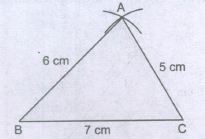
Construct a triangle ABC if the lengths of its sides are given by AB = 6 cm, BC = 7 cm and AC = 5 cm.
6.
Draw a ΔABC in which BC = 5.2 cm, \(\angle B\) = 60° and \(\angle C\) = 100°. Measure \(\angle A.\)
7.
Draw a right angle triangle having hypotenuse of length 5.4 cm, and one of the acute angles of measure 60°
8.
Draw triangle ABC with ∠C as right angle, AB = 6.2 cm and BC = 4.5 cm.
9.
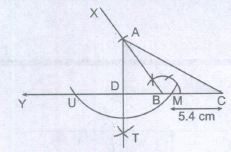
Construct a triangle ABC in which BC = 5.4 cm, \(\angle B\) = 120° and AB = 4.5 cm. Also draw AD perpendicular to BC.
10.
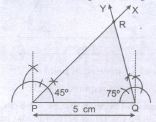
Construct a ΔPQR, where PQ = 5 cm, \(\angle P\) = 45° and \(\angle Q\) = 75°.
11.
Draw a \(\triangle ABC\) with sides 15 cm, 8 cm and 17 cm and find the measure of the angle opposite to the longest side, what type of triangle is it?
12.
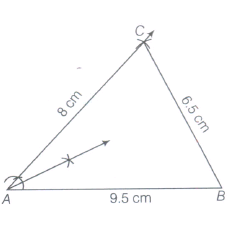
Draw the angle bisector of \(\angle A\) in the triangle with sides AB = 9.5 cm, AC = 8 cm and BC = 6.5 cm.
13.
Find the measure of side AB from the following figure.
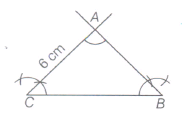
14.
The Measures of certain sides and angles ot triangles. Identity those which cannot be constructed and say why you cannot construct them? Construct rest ot the triangles.
| Triangle | Given Measurements | ||
| ΔABC | mㄥA=700 | mㄥB=500 | AC=3 cm |
15.
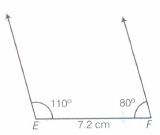
Examine whether you can construct ΔDEF such that EF = 7. 2 cm, mㄥE = 110° and mㄥF = 80°. Justify your answer.
1.
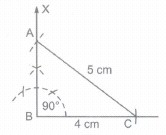
Steps of construction:
I. Draw a line segment BC = 4 cm. A,
II. At B, construct \(\angle\)CBX = 90°.
III. With centre C and radius 5 cm, draw an arc to cut \(\overrightarrow{BX}\) at A.
IV. Join AC.
Thus, \(\triangle\) ABC is the required triangle.
2.
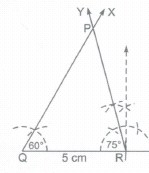
Steps of construction:
I. Draw a line segment QR = 5 cm.
II. At Q, construct \(\angle\)RQX = 60°.
III. At R, construct \(\angle\)QRY = 75°
IV. Let the rays \(\overrightarrow{QX}\) and \(\overrightarrow{RY}\) intersect at P.
Thus \(\triangle\)PQR is the required triangle.
3.
Steps of Construction:
Step I: Firstly, we draw a rough sketch of triangle with given measures marked on it.
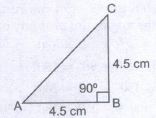
Step I: Draw a line segment AB of length 4.5 cm,
Step II: Draw an angle of 90° on point Band produce it to Y.
Step III: With B as centre, draw an arc of 4.5 cm which intersects ray BY to C
Step IV: Join CA.
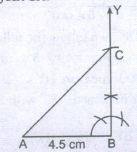
Thus, ΔABC is the required right angled isosceles triangle.
4.
In order to draw the ΔABC and the perpendicular bisector of BC, we follow the following steps:
(a) Draw a line segment BC = 5 cm,
(b) With centre B and radius AB = 4.5 cm, draw an arc of the circle
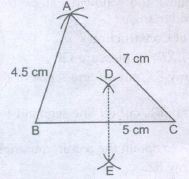
(c) With centre C and radius AC = 7 cm, draw an arc intersecting the previously drawn arc at A.
(d) Join AB and AC to obtain the desired triangle.
(e) With centre B and radius more than \(\frac { 1 }{ 2 } \) (BC), draw two arcs on both sides of BC.
(f) With centre C and the same radius as in step (v) draw two arcs intersecting the arcs drawn in step (v) at D and E.
(g) Join DE to obtain the required perpendicular bisector of BC.
5.
To construct the MBC, we follow the following
steps:
(a) Draw a line segment BC = 7 cm,
(b) With centre Band radius AB = 6 cm, draw an arc of the circle.
(c) With centre C and radius AC = 5 cm, draw another arc intersecting the arc drawn in step (iii) at A.
(d) Join AB and AC to obtain the desired triangle.
6.
Here, we are given the side BC, \(\angle B\) and \(\angle A.\) But to draw the triangle, we required \(\angle C.\)
We know that
\(\angle A+\angle B+\angle C\) = 180°
\(\Rightarrow\) 100° + 60° \(\angle C\) = 180°
\(\Rightarrow\) 160° + \(\angle C\) = 180°
\(\Rightarrow\) \(\angle C\) = 180° - 160° = 20°
Thus, we have Bc, = 5.2 cm, \(\angle B\) = 60° and \(\angle C\) = 20°. Now, to draw the Δ ABC, we follow the following steps:
(a) Draw a line segment BC = 5.2 cm.
(b) Draw \(\angle CBX,\) such that \(\angle CBX\) = 60°
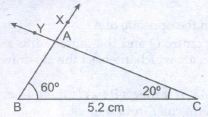
(c) Draw \(\angle BCY,\) with Y on the same side of BC as X such that \(\angle BCY\) = 20°
Let BX and CY intersect at A.
Then ΔABC is the required triangle.
7.
Let MBC be a right triangle, right angled at C, such that hypotenuse AB = 5.4 cm. Further, let Then by the angle sum property of ΔABC, we have
\(\angle A+\angle B+\angle C\) = 180°
\(\Rightarrow\) 60° \(\angle B\) + 90° = 180°
\(\Rightarrow\) 150° + \(\angle B\) = 180°
\(\Rightarrow\) \(\angle B\) =180° - 150° = 30°
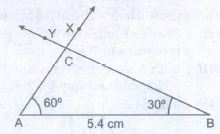
To draw ΔABC, we follow the following steps:
(a) Draw a line segment AB = 5.4 cm.
(b) Draw\(\angle BAX\) measure 60°.
Then, ΔABC is the required triangle.
8.
To construct the MBC, we follow the following steps:
(a) Draw a line segment BC of length 4.5 cm
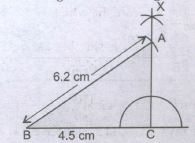
(b) Draw
(d) Join BA to obtain the desired triangle ABC.
9.
Steps of Construction:
Part I: Construction of ΔABC :
(a) Draw BC = 5.4 cm.
(b) Construct
(d) Join A and C.
Now ΔABC is the required triangle.
Part II: Construction of AD丄BC:
(a) Produce CB through B to Y.
(b) With centre A and a sufficient radius, draw an arc intersecting BY and BC at U and M respectively.
(c) With U as centre and a radius more than half of UM, draw an arc opposite to side A.
(d) With the same radius and centre M, draw another arc, cutting the previous arc at T.
(e) Joint AT such that it meets YB at D. Then AD丄 Be.
10.
Steps of Construction:
(a) Draw a line segment PQ = 5 cm,
(b) At P, construct
Thus, ΔPQR is the required triangle.
11.
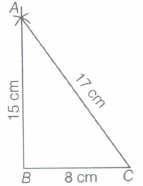
∠ABC = 90°
So, ΔABC is a right angled triangle.
12.
13.
From the figure, we get \(\angle ACB=\angle ABC=60^0\)
\(\therefore\triangle ABC\) is an isosceles triangle \(\Rightarrow\) AC = AB = 6 cm
14.
In ΔABC, we have mㄥA = 70°, mㄥB = 50° and AC=3 cm.
Here, two angles and one side AC are given.
So, to construct the triangle, we need mㄥC
By angle sum property of a triangle,
mㄥA + mㄥB + mㄥC = 180°
70° + 50° + mㄥC = 180° ⇒ 120° + mㄥC = 180°
⇒ mㄥC = 180° -120° = 60°
15.
No, we cannot construct a ΔDEF such that EF = 7.2 cm, mㄥE = 110° and mㄥF = 80°
Justification
We know that, the sum of all the three angles of a triangle is 180°. But in given question, sum of two angles.
mㄥE + mㄥF
= 110° + 80° = 190° > 180°
The sum of these two angles should be less than 180°.
So, the triangle with given measures cannot be constructed.

7th Standard CBSE Syllabus & Materials
7th Standard CBSE
CBSE 7th Social Science Theme B - New Beginnings : Cities and States - New Sample Question Papers Study Material - QB365 Set A
NEW7th Standard CBSE
CBSE 7th Social Science Theme A - Climates of India - New Sample Question Papers Study Material - QB365 Set A
NEW7th Standard CBSE
CBSE 7th Social Science Theme A - Geographical Diversity of India - New Sample Question Papers Study Material - QB365 Set A
NEW7th Standard CBSE
CBSE 7th Science Earth, Moon and the Sun - New Sample Question Papers Study Material - QB365 Set A



NCERT Books

Syllabus

Exam Pattern

Sample Question Papers

Previous year Question Papers

Important Notes

MCQ Practice test

NCERT Exemplers

Case study Questions

Image Based Questions

Passage based Questions

HOT Questions

Value Based Questions

Model Questions Papers
NCERT ( Book Back ) Questions

Assertion and Reason
Important Questions And Answers

CBSE 7th Standard CBSE Subjects
CBSE Standards


