
 100% FREE ACCESS
7th Standard CBSE Syllabus & Materials
7th Standard CBSE
CBSE 7th Social Science Theme E - Understanding Market - New Sample Question Papers Study Material - QB365 Set A
NEW7th Standard CBSE
CBSE 7th Social Science Theme E - From Barter to Money - New Sample Question Papers Study Material - QB365 Set A
NEW7th Standard CBSE
CBSE 7th Social Science Theme D - The Constitution of India- An Introduction - New Sample Question Papers Study Material - QB365 Set A
NEW7th Standard CBSE
CBSE 7th Social Science Theme D - From the Rulers to the Ruled : Types of Governments - New Sample Question Papers Study Material - QB365 Set A
NEW7th Standard CBSE
CBSE 7th Social Science Theme B - The Age of Reorganisation - New Sample Question Papers Study Material - QB365 Set A
NEW7th Standard CBSE
CBSE 7th Social Science Theme B - The Rise of Empires - New Sample Question Papers Study Material - QB365 Set A

Published on: 31/10/2025
Download CBSE Class 7th Standard CBSE Mathematics question papers, sample papers, important questions, and previous year solved papers in PDF format. Get free study materials, NCERT solutions, and exam preparation resources for Class 7th Standard CBSE Mathematics
Questions + Answers key
Take MCQ Mathematics Test
1.
Find BC in the figure,if the area of the triangle ABC is 30 em2 and the height AD = 3 cm.
2.
'a' and 'b' are two different numbers taken from the numbers 1-50. What is the largest value that \(\frac{a-b}{a+b}\) can have? What is the largest value that \(\frac{a+b}{a-b}\) can have?
3.
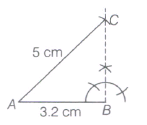
construct a right angled triangle, whose hypotenuse measures 5 cm and one of the other sides measures 3.2 cm.
4.
PQ is a given line. If RS and TV are parallel to PQ and are drawn on either side of PQ. Then, check if RS and TU are parallel to each other also.
5.
Study the following problem. ΔABC, if AC = 7 cm, m ㄥA = 600 and m ㄥB = 50°, can you draw the triangle?
6.
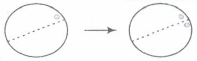
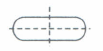
Given the line(s) of symmetry, find the other hole(s).

7.
One side of a rectangular lawn is 12 m and its diagonal is 13 m. Find the area of the field.
8.
Find the value of \(12\frac { 6 }{ 9 }\div \frac { 1 }{ 18 } \times \frac { 1 }{ 2 } \)
9.
If the area of circle is 38.5 cm2, find its circumference.
10.
Draw all lines of symmetry for each of the following figure.

11.
Can you slightly modify the construction of a line parallel to a given line through a point not on the line to use the idea of equal corresponding angles instead of equal alternate angles?
12.
Give two examples, where the area increases as the perimeter increases.
13.
\(\frac{-5}{6}\div3\)
14.
What is the type of each angle of an equilateral triangle?
15.
How many lines of symmetry are there in a square?
16.
Find X if sum of \(\frac{-1}{2}\) and x is 0.
17.
The area of a rhombus is 96 cm2. If one of its diagonals is 12 em, then find the perimeter of the rhombus.
18.
A rectangular park is 40 m long and 25 m wide. A path 2.5 m wide is constructed outside the park. Find the area of the path.
19.
Arrange the rational numbers \(\frac { -3 }{ 5 } ,\frac { 7 }{ -10 } ,\frac { -5 }{ 6 } \\ \) ascending order.
1.
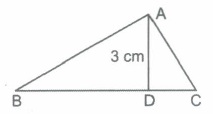
Here, Height (AD) = 3 cm and Area of LlABC = 30 cm2
But Area of a triangle =\(\frac{1}{2}\) \(\times\)b\(\times\)h
\(\therefore\) \(\frac{1}{2}\) \(\times\) b \(\times\)h=30 or \(\frac{1}{2}\)\(\times\)BC\(\times\)3=30
or BC =\(\frac{30\times2}{3}\)=20 cm
Therefore, BC = 20 cm.
2.
Since, a and b are two different numbers.
Let a = 15 and b = 10.
\(\therefore\) \(\frac{a-b}{a+b}\)=\(\frac{15-10}{15+10}\)=\(\frac{5}{25}=\frac{1}{5}\)
and \(\frac{a+b}{a-b}\)=\(\frac{15+10}{15-10}=\frac{25}{5}\)=5
So, (a + b) always greater than (a - b) when denominator is less number is greater,
then \(\left(\frac{a+b}{a-b}\right)>\left(\frac{a-b}{a+b}\right)\)
3.
4.
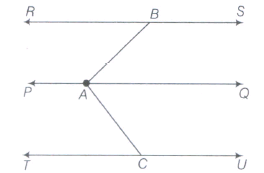
Yes, RS II PQ II TU. Since, two lines parallel to a given line are also parallel to each other.
5.
Yes,we can draw ΔABC.
Here, the side AC, ㄥA and ㄥB of ΔABC are given. But to draw the triangle, we required ㄥC.
In ΔABC, by angle sum property, we have
ㄥA + ㄥB + ㄥC = 180° ⇒ 60° + 50° + ㄥC = 180°
⇒ 110° + ㄥC = 180° ⇒ ㄥC = 180° -110° = 70°
Now, we have side AC, m ⇒ A and mㄥC.
So, we can draw MBC, by ASA criterion.
6.
With respect to the given line(s) of symmetry, the other hole(s) are marked in the figures given below:
7.
60 m2
8.
114
9.
Area of circle = \(\pi\)r2
\(\Rightarrow\) \(\pi\)r2 = 38.5 cm2
\(\Rightarrow\)\(\frac { 22 }{ 7 } \) r2 = 38.5
\(\Rightarrow\) r2 = \(\frac { 38.5\times 7 }{ 22 } \)
\(\Rightarrow\) r2 = 12.25
\(\Rightarrow\) r = 3.5cm
Circumference = 2\(\pi \)r
= 2 x \(\frac { 22 }{ 7 } \)x 3.5
= 22 cm
10.
All lines of symmetry for the given figure will be
11.
Yes,we can slightly modify the construction of a line parallel to a given line through a point not on the line to use the idea of equal corresponding angles instead of equal alternate angles. For modifying this construction, we change only Step IV, VI and VII and new steps are given below:
Step IV With A as centre and radius same as in Step III draw an arc EF to cut BA (extended) at P.
Step V Place the pointed tip of the compasses at C and adjust the. opening so that the pencil tip is at D.
Step VI With the same opening as in Step V and with Pas centre, draw an arc which cut the arc EF at Q.
Step VII Join AQ to draw a line m, which is parallel to the given line I.
Here, \(\angle ABC,\angle PAQ\) are corresponding angles,
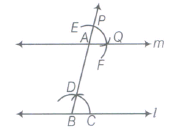
Therefore, I II m.
12.
There are two examples as given below:
Example 1. Let the length of a rectangle = 5 cm and breadth of a rectangle = 3 cm
\(\therefore\) Area of a rectangle = Length X Breadth
= 5 X 3=15 cm2
and perimeter of a rectangle = 2 (Length + Breadth)
= 2 ( 5 + 3) = 2 X 8 = 16 cm
Again, let the length of a rectangle = 6 cm and breadth of a rectangle = 5 cm
\(\therefore\) Area of a rectangle = Length X Breadth = 6 X 5 = 30 cm2
and perimeter of a rectangle = 2 (Length + Breadth)
= 2 (6 + 5) = 2 X 11 = 22 cm
Thus, for both rectangles, area increases as the perimeter Increases.
Example 2. Let the side of a square = 4 ern
\(\therefore\) Perimeter of square = 4 X Side = 4 x 4 = 16 cm
and area of square = (Side X Side)
= 4 X 4 = 16 sq ern
Again, let the side of a square = 5 cm
\(\therefore\) Perimeter of square = 4 X Side = 4 x 5 = 20 cm
and area of square = Side X Side
= 5 x 5 = 25 sq cm
Thus, for both squares, area increases as the perimeter Increases.
13.
()
\(\frac{-5}{18}\)
14.
()
acute angle
15.
()
Four
16.
()
x-\(\frac{1}{2}\)=0
x=\(\frac{1}{2}\)
17.
ABCD is the rhombus such that its diagonals AC and BD intersect at O. Here BD = 12 cm.
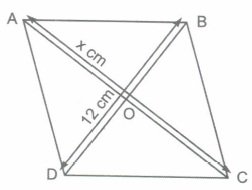
Suppose AC = x cm.
Since, the area of a rhombus =\(\frac{1}{2}\)\(\times\)[Product of 2 its diagonals]
\(\therefore\)Area of the rhombus ABCD =\(\frac{1}{2}\)\(\times\) 12 \(\times\) x cm2
2 But the area of the rhombus ABCD = 96 cm2
\(\Rightarrow\)\(\frac{1}{2}\)\(\times\)12 \(\times\) x = 96
\(\Rightarrow\)x=\(\frac{96\times2}{12}\)cm \(\Rightarrow\)x=8\(\times\)2cm
\(\Rightarrow\) x=16 cm
Since, the diagonals of a rhombus, bisect each other at right angles.
\(\therefore\)\(\angle \)COD = 90°, OC =\(\frac{1}{2}\)\(\times\) 16 cm=8 cm
and Od=\(\frac{1}{2}\)\(\times\) 12 cm =6 cm
Now, in right \(\Delta\)COD, we have
\(\Rightarrow\)OD2 + OC2 = CD2 \(\Rightarrow\) 62 + 82 = CD2
\(\Rightarrow\)36 + 64 = CD2 \(\Rightarrow\)100 = CD2
\(\Rightarrow\) 102 = CD2 \(\Rightarrow\) CD = 10 cm.
Since, all the sides of rhombus are equal and perimeter of a rhombus = 4 x Side.
\(\therefore\) Perimeter ofthe rhombus = 4 x 10 em = 40 cm
18.
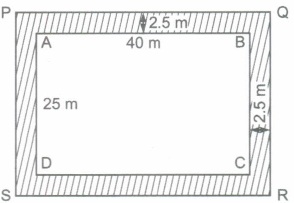
Let ABCD be the rectangular park of sides 40 m and 25 m, and the shaded region represents the path 2.5 m wide.
Now, PQ = (40 + 2.5 + 2.5) m = 45 m
PS = (25 + 2.5 + 2.5) m = 30 m
\(\therefore\)Area of rectangle ABCD = I x b = 40 m x 25 m
= 1000 m2
Area of rectangle PQRS = 45 m x 30 m = 1350 m2
So, Area of the path = [Area of rectangle PQRS] - [Area of rectangle ABCD]
= 1350 m2 - 1000 m2 = 350 m2
19.
Sequence is \(\frac { -3 }{ 5 } ,\frac { 7 }{ -10 } ,\frac { -5 }{ 6 } \\ \)
L.C.M.of 5, 10 and 6=30
\(\Rightarrow \frac { -3 }{ 5 } ,\frac { 7 }{ -10 } ,\frac { -5 }{ 6 } \)
\(\Rightarrow -\frac { 3\times 6 }{ 5\times 6 } ,\frac { 7\times 3 }{ -10\times 3 } ,-\frac { 5\times 5 }{ 6\times 5 } \)
\(\Rightarrow -\frac { 18 }{ 30 } ,\frac { 21 }{ 30 } ,\frac { 25 }{ 30 } \)
Since \(-\frac { 25 }{ 30 } <\frac { 7 }{ -10 } <\frac { -3 }{ 5 } \)
Hence sequence in ascending order is
\(\frac { -5 }{ 6 } <\frac { 7 }{ -10 } <\frac { -3 }{ 5 } \).

7th Standard CBSE Syllabus & Materials
7th Standard CBSE
CBSE 7th Social Science Theme B - New Beginnings : Cities and States - New Sample Question Papers Study Material - QB365 Set A
NEW7th Standard CBSE
CBSE 7th Social Science Theme A - Climates of India - New Sample Question Papers Study Material - QB365 Set A
NEW7th Standard CBSE
CBSE 7th Social Science Theme A - Geographical Diversity of India - New Sample Question Papers Study Material - QB365 Set A
NEW7th Standard CBSE
CBSE 7th Science Earth, Moon and the Sun - New Sample Question Papers Study Material - QB365 Set A



NCERT Books

Syllabus

Exam Pattern

Sample Question Papers

Previous year Question Papers

Important Notes

MCQ Practice test

NCERT Exemplers

Case study Questions

Image Based Questions

Passage based Questions

HOT Questions

Value Based Questions

Model Questions Papers
NCERT ( Book Back ) Questions

Assertion and Reason
Important Questions And Answers

CBSE 7th Standard CBSE Subjects
CBSE Standards


