
 100% FREE ACCESS
7th Standard CBSE Syllabus & Materials
7th Standard CBSE
CBSE 7th Social Science Theme E - Understanding Market - New Sample Question Papers Study Material - QB365 Set A
NEW7th Standard CBSE
CBSE 7th Social Science Theme E - From Barter to Money - New Sample Question Papers Study Material - QB365 Set A
NEW7th Standard CBSE
CBSE 7th Social Science Theme D - The Constitution of India- An Introduction - New Sample Question Papers Study Material - QB365 Set A
NEW7th Standard CBSE
CBSE 7th Social Science Theme D - From the Rulers to the Ruled : Types of Governments - New Sample Question Papers Study Material - QB365 Set A
NEW7th Standard CBSE
CBSE 7th Social Science Theme B - The Age of Reorganisation - New Sample Question Papers Study Material - QB365 Set A
NEW7th Standard CBSE
CBSE 7th Social Science Theme B - The Rise of Empires - New Sample Question Papers Study Material - QB365 Set A

Published on: 31/10/2025
Download CBSE Class 7th Standard CBSE Mathematics question papers, sample papers, important questions, and previous year solved papers in PDF format. Get free study materials, NCERT solutions, and exam preparation resources for Class 7th Standard CBSE Mathematics
Questions + Answers key
Take MCQ Mathematics Test
1.
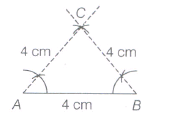
In the given figure, AB = AC = BC, then the value of each angle is equal to
40°
70°
90°
60°
2.
In which of the following cases, a triangle can be drawn?
AB= 4 cm, BC= 8 cm and CA= 2 cm
BC= 5.2 cm, \(\angle B=90^0\) and \(\angle C=110^0\)
XY = 5 cm,\(\angle X=45^0\)and \(\angle Y=60^0\)
An isosceles triangle with the length of each equal side 6.2 cm.
3.
Which of the following sets of triangles could be the lengths of the sides of a right angled triangle?
3 cm, 4 cm, 6 cm
9 cm, 16 cm, 26 cm
1.5 cm, 3.6 cm, 3.9 cm
7 cm, 24 cm, 26 cm
4.
A triangle can be constructed by taking two of its angles as
110°, 40°
70°,115°
135°, 45°
90°,90°
5.
A triangle can be constructed by taking its sides as.
1.8 cm, 2.6 cm, 4.4 cm
2 cm, 3 cm, 4 cm
2.4 cm, 2.4 cm, 6.4 cm
3.2 cm, 2.3 cm, 5.5 cm
6.
Draw a \(\triangle ABC\) with sides 15 cm, 8 cm and 17 cm and find the measure of the angle opposite to the longest side, what type of triangle is it?
7.
A line segment XY is taken as 6cm. At Y, draw ZY ⊥ XY and cut-off ZY=4 cm. Complete the rectangle XYZW by drawing WZ||XY and join WX. Then, measure the lengths ZW and XW. What do you observe?
8.
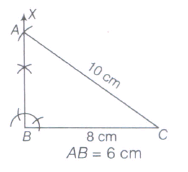
Constuct a right angled triangle at B, such that BC = 8 cm and AC = 10 cm. Measure AB.
9.
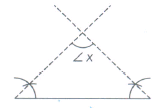
In the following constructed figure, find the value of \(\angle X.\)
10.
Can you slightly modify the construction of a line parallel to a given line through a point not on the line to use the idea of equal corresponding angles instead of equal alternate angles?
11.
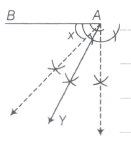
Find the value of x.
12.
Construct \(\triangle ABC\) ABC such that AB = 2.5 cm, BC = 6 cm and AC = 6.5 cm. Measure \(\angle B\).
13.
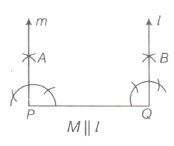
Draw the lines perpendicular to the line segment PQ at P and Q What is the relation between the two lines drawn?
14.
Construct a \(\triangle MNO,\) whose sides are MN = 5 cm, NO = 5.5 cm and OM = 6 cm.
15.
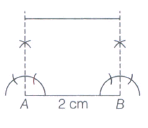
Draw two parallel lines at a distance of 2 cm apart.
16.
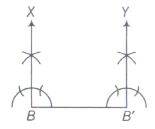
In the following construction figure, is BX II B' Y?
17.
If a perpendicular bisector is drawn on a ray. Then, find the angle made by perpendicular bisector.
18.
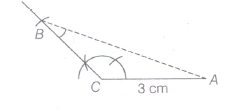
In the following constructed figure, the sum of \(\angle A\) and \(\angle B\) should be equal to_____.
19.
The angle made by perpendicular bisector of line is equal to__________.
20.
We can construct a right angled triangle, if the value of__________of the angle is given.
21.
A triangle can be constructed only if the sum of its any two sides is_________than the third side.
22.
The bisector of a line segment, divide the line segment in two___________parts.
23.
A right angled triangle can be constructed, if the given angles are 90°, 60° and 70°.
24.
In a right angled triangle, the square of hypotenuse is greater than the sum of square of base and perpendicular length.
25.
The angle made by angle bisector is always half of the angle.
26.
The distance between the two parallel lines is the same everywhere.
27.
We can draw exactly one triangle whose angles are 70°, 30° and 80°.
1.
(d)
60°
2.
(c)
XY = 5 cm,\(\angle X=45^0\)and \(\angle Y=60^0\)
3.
(c)
1.5 cm, 3.6 cm, 3.9 cm
4.
(a)
110°, 40°
5.
(b)
2 cm, 3 cm, 4 cm
6.
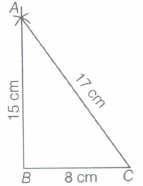
∠ABC = 90°
So, ΔABC is a right angled triangle.
7.
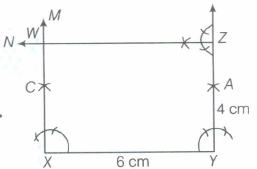
WZ =XY = 6cm
ZY = XW = 4cm
We observed that opposite sides of rectangle are equal and each angles of rectangle is 90°.
8.
9.
In the given figure, angle made by an arc is equal to 60°.
∴ The sum of all three angles in a triangle is equal to 180°.
So, 60° + 60° + x = 180° \(\Rightarrow\) 120° + x = 180°
\(\Rightarrow\) x = 180° - 120° \(\Rightarrow\) x = 60°
10.
Yes,we can slightly modify the construction of a line parallel to a given line through a point not on the line to use the idea of equal corresponding angles instead of equal alternate angles. For modifying this construction, we change only Step IV, VI and VII and new steps are given below:
Step IV With A as centre and radius same as in Step III draw an arc EF to cut BA (extended) at P.
Step V Place the pointed tip of the compasses at C and adjust the. opening so that the pencil tip is at D.
Step VI With the same opening as in Step V and with Pas centre, draw an arc which cut the arc EF at Q.
Step VII Join AQ to draw a line m, which is parallel to the given line I.
Here, \(\angle ABC,\angle PAQ\) are corresponding angles,
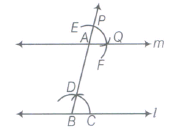
Therefore, I II m.
11.
x=45°
12.
Given, a \(\triangle ABC\) ABCin which AB = 25 cm, BC = 6 cm and AC =65 cm.
To construct this triangle, we use the following steps:
Steps of construction
Step I Firstly, draw a rough sketch of\(\triangle ABC\)with given measures marked on it.
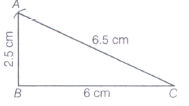
Step II Draw a line segment BC = 6 cm.

Step III With B as centre and radius 2.5 cm, draw an arc.
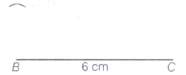
Step IV Now, with C as centre and radius 6.5 cm, draw another arc intersecting the previous arc at A.
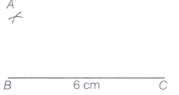
Step V Join AB and AC.
Thus, \(\triangle ABC\) the required triangle.
Here, BC = 6 cm, AB = 2.5 cm and AC = 6.5
(AC)2 = (AB)2 + (BC)2 = (2.5)2 + (6)2 = 6.25 +36
(AC)2 = 42.25
Then, AC =6.5, which satisfy Pythagoras theorem.
So, \(\angle B=90^0\)
13.
14.
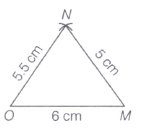
15.
16.
In the given figure, a perpendicular is drawn at both Band B'.
\(\angle XBB'=\angle YB'B=90^0\)
∴ The angle between made by rays with BB' is equal to 90°. Hence, both rays BX II B'Y.
17.
Angle made by perpendicular bisector on a ray is equal to 90°.
18.
()
600
19.
()
900
20.
()
one
21.
()
greater
22.
()
equal
23.
(b)
24.
(b)
25.
(a)
26.
(a)
27.
(b)

7th Standard CBSE Syllabus & Materials
7th Standard CBSE
CBSE 7th Social Science Theme B - New Beginnings : Cities and States - New Sample Question Papers Study Material - QB365 Set A
NEW7th Standard CBSE
CBSE 7th Social Science Theme A - Climates of India - New Sample Question Papers Study Material - QB365 Set A
NEW7th Standard CBSE
CBSE 7th Social Science Theme A - Geographical Diversity of India - New Sample Question Papers Study Material - QB365 Set A
NEW7th Standard CBSE
CBSE 7th Science Earth, Moon and the Sun - New Sample Question Papers Study Material - QB365 Set A



NCERT Books

Syllabus

Exam Pattern

Sample Question Papers

Previous year Question Papers

Important Notes

MCQ Practice test

NCERT Exemplers

Case study Questions

Image Based Questions

Passage based Questions

HOT Questions

Value Based Questions

Model Questions Papers
NCERT ( Book Back ) Questions

Assertion and Reason
Important Questions And Answers

CBSE 7th Standard CBSE Subjects
CBSE Standards


