
 100% FREE ACCESS
7th Standard CBSE Syllabus & Materials
7th Standard CBSE
CBSE 7th Social Science Theme E - Understanding Market - New Sample Question Papers Study Material - QB365 Set A
NEW7th Standard CBSE
CBSE 7th Social Science Theme E - From Barter to Money - New Sample Question Papers Study Material - QB365 Set A
NEW7th Standard CBSE
CBSE 7th Social Science Theme D - The Constitution of India- An Introduction - New Sample Question Papers Study Material - QB365 Set A
NEW7th Standard CBSE
CBSE 7th Social Science Theme D - From the Rulers to the Ruled : Types of Governments - New Sample Question Papers Study Material - QB365 Set A
NEW7th Standard CBSE
CBSE 7th Social Science Theme B - The Age of Reorganisation - New Sample Question Papers Study Material - QB365 Set A
NEW7th Standard CBSE
CBSE 7th Social Science Theme B - The Rise of Empires - New Sample Question Papers Study Material - QB365 Set A

Published on: 31/10/2025
Download CBSE Class 7th Standard CBSE Mathematics question papers, sample papers, important questions, and previous year solved papers in PDF format. Get free study materials, NCERT solutions, and exam preparation resources for Class 7th Standard CBSE Mathematics
Questions + Answers key
Take MCQ Mathematics Test
1.
List five rational numbers between:
-2 and -1
2.
Find the sum \(\frac { -2 }{ 3 } +0\)
3.
Find the sum \(\frac { 5 }{ 3 } +\frac { 3 }{ 5 } \)
4.
Write the following rational number in ascending order.
\(\\ \frac { -3 }{ 7 } ,\frac { -3 }{ 2 } ,\frac { -3 }{ 4 } \)
5.
Which is greater in each of the following?
\(\frac { -1 }{ 4 } ,\frac { 1 }{ 4 } \)
6.
Fill in the box with correct symbol out >,< and =
0 \(\boxed { } \)\(\frac { -7 }{ 6 } \)
7.
Which of the following pairs represent the same rational numbers?
\(\frac { 8 }{ -5 } \) and \(\frac { -24 }{ 15 } \)
8.
Write four more rational numbers in each of the following patterns:
\(\frac { -3 }{ 5 } ,\frac { -6 }{ 10 } ,\frac { -9 }{ 15 } ,\frac { -12 }{ 20 } ,....\)
9.
Fill in the boxes.
\(\frac { 5 }{ 4 } =\frac { \boxed { } }{ 16 } =\frac { 25 }{ \boxed { } } =\frac { -15 }{ \boxed { } } \)
10.
Write 5 rational numbers between \(\frac { 1 }{ 3 } \) and \(\frac { 1 }{ 4 } \).
11.
Add the following rational numbers.
\(\frac { 2 }{ 4 } +\frac { 2 }{ 20 } \)
12.
Add the following rational numbers.
\(\frac { 1 }{ 3 } +\frac { 2 }{ 6 } \)
13.
Which of the following rational numbers \(\frac { -5 }{ 12 } \) and \(\frac { 7 }{ -18 } \) is greater?
14.
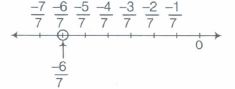
Draw the number line and represent the following rational numbers on it .
\(\frac { -6 }{ 7 } \)
15.
Given rational numbers are \(\frac { -4 }{ 5 } \) and \(\frac { -2 }{ 3 } \)
16.
Write 3 rational numbers between \(\frac { 1 }{ 2 } \) and \(\frac { 1 }{ 3 } \)
17.
Divide the reciprocal of \(\frac { 1 }{ 3 } \) by the additive inverse of -5 to get a rational number.
18.
Simplify \(\left( 1-\frac { 1 }{ 2 } \right) \div \left( 1+\frac { 1 }{ 2 } \right) \)
19.
Arun spend \( \frac { 3 }{ 5 } \) of his pocket money during launch break and \(\frac { 3 }{ 8 } \) after school.He also spend \(\frac { 1 }{ 6 } \) of the pocket money for his younger brother.What part of money he spend in all?
20.
A city received \(\frac { 5 }{ 12 } \) cm rainfall on Saturday and \(\frac { 14 }{ 3 } \) cm on Friday. How much rainfall did it receive in two days?
1.
Given, -2 and -1
Let -2 and -1 be rational numbers with denominator 6.
Then, we have -2 and -1 = \(\\ \frac { -12 }{ 6 } \) and \(\frac { -6 }{ 6 } \)
So,\(\frac { -12 }{ 6 } <\frac { -11 }{ 6 } <\frac { -10 }{ 6 } <\frac { -9 }{ 6 } <\frac { -8 }{ 6 } <\frac { -7 }{ 6 } <\frac { -6 }{ 6 } \)
or \(\\ -2<\frac { -11 }{ 6 } <\frac { -5 }{ 3 } <\frac { -3 }{ 2 } <\frac { -4 }{ 3 } <\frac { -7 }{ 6 } <-1\)
Hence, the five rational numbers between -2 and -1
are \(\frac { -11 }{ 6 } ,\frac { -5 }{ 3 } ,\frac { -3 }{ 2 } ,\frac { -4 }{ 3 }\) and \(\frac { -7 }{ 6 } \).
2.
We have, \(\frac { -2 }{ 3 } +0\) = \(\frac { -2 }{ 3 } +0=\frac { -2 }{ 3 } +\frac { 0 }{ 3 } =\frac { -2+0 }{ 3 } =\frac { -2 }{ 3 } \)[ we can take any number as denominator of 0]
3.
\(\frac { 5 }{ 3 } +\frac { 3 }{ 5 } \)
Here, the denominator are not same.
\(\because \) LCM of denominator 3 and 5 = 15
\(\therefore \) \(\frac { 5 }{ 3 } =\frac { 5\times 5 }{ 3\times 5 } =\frac { 25 }{ 15 } \)
Which is an equivalent rational number.
and \(\frac { 3 }{ 5 } =\frac { 3\times 3 }{ 5\times 3 } =\frac { 9 }{ 15 } \)
Which is an equivalent rational number.
Now, \(\frac { 5 }{ 3 } +\frac { 3 }{ 5 } =\frac { 25 }{ 15 } +\frac { 9 }{ 15 } =\frac { 25+9 }{ 15 } =\frac { 34 }{ 15 } \)
4.
Here, the denominators of given rational numbers are not same.
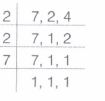
\(\because \) LCM = 2\(\times \)2\(\times \)7=28
\(\therefore \frac { -3 }{ 7 } =\frac { -3\times 4 }{ 7\times 4 } =\frac { -12 }{ 28 } ,\frac { -3 }{ 2 } \)
\(=\frac { -3\times 14 }{ 2\times 14 } =\frac { -42 }{ 28 } \)
and \(\\ \frac { -3 }{ 4 } =\frac { -3\times 7 }{ 4\times 7 } =\frac { -21 }{ 28 } \)
We observe that, 12 < 21 < 42
\(\Rightarrow \frac { 12 }{ 28 } <\frac { 21 }{ 28 } <\frac { 42 }{ 28 } \)
\(\Rightarrow \frac { -12 }{ 28 } >\frac { -21 }{ 28 } >\frac { -42 }{ 28 } \)
\(\Rightarrow \frac { -3 }{ 7 } >\frac { -3 }{ 4 } >\frac { -3 }{ 2 } \)
Hence, the given rational numbers, when arranged in ascending order are \(\frac { -3 }{ 2 } ,\frac { -3 }{ 4 } ,\frac { -3 }{ 7 } \).
5.
Given, \(\frac { -1 }{ 4 } ,\frac { 1 }{ 4 } \)
We know that, every positive rational number is greater than every negative rational number.
Hence, \(\\ \frac { 1 }{ 4 } \) is greater than \(\\ \frac { -1 }{ 4 } \).
6.
Given, 0 \(\boxed { } \)\(\frac { -7 }{ 6 } \)
We know that, a negative rational number is always to the left of zero. So, Zero is always greater than any negative rational number.
Hence , 0 > \(\frac { -7 }{ 6 } \)
7.
\(\frac { 8 }{ -5 } \) and \(\frac { -24 }{ 15 } \) represent the same rational number
8.
Given,\(\frac { -3 }{ 5 } ,\frac { -6 }{ 10 } ,\frac { -9 }{ 15 } ,\frac { -12 }{ 20 } ,....\)
Here,\(\frac { -3 }{ 5 } \) is the rational number in standard form.
Now, \(\frac { -3 }{ 5 } =\frac { -3\times 1 }{ 5\times 1 } ,\frac { -6 }{ 10 } =\frac { -3\times 2 }{ 5\times 2 } ,\)
\(\frac { -9 }{ 15 } =\frac { -3\times 3 }{ 5\times 3 } ,\frac { -12 }{ 20 } =\frac { -3\times 4 }{ 5\times 4 } \)
or \(\frac { -3\times 1 }{ 5\times 1 } =\frac { -3 }{ 5 } ,\frac { -3\times 2 }{ 5\times 2 } =\frac { -6 }{ 10 } \)
\(\frac { -3\times 3 }{ 5\times 3 } =\frac { -9 }{ 15 } ,\frac { -3\times 4 }{ 5\times 4 } =\frac { -12 }{ 20 } \)
Thus, we observe a pattern in these numbers. The next four numbers are
\(\frac { -3\times 5 }{ 5\times 5 } =\frac { -15 }{ 25 } ,\frac { -3\times 6 }{ 5\times 6 } =\frac { -18 }{ 30 } \)
\(\\ \frac { -3\times 7 }{ 5\times 7 } =\frac { -21 }{ 35 } ,\frac { -3\times 8 }{ 5\times 8 } =\frac { -24 }{ 40 } \)
Hence, the required four more rational numbers are
\(\frac { -15 }{ 25 } ,\frac { -18 }{ 30 } ,\frac { -21 }{ 35 } \)and \(\frac { -24 }{ 40 } \).
9.
We have, \(\frac { 5 }{ 4 } =\frac { \boxed { } }{ 16 } =\frac { 25 }{ \boxed { } } =\frac { -15 }{ \boxed { } } \)
Here, the rational numbers equivalent to rational number \(\frac { 5 }{ 4 } \) are as follows: \(\frac { 5 }{ 4 } =\frac { 5\times 4 }{ 4\times 4 } =\frac { 20 }{ 16 } \)
[\(\because \) 4\(\times \)4=16, since given denominators of equivalent rational number, so multiply by 4]
\(\frac { 5 }{ 4 } =\frac { 5\times 5 }{ 4\times 5 } =\frac { 25 }{ 20 } \)
[\(\because \) 5\(\times \)5=25, since given numerators of equivalent rational number, so multiply by 5]
Also, \(\\ \frac { 5 }{ 4 } =\frac { 5\times (-3) }{ 4\times (-3) } =\frac { -15 }{ -12 } \)
[\(\because \) 5\(\times \)(-3)=-15, since given numerators of equivalent rational numbers, so multiply by (-3)]
So, the missing integers in the boxes are filled as
\(\frac { 5 }{ 4 } =\frac { \boxed { 20 } }{ 16 } =\frac { 25 }{ \boxed { 20 } } =\frac { -15 }{ \boxed { -12 } } \)
10.
Given rational numbers are \(\frac { 1 }{ 3 } \) and \(\frac { 1 }{ 4 } \).
LCM of 3 and 4 is 12,
\(\frac { 1\times 4 }{ 3\times 4 } =\frac { 4 }{ 12 } \) and \(\frac { 1\times 3 }{ 4\times 3 } =\frac { 3 }{ 12 } \)
Now, \(\frac { 4\times 10 }{ 12\times 10 } =\frac { 40 }{ 120 }
\) and \(\frac { 3\times 10 }{ 12\times 10 } =\frac { 30 }{ 120 } \)
\(\frac { 30 }{ 120 } <\frac { 31 }{ 120 } <\frac { 32 }{ 120 } <\frac { 33 }{ 120 } <\frac { 34 }{ 120 } <\frac { 35 }{ 120 } <.......<\frac { 40 }{ 120 } \)
Hence, 5 rational numbers between \(\frac { 1 }{ 3 } \) and \(\frac { 1 }{ 4 } \) are
\(\frac { 31 }{ 120 } ,\frac { 32 }{ 120 } ,\frac { 33 }{ 120 } ,\frac { 34 }{ 120 } ,\frac { 35 }{ 120 } .\)
11.
We have,\(\frac { 2 }{ 4 } +\frac { 2 }{ 10 } \)
LCM of 4 and 10 is 20
\(\\ \frac { 2\times 5 }{ 4\times 5 } =\frac { 10 }{ 20 } ,\frac { 2\times 2 }{ 10\times 2 } =\frac { 4 }{ 20 } \)
So, \(\\ \frac { 10 }{ 20 } +\frac { 4 }{ 20 } =\frac { 10+4 }{ 20 } =\frac { 14 }{ 20 } =\frac { 7 }{ 10 } \)
12.
We have,\(\frac { 1 }{ 3 } +\frac { 2 }{ 6 } \)
LCM of 3 and 6 is 6,
\(\frac { 1\times 2 }{ 3\times 2 } =\frac { 2 }{ 6 } \Rightarrow \frac { 2\times 1 }{ 6\times 1 } =\frac { 2 }{ 6 } \)
So,\(\frac { 2 }{ 6 } +\frac { 2 }{ 6 } =\frac { 2+2 }{ 6 } =\frac { 4 }{ 6 } =\frac { 2 }{ 3 } \)
13.
Given rational numbers are \(\frac { -5 }{ 12 } \) and \(\frac { 7 }{ -18 } \)
For the same /common denominator,
LCM of 12 and 18 is 36,
\(\frac { (-5)\times 3 }{ 12\times 3 }= \frac { -15 }{ 36 } \) and \(\frac { 7\times 2 }{ (-18\times 2) } =\frac { 14 }{ -36 }= \frac { -14 }{ 36 } \)
-14 is greater than -15.
So,\(\frac { -14 }{ 36 } >\frac { -15 }{ 36 } \) or \(\frac { -7 }{ 18 } >\frac { -15 }{ 12 } \)
14.
Representation of rational number\(\frac { -6 }{ 7 } \) on number line .
15.
For common denominators, LCM of 5 and 3 is 15.
\(\frac { -4\times 3 }{ 5\times 3 } =\frac { -12 }{ 15 } \) and \(\frac { -2\times 5 }{ 3\times 5 } \frac { -10 }{ 15 } \)
\(\frac { -12\times 2 }{ 15\times 2 } =\frac { -24 }{ 30 } \) and \(\frac { -10\times 2 }{ 15\times 2 } =\frac { -20 }{ 30 } \)
so,\(\\ \frac { -24 }{ 30 } <\frac { -23 }{ 30 } <\frac { -22 }{ 30 } <\frac { -21 }{ 30 } <\frac { -20 }{ 30 } \)
Hence rational numbers between \(\frac { -4 }{ 5 } \) and \(\frac { -2 }{ 3 } \)
are \(\frac { -23 }{ 30 } <\frac { -22 }{ 30 } <\frac { -21 }{ 30 }\)
16.
Given rational numbers are \(\frac { 1 }{ 2 } \) and \(\frac { 1 }{ 3 } \).
For common denominator, LCM of 2and 3 is 6,
\(\frac { 1\times 3 }{ 2\times 3 } \frac { 3 }{ 6 } \) and \(\frac { 1\times 2 }{ 3\times 2 } =\frac { 2 }{ 6 } \)
Now,\(\frac { 3\times 10 }{ 6\times 10 } =\frac { 30 }{ 60 } \) and \(\frac { 2\times 10 }{ 6\times 10 } =\frac { 20 }{ 60 } \)
so, \(\frac { 20 }{ 60 } <\frac { 21 }{ 60 } <\frac { 22 }{ 60 } <\frac { 23 }{ 60 } <.......<\frac { 30 }{ 60 } \)
Hence, 3 rational numbers between \(\frac { 1 }{ 2 } \) and \(\frac { 1 }{ 3 } \) are
\(\frac { 21 }{ 60 } <\frac { 22 }{ 60 } <\frac { 23 }{ 60 }\)
17.
\(\frac { 3 }{ 5 } \)
18.
\(\frac { 1 }{ 3 } \)
19.
\(\frac { 137 }{ 120 } \)
20.
5\(\frac { 1 }{ 12 } \)

7th Standard CBSE Syllabus & Materials
7th Standard CBSE
CBSE 7th Social Science Theme B - New Beginnings : Cities and States - New Sample Question Papers Study Material - QB365 Set A
NEW7th Standard CBSE
CBSE 7th Social Science Theme A - Climates of India - New Sample Question Papers Study Material - QB365 Set A
NEW7th Standard CBSE
CBSE 7th Social Science Theme A - Geographical Diversity of India - New Sample Question Papers Study Material - QB365 Set A
NEW7th Standard CBSE
CBSE 7th Science Earth, Moon and the Sun - New Sample Question Papers Study Material - QB365 Set A



NCERT Books

Syllabus

Exam Pattern

Sample Question Papers

Previous year Question Papers

Important Notes

MCQ Practice test

NCERT Exemplers

Case study Questions

Image Based Questions

Passage based Questions

HOT Questions

Value Based Questions

Model Questions Papers
NCERT ( Book Back ) Questions

Assertion and Reason
Important Questions And Answers

CBSE 7th Standard CBSE Subjects
CBSE Standards


