
 100% FREE ACCESS
7th Standard CBSE Syllabus & Materials
7th Standard CBSE
CBSE 7th Social Science Theme E - Understanding Market - New Sample Question Papers Study Material - QB365 Set A
NEW7th Standard CBSE
CBSE 7th Social Science Theme E - From Barter to Money - New Sample Question Papers Study Material - QB365 Set A
NEW7th Standard CBSE
CBSE 7th Social Science Theme D - The Constitution of India- An Introduction - New Sample Question Papers Study Material - QB365 Set A
NEW7th Standard CBSE
CBSE 7th Social Science Theme D - From the Rulers to the Ruled : Types of Governments - New Sample Question Papers Study Material - QB365 Set A
NEW7th Standard CBSE
CBSE 7th Social Science Theme B - The Age of Reorganisation - New Sample Question Papers Study Material - QB365 Set A
NEW7th Standard CBSE
CBSE 7th Social Science Theme B - The Rise of Empires - New Sample Question Papers Study Material - QB365 Set A

Published on: 31/10/2025
Download CBSE Class 7th Standard CBSE Mathematics question papers, sample papers, important questions, and previous year solved papers in PDF format. Get free study materials, NCERT solutions, and exam preparation resources for Class 7th Standard CBSE Mathematics
Questions + Answers key
Take MCQ Mathematics Test
1.
Construct a triangle \(\triangle\)PQR when QR = 5 cm, \(\angle\)Q = 60° and \(\angle\)R = 75°.
2.
If the diameter of a circular park is 84 m. A 3.5 m broad road runs round it Find the cost of constructing the road at Rs. 200 per m2 .
3.
Take away\(({8\over 5}x^2-{2\over3}x^3+{3\over2}x-1)\) from \(({x^3\over 5}-{3\over2}x^2+{2\over3}x+{1\over4})\) .
4.
Draw triangle ABC with ∠C as right angle, AB = 6.2 cm and BC = 4.5 cm.
5.
Find:
(a) \(\frac{7}{48}-\frac{17}{36}\) (b) \(\frac{5}{63}-(\frac{-6}{21})\)
(c) \(\frac{-6}{13}-(\frac{-7}{15})\) (d) \(\frac{-3}{8}-\frac{7}{11}\)
6.
Simplify: \({ \left( \frac { 3 }{ 4 } \right) }^{ 4 }\div { \left( \frac { 6 }{ 8 } \right) }^{ 2 }\times \left( \frac { 1 }{ 2 } \right) \)
7.
A verandah of width 2.25 m is constructed all along outside a room, which is 5.5 m long and 4 m wide. Find
(i) the area of the verandah.
(ii) the cost of cementing the floor of the verandah at the rate of Rs 200 m2.
8.
Saima wants to put a lace on the edge of a circular table cover of diameter 1.5 m. Find the length of the lace required and also find its cost, if one meter of the lace costs Rs 15. (take \(\pi\) = 3.14)
9.
A door of length 2 m and breadth 1 m is fitted in a wall. The length of the wall is 4.5 m and the breadth is 3.6 m in the given figure. Find the cost of whitewashing the wall, if the rate of whitewashing the wall is Rs 20 per m2.
.png)
10.
Add reciprocal of \(\frac { 2 }{ -9 } \) to the additive inverse \(\frac { -3 }{ 8 } \)
11.
The perimeter of the following figure is
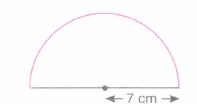
27 cm
28 cm
36 cm
40 cm
12.
The area of a parallelogram is 20 cm2 and height is 2 cm. Find the corresponding base
4 cm
6 cm
8 cm
10 cm
13.
1 hectare=
10 m2
100 m2
1000 m2
10000 m2
14.
Subtracting - 3x2 - 1 from 0, we get:
-3x2 - 1
-3x2 + 1
3x2 - 1
3x2 + 1
15.
The additive inverse of \(-\frac{4}{5}\) is:
\(\frac{4}{5}\)
\(\frac{5}{4}\)
\(\frac{-5}{4}\)
\(\frac{4}{-5}\)
16.
The circumference of a circle is 44 cm. What is its radius?
42 cm
21 cm
7 cm
14 cm
17.
Which of the following is the measures of a right angled triangle?
7 cm, 3 cm, 9 cm
4·5 cm, 6 cm,5 cm
8 cm, 15 cm, 17 cm
4 cm, 3·5 cm, 4 cm.
18.
Find the area of a square park, whose perimeter is 96 cm.
576 cm2
626 cm2
726 cm2
748 cm2
19.
The degree of the polynomial x3y - 2xy4 + 5 is
5
4
3
2
20.
Out of the following, which is a 3-D figure?
Square
Sphere
Triangle
Circle
21.
If \(\frac { p }{ q } =\left( \frac { 5 }{ 6 } \right) ^{ 2 }\div \left( \frac { 5 }{ 6 } \right) ^{ 0 }\), then the value of \(\left( \frac { p }{ q } \right) ^{ 2 }\) is
\(\frac { 125 }{ 1290 } \)
\(\frac { 625 }{ 1296 } \)
\(\frac { 164 }{ 125 } \)
\(\frac { 169 }{ 144 } \).
22.
\(\left[ \{ \left( \frac { 2 }{ -9 } \right) ^{ 2 }\} ^{ 0 } \right] ^{ 2 }\) is equal to
2
\(\frac { 4 }{ 81 } \)
\(\frac { 81 }{ 4 } \)
1
23.
The number of lines of symmetry in figure is
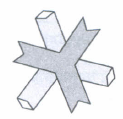
1
3
6
infinitely many
24.
The value of \(\frac { { 10 }^{ 22 }+{ 10 }^{ 20 } }{ 10^{ 20 } } \) is
10
1042
101
1022
25.
In the standard form of a rational number, the denominator is always a
0
Negative integer
Postive integer
1
26.
The distance between Saturn and Uranus is 1,439,000,000,000 m.Its standard form is _________________m
27.
A half-turn means a rotation of ___________degrees
28.
A triangle can be constructed only if the sum of its any two sides is_________than the third side.
29.
If ax = 1, then the value of x is _______ where a ≠ 1.
30.
Rotation turns an object about a fixed point. This fixed point is called _____________
31.
\(4\frac { 4 }{ 5 } \div \frac { 24 }{ 5 } +8\frac { 1 }{ 4 } =\)__________
32.
(i) How are prisms and cylinders alike?
(ii) How are pyramids and cones alike?
33.
Find the value of [(52)3 x 54] \(\div \) 57
34.
Simplify the expressions and find the value, if x is equal to 2.
4(2x-1)+3x+11
35.
A room is 12 m long and 8 m broad. Find the cost of carpeting the room at the rate of Rs 7.50 per metre.
36.
Draw a triangle whose sides are of lengths 4 cm, 5 cm and 7 cm.
37.
Simplify the following expression and write the answer in exponential form: \(\frac { { 2 }^{ 8 }\times { 5 }^{ 4 }\times { 4 }^{ 3 } }{ { 2 }^{ -2 }\times { 5 }^{ -6 }\times { 4 }^{ 3 } } \)
38.
Draw the mirror image of English letter E.
39.
Find the reciprocal of \(\frac { 3 }{ -8 } \times \frac { -1 }{ -5 } \) .
40.
Express 128 as a power of 2
41.
The perimeter of a rectangle is 130 cm. If the breadth of the rectangle is 30 cm, find its length. Also, find the area of the rectangle.
42.
Using laws of exponents, solve the following: \(\left[ { \left( \frac { -2 }{ 3 } \right) }^{ 4 }\times \left( \frac { 216 }{ 125 } \right) \right] \div \left[ { \left( \frac { 6 }{ 5 } \right) }^{ 2 }\times \left( \frac { 4 }{ 9 } \right) \right] \)
43.
A man has a property of value a2b + 3b2 + 2a2 - 4ab. He distributed 2b2+2ab - b2a to his son and 4a2 + ab + b2 a to his daughter. What amount is left with him?
44.
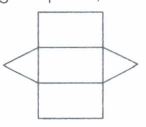
Draw the nets of the followings:
(i) Triangular prism (ii) Tetrahedron (iii) Cuboid
45.
A wall of a room is of dimensions 5 m x 4m. lt has a window of dimensions 1.5 m x 1 m and a door of dimensions 2.25 m x 1 m. Find the area of the wall, which is to be painted.
46.
Draw a line AB of 5 cm and mark a point C outside it. From C, draw a line parallel to AB by using ruler and compasses only.
47.
Two cross roads, each of width 3 m, run at right angles through the centre of a rectangular park of length 70 m and breadth 45 m and parallel to its sides. Find the area of the roads. Also find the cost of constructing the roads at the rate of Rs.110 per m2.
48.
Simplify the following:
(a) (6-1 - 8-1)-1 + (2-1 - 3-1)-1
(b) \({ \left\{ { 6 }^{ -1 }+{ \left( \frac { 3 }{ 2 } \right) }^{ -1 } \right\} }^{ -1 }\)
49.
How many faces are there in a tetrahedron?
50.
Subtract 24ab - 10b - 18a from 14a + 12b + 30ab
51.
Write the following rational numbers in ascending order: \(\frac{3}{4}\), \(\frac{-1}{2}\), \(\frac{-4}{5}\), \(\frac{-1}{-4}\)
52.
Each of the equal sides of an isosceles triangle is 4 Cm. What is its base if its perimeter is 13 cm?
1.
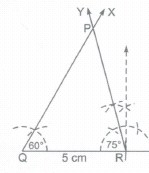
Steps of construction:
I. Draw a line segment QR = 5 cm.
II. At Q, construct \(\angle\)RQX = 60°.
III. At R, construct \(\angle\)QRY = 75°
IV. Let the rays \(\overrightarrow{QX}\) and \(\overrightarrow{RY}\) intersect at P.
Thus \(\triangle\)PQR is the required triangle.
2.
Radius of circular park = \(\frac { 84 }{ 2 } \)=42 m (given)
Width of the road = 3.5m (given)
Radius of outer circle = 42 + 3.5 = 45.5 m
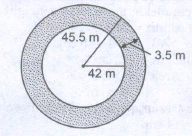
Are of the road = (Area of outer circle) - (Area of inner circle)
= \(\pi\) x (45.5)2 - \(\pi\) x (42)2
= \(\pi\) x {(45.5)2 - (42)2}
= \(\pi\) x {(45.4 + 42)(45.4 - 42)}
= \(\pi \) x 87.5 x 3.5
= \(\frac { 22 }{ 7 } \)x 87.5 x 3.5 = 11 x 87.5
= 962.5 m2
Cost of the road = 962.5 x Rs. 200
= Rs. 192500
3.
We have \(({x^3\over 5}-{3\over2}x^2+{2\over3}x+{1\over4})\)-\(({8\over 5}x^2-{2\over3}x^3+{3\over2}x-1)\)
= \({x^3\over 5}-{3\over2}x^2+{2\over3}x+{1\over4}\)-\(({8\over 5}x^2-{2\over3}x^3+{3\over2}x-1)\)
=\(({1\over5}+{2\over3})x^3+(-{3\over2}-{8\over5})x^2+({2\over3}-{3\over2})x+({1\over4}+1)\)
\(={13x^3\over 15}-{31x^2\over10}-{5x\over 6}+{5\over4}\)
4.
To construct the MBC, we follow the following steps:
(a) Draw a line segment BC of length 4.5 cm
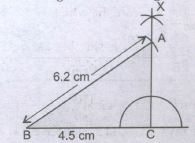
(b) Draw
(d) Join BA to obtain the desired triangle ABC.
5.
(a)\(\frac{7}{48}-\frac{17}{36}\)=\(\frac{7(3)-17(4)}{144}\)
=\(\frac{21-68}{144}\)
=\(\frac{-47}{144}\)
(b) \(\frac{5}{63}-(\frac{-6}{21})\)=\(\frac{5}{63}+\frac{6}{21}\)
=\(\frac{5+6(3)}{63}\)
=\(\frac{5+18}{63}=\frac{23}{63}\)
(c) \(\frac{-6}{13}-(\frac{-7}{15})\)=\(\frac{-6}{13}+\frac{7}{15}\)
=\(\frac{-6(15)+7(13)}{195}\)
=\(\frac{-90+91}{195}=\frac{1}{195}\)
(d) \(\frac{-3}{8}-\frac{7}{11}\)=\(\frac{-3(11)-7(8)}{88}\)
=\(\frac{-33-56}{88}=\frac{-89}{88}\)
=-1\(\frac{1}{88}\)
6.
\(\frac { 9 }{ 32 } \)
7.
Let ABeD represents the rectangular floor of the room and shaded region represents the verandah of width 2.25 m all along the outside of a room.
.png)
Given, length of the room, AB = 5.5 m
and breadth of the room, AD = 4 m
\(\therefore\) Area of the room ABeD = AB x AD = 5 .5 x 4 = 22 m2
Length of the room and verandah, PQ or SR
= 5.5 + 2 x 2.25 = 5.5 + 4.5 = 10 m
Breadth of the room and verandah, PS or QR
= 4 + 2 x 2.25 = 4 + 4.5 = 8.5 m
\(\therefore\) Area of the room and verandah
= PQ x PS = 10 x 8.5 = 85 m2
(i) Area of the verandah = Area of the room and verandah - Area of the room
= 85 - 22 = 63 m2.
(ii) Cost of cementing the floor of the verandah at the rate of Rs 200 per m2 = Rs (200 x 63) = Rs 12600.
8.
Given, diameter of a circular table cover (d) = 1.5 m
\(\therefore\) Length of the lace required
= Circumference of circular table cover
= \(\pi\) x d = 3.14 x 1.5 = 4.71 m
\(\therefore\) Cost of 1 m of lace = Rs 15
\(\therefore\) Cost of 4.71 m of lace = Rs (15 x 4.71) = Rs 70.65
Hence, the length of the lace required is 4.71 m and cost of the lace is Rs 70.65.
9.
Given, length of the door = 2 m and breadth of a door = 1m
Since door is in the shape of a rectangle
\(\therefore\) Area of the door = Length x Breadth = 2 x 1= 2 m
Also, length of the wall = 4.5 m and breadth of the wall = 3.6 m
\(\therefore\) Area of the wall including door = Length x Breadth = 4.5 x 3.6 = 16.2 m2
Now, area of the wall for whitewash = Area of the wall including door - Area of the door = 16.2 - 2 = 14.2 m2
\(\therefore\) Cost of whitewashing the wall at the rate of Rs 20 per m2
= Rs (14.2 x 20) = Rs 284
Hence, the cost of whitewashing the wall is Rs 284.
.png)
10.
\(\frac { -39 }{ 10 } \)
11.
Perimeter = \(2\times 7+\frac { 22 }{ 7 } \times 7\)
= 14 + 22 = 36 cm
12.
Base =\(\frac { 20 }{ 2 } \)=10 cm
13.
(b)
100 m2
14.
(d)
3x2 + 1
15.
16.
(c)
7 cm
17.
(c)
8 cm, 15 cm, 17 cm
18.
(a)
576 cm2
19.
(a)
5
20.
(b)
Sphere
21.
(b)
\(\frac { 625 }{ 1296 } \)
22.
(d)
1
23.
(b)
3
24.
(c)
101
25.
(c)
Postive integer
26.
()
1.439x 10¹²
27.
()
180
28.
()
greater
29.
()
0
30.
()
Center of rotation
31.
\(4\frac { 4 }{ 5 } \div \frac { 24 }{ 5 } +8\frac { 1 }{ 4 } =\frac { (5\times 4)+4 }{ 5 } \div \frac { 24 }{ 5 } +\frac { (8\times 4)+1 }{ 4 } \)
\(\frac { 24 }{ 5 } \div \frac { 24 }{ 5 } +\frac { 33 }{ 4 } \)
Since , the reciprocal of \(\frac { 24 }{ 5 } \) is \(\frac { 5 }{ 24 } \)
\(\\ \therefore \quad \frac { 24 }{ 5 } \times \frac { 5 }{ 24 } +\frac { 33 }{ 4 } =1+\frac { 33 }{ 4 } =\frac { 37 }{ 4 } \)
32.
(i) The prisms and cylinder, both, have their base and top faces as congruent and parallel to each other. Also, a prism becomes a cylinder as the number of sides of its base becomes larger and larger.
(ii) The pyramids and cones are alike in the sense that their lateral faces meet at a point (called vertex). Also, a pyramid becomes a cone as the number of sides of its base becomes larger and larger.
33.
125
34.
The simplified expression is 11x+7 and its required value is 29.
35.
Rs 720.
36.
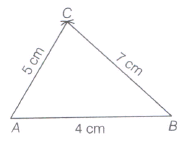
37.
210x510
38.
The mirror image of English letter E will be

39.
\(\frac { 40 }{ -3 } \)
40.
We have, 128 = 2 x 2 x 2 x 2 x 2 x 2 x 2 = 27
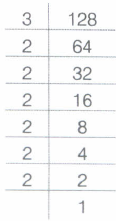
Here, base = 2 and exponent = 7, since 2 repeated 7 times.
41.
Perimeter of the rectangle
= 2\(\times\)(l+b)
⇒ 130 = 2\(\times\)(l + 30)
⇒ l+30 = \(\frac { 130 }{ 2 } \)
⇒ l+30= 65
⇒ l = 65 - 30 = 35 cm
Hence, the length of the rectangle is 35 cm.
Area of the rectangle
= l\(\times\)b
= 35\(\times\)30 = 1050 cm2
Hence, the area of the rectangle is 1050 cm2
42.
\(\frac { 8 }{ 3 } \)
43.
a2b + b2 - 2a2 - 7ab
44.
(i) Net for triangular prism
(ii) Net for tetrahedron,
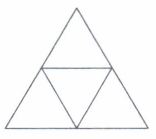
(iii) Net for cuboid
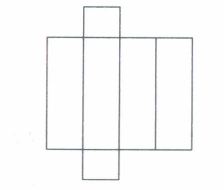
45.
A wall of a room is of dimensions 5 m x 4 m.
Length of the room = 5 m
Breadth of the room = 4 m
\(\therefore\) Area of the room = 5 x 4= 20 m2
Length of the window = 1.5 m
Breadth of the window = 1 m
\(\therefore\) Area of the window = 1.5 x 1 = 1.5 m2
Length of the door = 2.25 m
Breadth of the door = 1 m
\(\therefore\) Area of the door = 2.25 x 1 = 2.25 m2
The area of the wall to be painted = Area of the room - Area of the window - Area of the door
= 20 - 1.5 - 2.25
= 20 - 3.75 = 16.25 m2.
46.
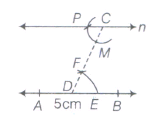
Steps of construction
(i) Draw a line AB= 5 cm and mark a point C outside it.
(ii) Mark another point D on AB, join CD.
(iii) With point D as centre, draw an arc cutting AB at E and also, CD at F.
(iv) With point C as centre and radius equal to DE, draw another arc cutting CD at M.
(v) With point M as centre and radius equal to EF, mark a point P on the previous arc.
(vi) Now, join PC to draw a line n.
Hence, line n is required line parallel to AB.
47.
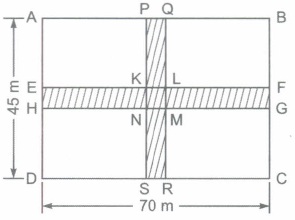
Here, Length of the rectangular park = 70 m
Breadth of the rectangular park = 45 m
The cross paths are shown by EFGH and PQRS in the figure.
Now, PQ =3 m and PS = 45 m
EH = 3 m and EF = 70 m
KL = 3 m and KN = 3 m
Now, area of the path = [Area of rectangle PQRS] + [Area of rectangle EFGH]- [Area of square KLMN]
= [PS x PQ] + [EF x EH] - [KL x KN]
= [45 x 3] m2 + [70 x 3] m2 - [3 x 3] m2
= 135 m2 + 210 m2 - 9 m2 = 336 m2
Now, cost of constructing the path = Rs. 110 x 336 = Rs. 36960.
Note: While finding the area of cross roads, the area of the middle square (here, KLMN) is taken twice
which is to be subtracted once.
48.
(a) (6-1 - 8-1)-1 + (2-1 - 3-1)-1
\(=(\frac{1}{6}-\frac{1}{8})^{-1}+(\frac{1}{2}-\frac{1}{3})^{-1}\)
\(=(\frac{4-3}{24})^{-1}+(\frac{3-2}{6})^{-1}\)
\((\frac{1}{24})^{-1}+(\frac{1}{6})^{-1}\)
= 24 + 6 = 30
(b) \({ \left\{ { 6 }^{ -1 }+{ \left( \frac { 3 }{ 2 } \right) }^{ -1 } \right\} }^{ -1 }\)
\(=(\frac{1}{6}+\frac{2}{3})^{-1}\)
\(=(\frac{1+4}{6})^{-1}=(\frac{5}{6})^{-1}\)
\(=\frac{6}{5}\)
49.
()
4
50.
()
6ab+22b+32a
51.
()
\(\frac{-4}{5}<\frac{-1}{2}<\frac{-1}{-4}<\frac{3}{4}\)
52.
()
5 cm

7th Standard CBSE Syllabus & Materials
7th Standard CBSE
CBSE 7th Social Science Theme B - New Beginnings : Cities and States - New Sample Question Papers Study Material - QB365 Set A
NEW7th Standard CBSE
CBSE 7th Social Science Theme A - Climates of India - New Sample Question Papers Study Material - QB365 Set A
NEW7th Standard CBSE
CBSE 7th Social Science Theme A - Geographical Diversity of India - New Sample Question Papers Study Material - QB365 Set A
NEW7th Standard CBSE
CBSE 7th Science Earth, Moon and the Sun - New Sample Question Papers Study Material - QB365 Set A



NCERT Books

Syllabus

Exam Pattern

Sample Question Papers

Previous year Question Papers

Important Notes

MCQ Practice test

NCERT Exemplers

Case study Questions

Image Based Questions

Passage based Questions

HOT Questions

Value Based Questions

Model Questions Papers
NCERT ( Book Back ) Questions

Assertion and Reason
Important Questions And Answers

CBSE 7th Standard CBSE Subjects
CBSE Standards


