
 100% FREE ACCESS
7th Standard CBSE Syllabus & Materials
7th Standard CBSE
CBSE 7th Social Science Theme E - Understanding Market - New Sample Question Papers Study Material - QB365 Set A
NEW7th Standard CBSE
CBSE 7th Social Science Theme E - From Barter to Money - New Sample Question Papers Study Material - QB365 Set A
NEW7th Standard CBSE
CBSE 7th Social Science Theme D - The Constitution of India- An Introduction - New Sample Question Papers Study Material - QB365 Set A
NEW7th Standard CBSE
CBSE 7th Social Science Theme D - From the Rulers to the Ruled : Types of Governments - New Sample Question Papers Study Material - QB365 Set A
NEW7th Standard CBSE
CBSE 7th Social Science Theme B - The Age of Reorganisation - New Sample Question Papers Study Material - QB365 Set A
NEW7th Standard CBSE
CBSE 7th Social Science Theme B - The Rise of Empires - New Sample Question Papers Study Material - QB365 Set A

Published on: 31/10/2025
Download CBSE Class 7th Standard CBSE Mathematics question papers, sample papers, important questions, and previous year solved papers in PDF format. Get free study materials, NCERT solutions, and exam preparation resources for Class 7th Standard CBSE Mathematics
Questions + Answers key
Take MCQ Mathematics Test
1.
Find \(\frac{-6}{5}\times4,\) using both ways. What do you observe?
2.
Can you list five rational numbers between \(-\frac{5}{3}\ and-\frac{8}{7}?\)
3.
The points P, Q, R, S T, U, A and B on the number line are such that, TR=RS=SU and AP =PQ =QB.
Name the rational numbers represented by P, Q, R and S.

4.
What should be subtracted from \(-\frac { 3 }{ 5 } \) to obtain the nearest integer?
5.
Taking x\(=\frac { -4 }{ 9 } \), y\(=\frac { 5 }{ 12 } \), and z\(=\frac { 7 }{ 18 } \), Find
( x - y) +z
6.
Write the following rational number in the standard form.
35%
7.
Write each of the following numbers in the form of \(\frac { p }{ q } \), Where p and q are integers.
Reciprocal of 1
8.
Simplify
\(\frac { 6 }{ 5 } \times \frac { 3 }{ 7 } -\frac { 1 }{ 5 } \times \frac { 3 }{ 7 } \)
9.
Find the sum of \(\frac { 4 }{ 7 } +\frac { -8 }{ 9 } +\frac { -5 }{ 21 } +\frac { 1 }{ 3 } \).
10.
Add the following rational number.
\(\frac { 1 }{ 2 } +\frac { 1 }{ 6 } +\frac { 1 }{ 8 } \)
1.
(a) On the number line, it will mean four jumps of \(\frac{6}{5}\) to the left from zero. We reach at \(\frac{-24}{5}.\)

So, \(\frac{-6}{5}\times4=\frac{-24}{5}\)
(b) \(\frac{-6}{5}\times4=\frac{-6\times4}{5}=\frac{-24}{5}\)
We observe that we arrive at the same rational number.
2.
\(-\frac{5}{3}=-\frac{5\times7}{3\times7}=-\frac{35}{21}\)
\(-\frac{8}{7}=-\frac{8\times3}{7\times3}=-\frac{24}{21}\)
Five rational numbers:
\(-\frac{35}{21}<-\frac{33}{21}<-\frac{32}{21}<-\frac{31}{21}<-\frac{30}{21}<\frac{-29}{21}<\frac{-24}{21}\)
\(\Rightarrow -\frac{5}{3}<(-\frac{33}{21})<(-\frac{32}{21})<(-\frac{31}{21})<(-\frac{30}{21})<(-\frac{29}{21})<\frac{-8}{7}\)
So, five rational numbers between \(-\frac{5}{3}\ and-\frac{8}{7}\)
\(-\frac{33}{21},-\frac{32}{21},\frac{-31}{21},\frac{-30}{21}\ and -\frac{29}{21}\)
3.
Given points, P, Q, R, S, T, U, A and B are on the number line such that TR =RS =SU and AP =PQ =QB.
It means that distance between AB is divided into 3 equal parts and similarly UT on the left of zero is divided into 3 equal parts.
Now, point P is on the right of zero on the number line and between 2 and 3.
So, the rational number represented by P = \(\\ 2+\frac { 1 }{ 3 } \)
[ since, AB is divided into 3 equal parts and each part shows \(\\ \frac { 1 }{ 3 } \)]
\(=\frac { 2\times 3 }{ 1\times 3 } =\frac { 1 }{ 3 } =\frac { 6+1 }{ 3 } =\frac { 7 }{ 3 } \)
Similarly, Q is on the right of zero and between 2 and 3.
So, the rational number represented by Q = \(2+\frac { 1 }{ 3 } +\frac { 1 }{ 3 } \)
[since, Q shows 2 equal parts out of 3 between 2 and 3 ]
\(\\ =\frac { 2\times 3 }{ 3 } +\frac { 1 }{ 3 } +\frac { 1 }{ 3 } =\frac { 6+1+1 }{ 3 } =\frac { 8 }{ 3 } \)
Also, R and S lie on the left of zero and between -1 and -2 then each part show \(\frac { -1 }{ 3 } \).
So, the rational number represented by
R=\(-1+\left( \frac { -1 }{ 3 } \right) =\frac { -1\times 3 }{ 3 } -\frac { 1 }{ 3 } =\frac { -3-1 }{ 3 } =\frac { -4 }{ 3 } \)
and the rational number represented by
S = -1+\(-1+\left( \frac { -1 }{ 3 } \right) +\left( \frac { -1 }{ 3 } \right) \)
[since, S shows 2 equal parts out of 3 parts between -1 and -2 ]
\(=\frac { -1\times 3 }{ 3 } -\frac { 1 }{ 3 } -\frac { 1 }{ 3 } =\frac { -3-1-1 }{ 3 } =\frac { -5 }{ 3 } \)
4.
Since, the nearest integer to \(-\frac { 3 }{ 5 } \)is -1.
Let x be subtracted from \(-\frac { 3 }{ 5 } \) to obtain -1.
Then , \(-\frac { 3 }{ 5 } \) -x=-1
\(\Rightarrow \) -x =-1+\(\frac { 3 }{ 5 } \) [by transposing \(-\frac { 3 }{ 5 } \) to RHS]
\(\Rightarrow \) -x =\(-\frac { 5 }{ 5 } +\frac { 3 }{ 5 } \left[ \because \frac { -1\times 3 }{ 1\times 3 } =\frac { -3 }{ 3 } \right] \)
\(\Rightarrow \) -x \(=-\frac { 2 }{ 5 } \Rightarrow x=\frac { 2 }{ 5 } \)
Hence, \(\frac { 2 }{ 5 } \)should be subtracted from \(-\frac { 3 }{ 5 } \) to obtain nearest integer.
5.
We have,( x - y) +z
Put the value of x,y and z
\(=\left( \frac { -4 }{ 9 } -\frac { 5 }{ 12 } \right) +\frac { 7 }{ 18 } \\ \frac { -4\times 4-5\times 3 }{ 36 } +\frac { 7 }{ 18 } =\frac { -16-15 }{ 36 } +\frac { 7 }{ 18 } \\ =\left( \frac { -31 }{ 36 } +\frac { 7 }{ 18 } \right) =\frac { -31+7\times 2 }{ 36 } =\frac { -31+14 }{ 36 } =\frac { -17 }{ 36 } \)
6.
Given,35%=\(\frac { 35 }{ 100 } \)
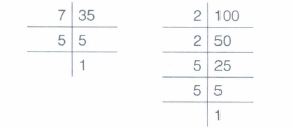
\(\because 35=7\times 5\)
and 100 = 2\(\times\)2\(\times\)5
\(\because \) HCF of 35 and 100 = 5
On dividing numerator and denominator by their HCF, We get
\(\frac { 35\div 5 }{ 100\div 5 } =\frac { 7 }{ 20 } \)
7.
Reciprocal of 1 =\(\frac { 1 }{ 1 } \)
8.
\(\frac { 6 }{ 5 } \times \frac { 3 }{ 7 } -\frac { 1 }{ 5 } \times \frac { 3 }{ 7 } \)
\(\\ \therefore \) Product of rational numbers
\(=\frac { Product\quad of\quad numerators }{ Product\quad of\quad denominators\quad } \)
\(\\ \\ =\frac { 6\times 3 }{ 5\times 7 } -\frac { 1\times 3 }{ 5\times 7 } =\frac { 18 }{ 35 } -\frac { 3 }{ 35 } =\frac { 18-3 }{ 35 } =\frac { 15 }{ 35 } =\frac { 3 }{ 7 } \)
9.
Given,\(\frac { 4 }{ 7 } +\frac { -8 }{ 9 } +\frac { -5 }{ 21 } +\frac { 1 }{ 3 } \)
For same denominator
LCM of 7,9,21 and 3 is 63,\(\)
\(\frac { 4\times 9 }{ 7\times 9 } =\frac { 36 }{ 63 } \),\(\frac { -8\times 7 }{ 9\times 7 } =\frac { -56 }{ 63 } \)
\(\frac { -5\times 3 }{ 21\times 3 } =\frac { -15 }{ 63 } \) , \(\frac { 1\times 21 }{ 3\times 21 } =\frac { 21 }{ 63 } \)
\(\therefore \)\(\frac { 4 }{ 7 } +\frac { -8 }{ 9 } +\frac { -5 }{ 21 } +\frac { 1 }{ 3 } =\frac { 36 }{ 63 } +\frac { -56 }{ 63 } +\frac { -15 }{ 63 } +\frac { 21 }{ 63 } \)
So,\(\frac { 36+(-56)+(-15)+(21) }{ 63 } \)
\(=\frac { 36+21+(-56)+(-15) }{ 63 } =\frac { 57+(-71) }{ 63 } \)
\(=-\frac { 14 }{ 63 } =\frac { -2 }{ 9 } \)
10.
Given, \(\\ \frac { 1 }{ 2 } +\frac { 1 }{ 6 } +\frac { 1 }{ 8 } \)
For common/same denominator
LCM of 2,6 and 8 is 24.
\(\frac { 1 }{ 2 } =\frac { 1\times 12 }{ 2\times 12 } =\frac { 12 }{ 24 } \frac { 1 }{ 6 } =\frac { 1\times 4 }{ 6\times 4 } =\frac { 4 }{ 24 } \\ \frac { 1 }{ 8 } =\frac { 1\times 3 }{ 8\times 3 } =\frac { 3 }{ 24 } \\ \therefore \frac { 1 }{ 2 } +\frac { 1 }{ 6 } +\frac { 1 }{ 8 } =\frac { 12 }{ 24 } +\frac { 4 }{ 24 } +\frac { 3 }{ 24 } \\ =\frac { 12+4+3 }{ 24 } =\frac { 19 }{ 24 } \)

7th Standard CBSE Syllabus & Materials
7th Standard CBSE
CBSE 7th Social Science Theme B - New Beginnings : Cities and States - New Sample Question Papers Study Material - QB365 Set A
NEW7th Standard CBSE
CBSE 7th Social Science Theme A - Climates of India - New Sample Question Papers Study Material - QB365 Set A
NEW7th Standard CBSE
CBSE 7th Social Science Theme A - Geographical Diversity of India - New Sample Question Papers Study Material - QB365 Set A
NEW7th Standard CBSE
CBSE 7th Science Earth, Moon and the Sun - New Sample Question Papers Study Material - QB365 Set A



NCERT Books

Syllabus

Exam Pattern

Sample Question Papers

Previous year Question Papers

Important Notes

MCQ Practice test

NCERT Exemplers

Case study Questions

Image Based Questions

Passage based Questions

HOT Questions

Value Based Questions

Model Questions Papers
NCERT ( Book Back ) Questions

Assertion and Reason
Important Questions And Answers

CBSE 7th Standard CBSE Subjects
CBSE Standards


