
 100% FREE ACCESS
7th Standard CBSE Syllabus & Materials
7th Standard CBSE
CBSE 7th Social Science Theme E - Understanding Market - New Sample Question Papers Study Material - QB365 Set A
NEW7th Standard CBSE
CBSE 7th Social Science Theme E - From Barter to Money - New Sample Question Papers Study Material - QB365 Set A
NEW7th Standard CBSE
CBSE 7th Social Science Theme D - The Constitution of India- An Introduction - New Sample Question Papers Study Material - QB365 Set A
NEW7th Standard CBSE
CBSE 7th Social Science Theme D - From the Rulers to the Ruled : Types of Governments - New Sample Question Papers Study Material - QB365 Set A
NEW7th Standard CBSE
CBSE 7th Social Science Theme B - The Age of Reorganisation - New Sample Question Papers Study Material - QB365 Set A
NEW7th Standard CBSE
CBSE 7th Social Science Theme B - The Rise of Empires - New Sample Question Papers Study Material - QB365 Set A

Published on: 31/10/2025
Download CBSE Class 7th Standard CBSE Mathematics question papers, sample papers, important questions, and previous year solved papers in PDF format. Get free study materials, NCERT solutions, and exam preparation resources for Class 7th Standard CBSE Mathematics
Questions + Answers key
Take MCQ Mathematics Test
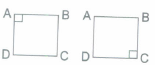
1.
Draw two identical parallelograms, one ABCD on a piece of paper and other A' B' C' D' on a transparent sheet. Mark the points of intersection of their diagonals O and O', respectively. Place the parallelograms such that A' lies on A, B' lies on B and so on. O' then falls on O. Stick a pin into the shapes at the point O. Now, turn the transparent shape in the clockwise direction.
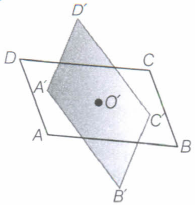
What is the order of rotational symmetry?
2.
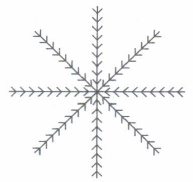
Find the number of lines of symmetry of the following figure:
3.
What letters of the English alphabet have reflectional symmetry (i.e. symmetry related to mirror reflection) about a both horizontal and vertical mirror?
4.
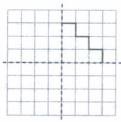
Copy the diagram and complete each shape to be symmetric about the mirror line(s).
5.
The following figures have more than one line of symmetry. Such figures are said to have multiple lines of symmetry.
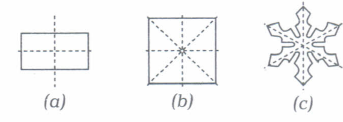
Identify multiple lines of symmetry, if any, in each of the following figures.

6.
The following figures have more than one line of symmetry. Such figures are said to have multiple lines of symmetry.
Identify multiple lines of symmetry, if any, in each of the following figures.

7.
In the following figures, the mirror line (i.e. the line of symmetry) is given as a dotted line. Complete each figure performing reflection in the dotted (mirror) line. (You might perhaps place a mirror along the dotted line and look into the mirror for the image). Are you able to recall the name of the figure you complete?

8.
In the following figures, the mirror line (i.e. the line of symmetry) is given as a dotted line. Complete each figure performing reflection in the dotted (mirror) line. (You might perhaps place a mirror along the dotted line and look into the mirror for the image). Are you able to recall the name of the figure you complete?
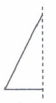
9.
Given the line(s) of symmetry, find the other hole(s).

10.
Copy the figure with punched holes and find the axes of symmetry for the following:

11.
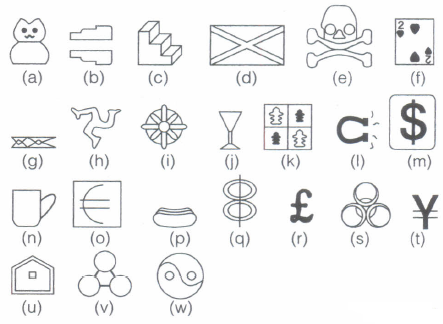
In each of the following figures, write the number of lines of symmetry and order of rotational symmetry.
12.
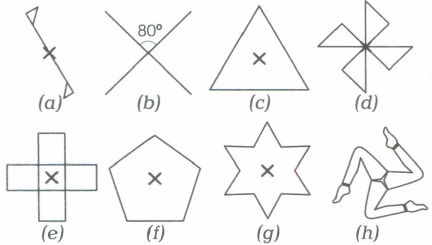
Give the order of rotational symmetry for each figure.
13.
Draw all lines of symmetry for each of the following figures as given below.

14.
Trace each figure. Then, draw all lines of symmetry, if it has.

15.
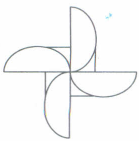
State the order of rotation and angle of rotation of the following figure.
16.
Some of the English alphabets have fascinating symmetrical structures. Which capital letters have just one line of symmetry (like E)? Which capital letters have a rotational symmetry of order 2 (like I)? .By attempting to think on such lines, you will be able to fill in the following table.
| Alphabet letters | Line symmetry | Number of lines of symmetry | Rotational symmetry | Order of rotational symmetry |
|---|---|---|---|---|
| Z | No | 0 | Yes | 2 |
| S | ||||
| H | Yes | Yes | ||
| O | Yes | Yes | ||
| E | Yes | |||
| N | Yes | |||
| C |
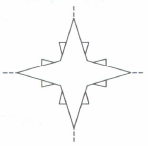
17.
In the following figure, show both line of symmetry and rotational symmetry.
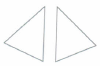
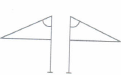
18.
Which of the following has rotational symmetry?

19.
A scalene triangle has:
No line of symmetry
One line of symmetry
Two lines of symmetry
None of these.
20.
Which of the following letters of English alphabets have more than 2 lines of symmetry?
Z
O
E
H
21.
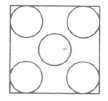
The angle of rotation for the figure given below is
45°
60°
90°
180°
22.
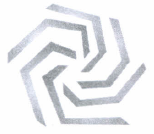
The order of rotational symmetry in the figure given below is
4
8
6
infinitely many
1.
The parallelogram has rotational symmetry of order 2.
2.
Four
3.
We know that, a shape has reflectional symmetry, if one half of it, is the mirror image of the other half. Letters of the English alphabet having reflectional symmetry about a horizontal mirror are both horizontal and vertical mirrors are H, I, O and X.
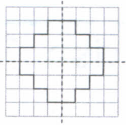
4.
Copying the diagram and then completing all the figures such that each shape is symmetric about the mirror line(s) or line of symmetry, we get the following figures:
5.
The multiple lines of symmetry of each figure are shown below:
This figure has 4 lines of symmetry which are shown by dotted lines.

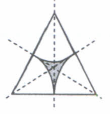
6.
The multiple lines of symmetry of each figure are shown below:
This figure has 3 lines of symmetry which are shown by dotted lines.
7.
On completing all of the figures about their lines of symmetry which are given as a dotted line, we get the following figures:
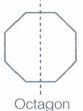
Yes,we are able to recall the name of the complete figure and name of the each figure is written under figures.
8.
On completing all of the figures about their lines of symmetry which are given as a dotted line, we get the following figures:
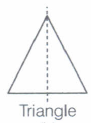
Yes,we are able to recall the name of the complete figure and name of the each figure is written under figures.
9.
With respect to the given line(s) of symmetry, the other hole(s) are marked in the figures given below:
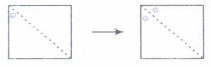
10.
On copying the figure with punched holes, the axis of symmetry corresponding to the punched holes are shown by dotted lines in the figures given below

11.
| Figure | Number of lines of symmetry | Order of rotational symmetry |
|---|---|---|
| a | 1 | 1 |
| b | 1 | 1 |
| c | 1 | 1 |
| d | 2 | 2 |
| e | 1 | 1 |
| f | 0 | 1 |
| g | 1 | 1 |
| h | 0 | 3 |
| i | 4 | 4 |
| j | 1 | 1 |
| k | 0 | 1 |
| l | 1 | 1 |
| m | 0 | 2 |
| n | 0 | 1 |
| o | 1 | 1 |
| p | 1 | 1 |
| q | 2 | 2 |
| r | 0 | 1 |
| s | 3 | 3 |
| t | 1 | 1 |
| u | 1 | 1 |
| v | 3 | 3 |
| w | 0 | 2 |
12.
Let mark a point A on each figure and also, indicate the angle through which is to be rotated as shown below:
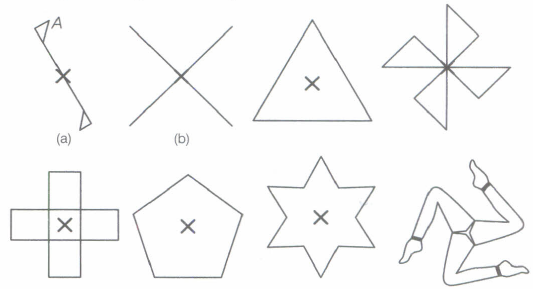
Now, to find the rotational symmetry,we proceed as follows:
For figure (a), it requires two rotations, each through an angle of 180°, about the marked point (X) to come back to its original position. So, it has a rotational symmetry of order 2.
For figure (b), it requires two rotations, each through an angle of 180°, about the marked point (X) to come back to its original position. So, it has a rotational symmetry of order 2.
For figure (c), it requires three rotations, each through an angle of 120° about the marked point (X) to come back to its original position. So, it has a rotational symmetry of order 3.
For figure (d), it requires four rotations, each through an angle of 90°, about the marked point (X) to come back to its original position. So, it has a rotational symmetry of order 4.
For figure (e), it requires four rotations, each through an angle of 90° about the marked point (X) to come back to its original position. So, it has a rotational symmetry of order 4.
For figure (f), it requires five rotations, each through an angle of 72°, about the marked point (X) to come back its original position. So, it has rotational symmetry of order 5.
For figure (g), it requires six rotations, each through an angle of 60° about the marked point (X) to come back its original position. So, it has rotational symmetry of order 6.
For figure (h), it requires three rotations, each through an angle of 120°, about the marked point to come back to its original position. So, it has rotational symmetry of order 3.
13.
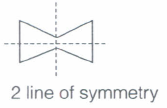
14.
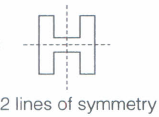
15.
The order of rotation is 4 and angle of rotation of given figure is \(\frac { 360° }{ 4 } =90°\)
16.
We know that, a figure has line of symmetry if there is a line about which the figure may be folded, so that the two parts of the figure will coincide and a figure has a rotational symmetry if after a rotation, the figure looks exactly the same. Then, the complete table is shown below:
| Alphabet letters | Line symmetry | Number of lines of symmetry | Rotational symmetry | Order of rotational symmetry |
|---|---|---|---|---|
| Z | No | 0 | Yes | 2 |
| S | No | 0 | Yes | 2 |
| H | Yes | 2 | Yes | 2 |
| O | Yes | 2 | Yes | 4 |
| E | Yes | 1 | Yes | 1 |
| N | No | 0 | Yes | 2 |
| C | Yes | 1 | Yes | 1 |
17.
We can show line of symmetry for given figure as
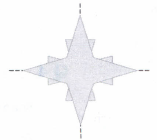
In the above figure, rotational angle will be 90°. So, rotational symmetry will take place as

Given figure will complete full rotation in 4 steps. So, its order of rotation will be 4.
18.
(a)
19.
(a)
No line of symmetry
20.
(b)
O
21.
(c)
90°
22.
(c)
6

7th Standard CBSE Syllabus & Materials
7th Standard CBSE
CBSE 7th Social Science Theme B - New Beginnings : Cities and States - New Sample Question Papers Study Material - QB365 Set A
NEW7th Standard CBSE
CBSE 7th Social Science Theme A - Climates of India - New Sample Question Papers Study Material - QB365 Set A
NEW7th Standard CBSE
CBSE 7th Social Science Theme A - Geographical Diversity of India - New Sample Question Papers Study Material - QB365 Set A
NEW7th Standard CBSE
CBSE 7th Science Earth, Moon and the Sun - New Sample Question Papers Study Material - QB365 Set A



NCERT Books

Syllabus

Exam Pattern

Sample Question Papers

Previous year Question Papers

Important Notes

MCQ Practice test

NCERT Exemplers

Case study Questions

Image Based Questions

Passage based Questions

HOT Questions

Value Based Questions

Model Questions Papers
NCERT ( Book Back ) Questions

Assertion and Reason
Important Questions And Answers

CBSE 7th Standard CBSE Subjects
CBSE Standards


