
 100% FREE ACCESS
7th Standard CBSE Syllabus & Materials
7th Standard CBSE
CBSE 7th Social Science Theme E - Understanding Market - New Sample Question Papers Study Material - QB365 Set A
NEW7th Standard CBSE
CBSE 7th Social Science Theme E - From Barter to Money - New Sample Question Papers Study Material - QB365 Set A
NEW7th Standard CBSE
CBSE 7th Social Science Theme D - The Constitution of India- An Introduction - New Sample Question Papers Study Material - QB365 Set A
NEW7th Standard CBSE
CBSE 7th Social Science Theme D - From the Rulers to the Ruled : Types of Governments - New Sample Question Papers Study Material - QB365 Set A
NEW7th Standard CBSE
CBSE 7th Social Science Theme B - The Age of Reorganisation - New Sample Question Papers Study Material - QB365 Set A
NEW7th Standard CBSE
CBSE 7th Social Science Theme B - The Rise of Empires - New Sample Question Papers Study Material - QB365 Set A

Published on: 31/10/2025
Download CBSE Class 7th Standard CBSE Mathematics question papers, sample papers, important questions, and previous year solved papers in PDF format. Get free study materials, NCERT solutions, and exam preparation resources for Class 7th Standard CBSE Mathematics
Questions + Answers key
Take MCQ Mathematics Test
1.
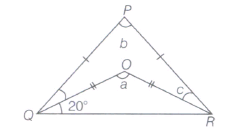
In the following figure,\(\triangle PQR\ and \triangle OQR\) are isosceles triangles and \(\angle a=2\angle b.\)Find \(\angle c\).
2.
The lengths of two sides of a triangle are 12 cm and 15 cm. Between what two measures should the length of the third side fall?
3.
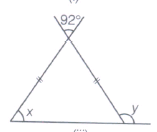
Find the angles x and y in each figure.
4.
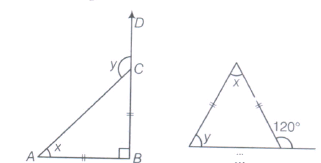
Find the angles x and y in each figure.
5.
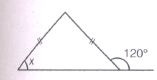
Find angle x in each figure.
6.
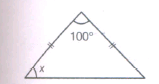
Find angle x in each figure.
7.
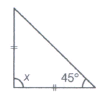
Find angle x in each figure.
8.
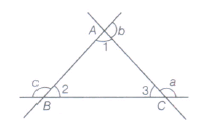
In the following figure, find the value of \(\angle A+\angle B+\angle C.\)
9.
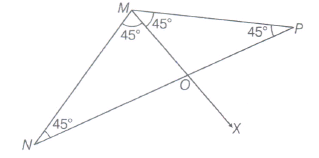
In the given \(\triangle MNP\), a line from vertex M is drawn passing through the side NP at O, such that the measure of angles are given. What would be the other name for OM?
10.
Draw rough sketches for the following:
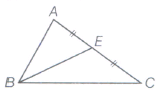
(a) In \(\triangle ABC\),BE is a median.
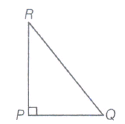
(b) In \(\triangle PQR\),PO and PR are altitudes of the triangle.
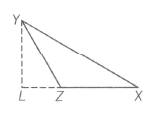
(c) In \(\triangle XYZ\),YL is an altitude in the exterior of the triangle.
11.
The diagonals of a rhombus measure 8 cm and 6 cm. Find its perimeter.
12.
The foot of a ladder is 8 m away from the wall and its top touches the wall at a height of 6 m. Find the length of the ladder
13.
In a right triangle PQR, right angled at Q. If PQ = 10 cm and QR = 24 cm, then find the length of PR.
14.
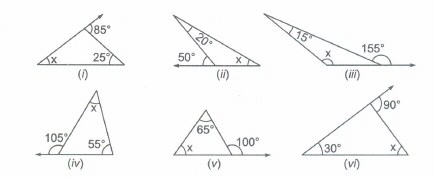
Find the measure of x in each of the following figures.
15.
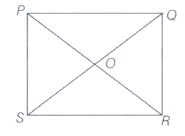
In quadrilateral PORS, show that PQ+ QR + RS + SP< 2(PR + SQ).
16.
While discussing the properties of a triangle, teacher asked about the angle of equilateral triangle and gave three options to Ajay.
(a) Each angle in an equilateral triangle is equal to 45°.
(b) Each angle in an equilateral triangle is equal to 90°.
(c) Each angle in an equilateral triangle is equal to 60°.
Ajay gave the answer as each angle of an equilateral triangle is equal to 45°.
(i) Is this the correct answer?
(ii) What is the value depicted by Ajay answer.
1.
\(\angle c=35^0\)
2.
Let x cm be the length of the third side.
We know that, the sum of lengths of two sides of a triangle is greater than the length of third side.
∴ 12 cm + 15 cm > x cm \(\Rightarrow\) 27 cm> x cm or x < 27 cm
Also, the difference between the lengths of two sides of a triangle is less than the length of third side.
∴ 15 cm - 12 cm < x cm \(\Rightarrow\) 3 cm > x cm or x < 3 cm
Hence, the length of third side can be any length between 3 cm and 27 cm.
3.
Let given triangle be \(\triangle ABC\).
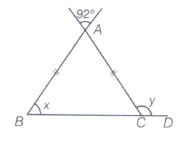
Then, we have AB = AC.
So, \(\triangle ABC\) is an isosceles triangle.
\(\therefore\angle ABC=\angle ACB\)
(since, angle opposite to equal sides are equal]
\(\Rightarrow\angle ACB=x\)
\(\angle BAC=92^0\) [vertically opposite angles]
In,\(\triangle ABC\), [by angle sum property of a traingle]
\(\angle ABC+\angle BAC+\angle ACB=180^0\)
\(\Rightarrow\) x + 92° + x = 180°
\(\Rightarrow\) 2x + 92° = 180°
\(\Rightarrow x=\frac{88^0}{2}\Rightarrow x=44^0\)
Also, \(\angle ACD\) is an exterior angle of \(\triangle ABC\).
By exterior angle property,
Exterior angle = Sum of two interior opposite angles
\(\Rightarrow y= \angle BAC+\angle ABC\)
\(\Rightarrow\)y = 92° + x
\(\Rightarrow\) y = 92° + 44° = 1360
Hence, the value of x is 44° and y is 136°.
4.
Let given triangle be \(\triangle ABC\).
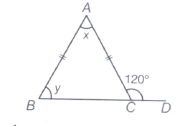
Then, we have AB = AC.
So,\(\triangle ABC\) is an isosceles triangle.
\(\therefore \angle ACB=\angle ABC=y^0\)
Also, \(\angle ACD\) is an exterior angle.
We know that, in a triangle an exterior angle and the interior adjacent angle form a linear pair.
\(\therefore\angle ACB+\angle ACD=180^0\)
\(\Rightarrow \angle ACD+120^0=180^0\Rightarrow\angle ACB=180^0-120^0=60^0\)
\(\therefore \angle ABC=\angle ACB=60^0\)
\(\triangle ABC\),\(\angle A+\angle B+\angle ACB=180^0\) [by angle sum property of a triangle]
\(\Rightarrow\) x+ y+ y=1800 \(\Rightarrow\) x+600+600=1800
\(\Rightarrow\) x = 180° -120° = 60°
Hence, the value of x is 60° and y is 60°.
5.
Let the given triangle be \(\triangle ABC\).Then, we have AB = AC
So,\(\triangle ABC\) is an isosceles triangle.
\(\therefore\angle ACB=\angle B\)
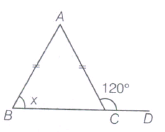
[since, the angle opposite to equal sides of an isosceles triangle are equal]
\(\angle ACB=x^0\)
We know that, linear pair of angles is supplementry.
\(\angle ACB+\angle ACD=180^0\)
\(\Rightarrow\) x + 120° = 180°[\(\therefore\angle ACD=120,given\) ]
\(\Rightarrow\) x = 180° -120° = 60°
Hence, the value of x is 60°.
6.
Let the given triangle be \(\triangle ABC\).Then, we have AB=AC
So,\(\triangle ABC\) is an isosceles triangle.
\(\therefore\angle B=\angle C=x\)
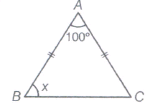
[since, the angle opposite to equal sides of an isosceles triangle are equal]
Now, in \(\triangle ABC\) by angle sum property of a triangle,
\(\angle A+\angle B+\angle C=180^0\)
\(\Rightarrow\) 100° + x + x = 1800 \(\Rightarrow\) 100° + 2x = 180°
\(\Rightarrow\) 2x=1800-100 \(\Rightarrow\) 2x=800 \(\Rightarrow=x=\frac{80^0}{2}=40^0\)
Hence, the value of x is 40°.
7.
Let the given triangle be \(\triangle ABC\).
Then, we have AB = AC.
So, \(\triangle ABC\) is an isosceles triangle.
\(\therefore \angle A= \angle C=45^{0}\)
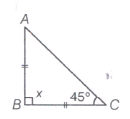
[since, the angle opposite to equal sides of an isosceles triangle are equal]
Now, in \(\triangle ABC\), by angle sum property of a triangle,
\(\angle A+\angle B+\angle C=180^0\Rightarrow45^0+x+45^0=180^0\)
\([\angle A=\angle B=45,because\ of\ equal\ side]\)
\(\Rightarrow\) x+900=180° \(\Rightarrow\) x=1800-90° =90°
Hence, the value of x is 90°.
8.
\(\angle A+\angle B+\angle C=360^0\)
9.
In \(\triangle OMP\),
\(\angle OMP=\angle OPM\)
\(\therefore\) OM=OP.................1
[Since, sides opposite to equal angles are equal]
Also, in \(\triangle OMN\),
\(\angle OMN=\angle ONM\Rightarrow OM=ON\Rightarrow OP=ON\) [from Eq.1]
Hence, OM is the median of \(\triangle MPN\).
10.
(a) In the following figure, we have \(\triangle ABC\).We know that, a median connects a vertex of a triangle to the mid-point of the opposite sides. On joining B and mid-point of AC i.e. E we get the required median BE.
(b) We know that, the perpendicular line segment from a vertex of a triangle to its opposite side is called an altitude of the triangle. In the following figure, we have \(\triangle PQR\) in which PQ and PR are the altitude drawn,from vertex Q to PR and from vertex R to PQ, respectively.
(c) In the adjoining figure, we have an obtuse angled triangle XYZ in which YL is an altitude drawn from Y to produced XZ such altitude lies in the exterior of the triangle.
11.
20 cm
12.
10m
13.
26 cm
14.
(i) 60°
(ii) 30°
(iii) 140°
(iv) 50°
(v) 35°
(vi) 60°
15.
We know that, in a triangle the sum of two sides are always greater than the third side. Consider
\(\triangle POS,OP+OS>PS\)..................1
\(\triangle POQ,OP+OQ>PQ\)..................2
\(\triangle QOR,OQ+OR>QR\).............3
\(\triangle ROS,OR+OS>SR\)................4
On adding Eqs. (i), (ii), (iii) and (iv), we get
2 (OP + OS + OQ + OR) > PS + PQ+ QR + SR
\(\Rightarrow\) 2(PR+ QS) > PQ+ QR+RS+SP
16.
(i) We know that, an equilateral triangle have equals sides and each angle equal to 60°.
i.e. 60° + 60° + 60° = 180°
Hence, answer of Ajay was wrong.
(ii) The value depicted by Ajay's answer is that he is not attentive in class, also do not understand the concept of equilateral triangle and their basic properties.

7th Standard CBSE Syllabus & Materials
7th Standard CBSE
CBSE 7th Social Science Theme B - New Beginnings : Cities and States - New Sample Question Papers Study Material - QB365 Set A
NEW7th Standard CBSE
CBSE 7th Social Science Theme A - Climates of India - New Sample Question Papers Study Material - QB365 Set A
NEW7th Standard CBSE
CBSE 7th Social Science Theme A - Geographical Diversity of India - New Sample Question Papers Study Material - QB365 Set A
NEW7th Standard CBSE
CBSE 7th Science Earth, Moon and the Sun - New Sample Question Papers Study Material - QB365 Set A



NCERT Books

Syllabus

Exam Pattern

Sample Question Papers

Previous year Question Papers

Important Notes

MCQ Practice test

NCERT Exemplers

Case study Questions

Image Based Questions

Passage based Questions

HOT Questions

Value Based Questions

Model Questions Papers
NCERT ( Book Back ) Questions

Assertion and Reason
Important Questions And Answers

CBSE 7th Standard CBSE Subjects
CBSE Standards


