
 100% FREE ACCESS
7th Standard CBSE Syllabus & Materials
7th Standard CBSE
CBSE 7th Social Science Theme E - Understanding Market - New Sample Question Papers Study Material - QB365 Set A
NEW7th Standard CBSE
CBSE 7th Social Science Theme E - From Barter to Money - New Sample Question Papers Study Material - QB365 Set A
NEW7th Standard CBSE
CBSE 7th Social Science Theme D - The Constitution of India- An Introduction - New Sample Question Papers Study Material - QB365 Set A
NEW7th Standard CBSE
CBSE 7th Social Science Theme D - From the Rulers to the Ruled : Types of Governments - New Sample Question Papers Study Material - QB365 Set A
NEW7th Standard CBSE
CBSE 7th Social Science Theme B - The Age of Reorganisation - New Sample Question Papers Study Material - QB365 Set A
NEW7th Standard CBSE
CBSE 7th Social Science Theme B - The Rise of Empires - New Sample Question Papers Study Material - QB365 Set A

Published on: 31/10/2025
Download CBSE Class 7th Standard CBSE Mathematics question papers, sample papers, important questions, and previous year solved papers in PDF format. Get free study materials, NCERT solutions, and exam preparation resources for Class 7th Standard CBSE Mathematics
Questions + Answers key
Take MCQ Mathematics Test
1.
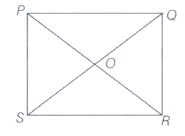
In quadrilateral PORS, show that PQ+ QR + RS + SP< 2(PR + SQ).
2.
Height of a pole is 8 m. Find the length of rope tied with its top from a point on the ground at a distance of 6 m from its bottom.
3.
The angles of a triangle are arranged in descending order of their magnitude. If the difference between two consecutive angles is 20°. Find the three angles.
4.
If one angle of a triangle is 60° and the other two angles are in the ratio 1: 3. Then, find the angles.
5.
The diagonals of a rhombus measure 16 cm and 30 cm. Then, find its perimeter.
6.
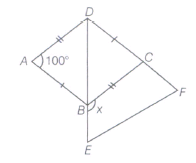
In the following figure, ABII CO. Find the value of \(\angle X\)
7.
If the sum of three exterior angles of a triangle is 360° and the corresponding interior opposite angles are equal to each other. Then, find the value of each of the interior angle of the triangle.
8.
The exterior \(\angle ACD\ of \triangle ABC\) 1150.If \(\angle B=50^0\).then find \(\angle A.\ is\angle ACD>\angle A?\)
9.
One of the exterior angles of a triangle is 112° and the interior opposite angles are in the ratio 3 : 4. Find the interior opposite angles.
10.
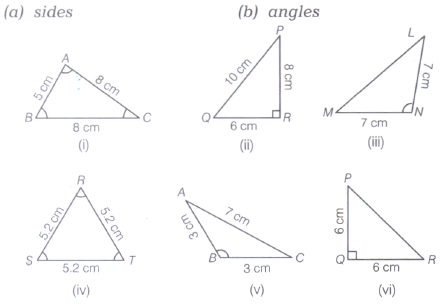
Look at following figures and classify each of the triangles according to its
1.
We know that, in a triangle the sum of two sides are always greater than the third side. Consider
\(\triangle POS,OP+OS>PS\)..................1
\(\triangle POQ,OP+OQ>PQ\)..................2
\(\triangle QOR,OQ+OR>QR\).............3
\(\triangle ROS,OR+OS>SR\)................4
On adding Eqs. (i), (ii), (iii) and (iv), we get
2 (OP + OS + OQ + OR) > PS + PQ+ QR + SR
\(\Rightarrow\) 2(PR+ QS) > PQ+ QR+RS+SP
2.
As per the given information in the question, height of a pole is 8 m. Distance between the bottom of the pole and a point on the ground is 6 m. On the basis of given information, we can draw the following figure:
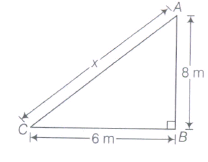
Let the length of the rope be x,
AB = Height of the pole
BC = Distance between the bottom of the pole and a point on the ground where rope was tied.
To find the length of the rope,we will use Pythagoras theorem, such that,
(AC)2 =(AB)2 + (BC)2
\(\Rightarrow\) (AC)2 =(8)2 + (6)2 \(\Rightarrow\) X2 = 64 + 36
\(\Rightarrow\) X2 =100
\(\Rightarrow x=\sqrt 100=10m\)
3.
Let one of the angle of a triangle be x. If angles are arranged in descending order. So, angles will be x, (x - 20°) and (x - 40°).
We know that, the sum of all angles in a triangle is equal to 180°.
So, x+(x-20°)+(x-40°)=180°
\(\Rightarrow\) x + x + x-20° - 40° = 180°
\(\Rightarrow\) 3x =180° + 60°
\(\Rightarrow\) 3x = 240°
\(\Rightarrow x=\frac{240°}{3}=80°\)
\(\Rightarrow\) x=80°
So, angles will be 80°, (80° - 20° ) and (80° - 40°)
i.e. 80°, 60°, 40.
4.
As per the given information in the question, one angle of a triangle is 60°. Let the other two angles be x and 3x.
We know that, the sum of all angles in a triangle is equal to 180°.
So, x+3x+600=180°
\(\Rightarrow\) 4x + 60° =180°
\(\Rightarrow\) 4x =180° - 60°
\(\Rightarrow\) 4x =120°
\(\Rightarrow x=\frac{120^0}{4}=30^0\)
x=300
So, angles will be x = 30° and 3x = 3 x 30° = 90°
Hence, the two angles are 90° and 30°.
5.
Let ABCD be the rhombus and AC and BD are its diagonal.
Then, given AC = 30 cm and BD = 16 cm.
We know that, the diagonals of a rhombus bisect each other at right angle.
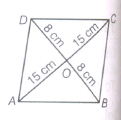
\(\therefore OA=\frac{1}{2}AC=\frac{1}{2}\times30cm=15cm\)
\(OB=\frac{1}{2}BD=\frac{1}{2}\times16cm=8cm\)
Also, \(\angle AOB\) is right angle.
In \(\triangle AOB\) by using Pythagoras property,
AB2 = OA2 + OB2
\(\Rightarrow\) AB2 = (15)2 + (8)2
\(\Rightarrow\) AB2 = 225 + 64
\(\Rightarrow\) AB2 = 289
\(\Rightarrow AB=\sqrt289=17\)
Perimeter of a rhombus = 4 X Side = 4 X AB
=4 X 17=68 cm
Hence, the perimeter of a rhombus is 68 cm.
6.
\(\angle X=140^0\)
7.
Each interior angles will be equal to 600.
8.
\(\angle A=65^0,yes \angle ACD>\angle A\)
9.
The two interior opposite angles are 480 and 640.
10.
We know that, On the basis of sides, a triangle is called
(i) scalene triangle, if all three sides of triangle are unequal.
(ii) isosceles triangle, if any rwo sides are equal.
(iii) equilateral triangle, if all three sides are equal.
On the basis of angles, a triangle is called
(i) acute angled triangle, if each angle is less than 90°.
(ii) right angled angled triangle, if one angle is a right angle.
(iii) obtuse angled triangle, if one angle is greater than 90°. Now,
Now,
(i) (a) In \(\triangle ABC\),AC=BC=8 cm
i.e. rwo sides are equal
Therefore,\(\triangle ABC\) is an isosceles triangle.
(b) Also, all the angles of \(\triangle ABC\) are less than 90°.
Therefore,\(\triangle ABC\) is an acute angled triangle.
(ii) (a) In \(\triangle PQR\),\(PQ\neq QR\neq RP \) [given]
i. e. all three sides are unequal.
Therefore,\(\triangle PQR\) is a scalene triangle.
(b) Also,\(\angle R=90^0\) [given]
Therefore, \(\triangle PQR\) is a right angled triangle.
(iii) (a) In \(\triangle LMN\),LN=MN=7cm
i.e. rwo sides are equal.
Therefore,\(\triangle LMN\) is an isosceles triangle.
(b) Also,\(\angle N>90^0\) [given]
Therefore,\(\triangle LMN\) is an obtuse angled triangle.
(iv) (a) In \(\triangle RST\),RS = ST = TR = 5.2 cm [given]
i.e. all three sides are equal.
Therefore,\(\triangle RST\) is an equilateral triangle.
(b) Also, all the angles of \(\triangle RST\) are acute.
Therefore,\(\triangle RST\) is an acute angled triangle.
(v) (a) In \(\triangle ABC\),AB = BC = 3 cm
i.e. rwo sides are equal.
Therefore,\(\triangle ABC\) is an isosceles angled triangle.
(b) Also,\(\angle B>90^0\)
Therefore, \(\triangle ABC\) is an obtuse angled triangle.
(vi) (a) In \(\triangle PQR\),PQ = QR = 6 cm [given]
i.e. rwo sides are equal.
Therefore, \(\triangle PQR\) is an isosceles triangle.
(b) Also,\(\angle Q=90^0\) [given]
Therefore \(\triangle PQR\) is a right angled angled triangle.

7th Standard CBSE Syllabus & Materials
7th Standard CBSE
CBSE 7th Social Science Theme B - New Beginnings : Cities and States - New Sample Question Papers Study Material - QB365 Set A
NEW7th Standard CBSE
CBSE 7th Social Science Theme A - Climates of India - New Sample Question Papers Study Material - QB365 Set A
NEW7th Standard CBSE
CBSE 7th Social Science Theme A - Geographical Diversity of India - New Sample Question Papers Study Material - QB365 Set A
NEW7th Standard CBSE
CBSE 7th Science Earth, Moon and the Sun - New Sample Question Papers Study Material - QB365 Set A



NCERT Books

Syllabus

Exam Pattern

Sample Question Papers

Previous year Question Papers

Important Notes

MCQ Practice test

NCERT Exemplers

Case study Questions

Image Based Questions

Passage based Questions

HOT Questions

Value Based Questions

Model Questions Papers
NCERT ( Book Back ) Questions

Assertion and Reason
Important Questions And Answers

CBSE 7th Standard CBSE Subjects
CBSE Standards


