
 100% FREE ACCESS
7th Standard CBSE Syllabus & Materials
7th Standard CBSE
CBSE 7th Social Science Theme E - Understanding Market - New Sample Question Papers Study Material - QB365 Set A
NEW7th Standard CBSE
CBSE 7th Social Science Theme E - From Barter to Money - New Sample Question Papers Study Material - QB365 Set A
NEW7th Standard CBSE
CBSE 7th Social Science Theme D - The Constitution of India- An Introduction - New Sample Question Papers Study Material - QB365 Set A
NEW7th Standard CBSE
CBSE 7th Social Science Theme D - From the Rulers to the Ruled : Types of Governments - New Sample Question Papers Study Material - QB365 Set A
NEW7th Standard CBSE
CBSE 7th Social Science Theme B - The Age of Reorganisation - New Sample Question Papers Study Material - QB365 Set A
NEW7th Standard CBSE
CBSE 7th Social Science Theme B - The Rise of Empires - New Sample Question Papers Study Material - QB365 Set A

Published on: 31/10/2025
Download CBSE Class 7th Standard CBSE Mathematics question papers, sample papers, important questions, and previous year solved papers in PDF format. Get free study materials, NCERT solutions, and exam preparation resources for Class 7th Standard CBSE Mathematics
Questions + Answers key
Take MCQ Mathematics Test
1.
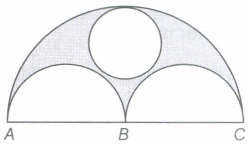
In the following figure, AB = BC and AC = 84 cm. The radius of the inscribed circle is 14 cm and B is the centre of the largest semi-circle. What is the area of the shaded region?
2.
Simplify \(\\ \left( \frac { -1 }{ 5 } \times \frac { 2 }{ -3 } \right) +\left( 2\times \frac { 5 }{ 3 } \right) -\left( -\frac { 2 }{ 3 } \times \frac { 5 }{ 6 } \right) \)
3.
Find the area of each of the following parallelogram.
.png)
4.
A rectangular grassy lawn is 18 m x 12 m. It has a ground path, 1.5 m wide all around it on the outside. What is the area of the path?
5.
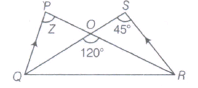
In the following figure, if PQllRS, then find the value of \(\angle Z\).
6.
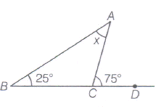
Find the value of x in the adjacent figure.
7.
Find the value of \(12\frac { 6 }{ 9 }\div \frac { 1 }{ 18 } \times \frac { 1 }{ 2 } \)
8.
The smallest rational number among \(\frac { -1 }{ 5 } ,\frac { -2 }{ 5 } \)and \(\frac { -3 }{ 5 } \)is________.
9.
The perimeter of an equilateral triangle is 9 cm. Its altitude is _________cm.
10.
\((\frac{-4}{7})\div(\frac{4}{7})\) =_________________.
11.
What should be added to \(\frac{13}{-17}\) to get 0?
12.
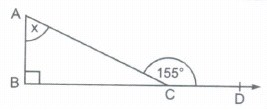
In \(\triangle\)ABC, \(\angle\)x=________________.
13.
For a \(\triangle\)ABC, \(\angle\)A + \(\angle\)B + \(\angle\)C =________________
14.
Two rectangles are congruent, if they have same ________ and________.
15.
In an isosceles triangle, two angles are always__________.
16.
The reciprocal of ____________does not exist.
17.
The area of a rectangle is 200 cm2. If its breadth is 20 cm, then its length is _____ cm.
18.
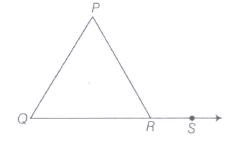
In the following figure, \(\angle PRS=\angle QPR+\)____________.
19.
\(\frac { -5 }{ 6 } +\frac { -1 }{ 6 }\)=_________
20.
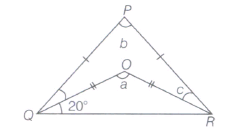
In the following figure,\(\triangle PQR\ and \triangle OQR\) are isosceles triangles and \(\angle a=2\angle b.\)Find \(\angle c\).
21.
Find the sum of \(\frac { 4 }{ 7 } +\frac { -8 }{ 9 } +\frac { -5 }{ 21 } +\frac { 1 }{ 3 } \).
22.
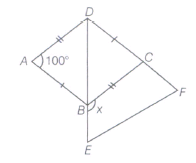
In the following figure, ABII CO. Find the value of \(\angle X\)
1.
770 cm2
2.
\(\frac { 181 }{ 45 } \)
3.
Given, base of a parallelogram = 2 cm
and height of a parallelogram = 4.4 cm
\(\therefore\) Area of a parallelogram = Base x Height
= 2 x 4.4 = 8.8 cm2.
4.
99 m2
5.
\(\angle Z=75^0\)
6.
50°
7.
114
8.
()
\(\frac { -3 }{ 5 } \)
9.
()
\(\frac{3}{2}\sqrt{3}\)
10.
()
(-1)
11.
()
\(\frac{13}{17}\)
12.
()
65o
13.
The measure of each angle of an equilateral triangle is_____________
14.
()
Length, breadth
15.
()
Equal/acute (anyone)
16.
()
0 (zero)
17.
()
10
18.
()
\(\angle PQR\)
19.
\(\frac { -5 }{ 6 } +\frac { -1 }{ 6 } =\frac { -5-1 }{ 6 } =\frac { -6 }{ 6 } =\)-1
20.
\(\angle c=35^0\)
21.
Given,\(\frac { 4 }{ 7 } +\frac { -8 }{ 9 } +\frac { -5 }{ 21 } +\frac { 1 }{ 3 } \)
For same denominator
LCM of 7,9,21 and 3 is 63,\(\)
\(\frac { 4\times 9 }{ 7\times 9 } =\frac { 36 }{ 63 } \),\(\frac { -8\times 7 }{ 9\times 7 } =\frac { -56 }{ 63 } \)
\(\frac { -5\times 3 }{ 21\times 3 } =\frac { -15 }{ 63 } \) , \(\frac { 1\times 21 }{ 3\times 21 } =\frac { 21 }{ 63 } \)
\(\therefore \)\(\frac { 4 }{ 7 } +\frac { -8 }{ 9 } +\frac { -5 }{ 21 } +\frac { 1 }{ 3 } =\frac { 36 }{ 63 } +\frac { -56 }{ 63 } +\frac { -15 }{ 63 } +\frac { 21 }{ 63 } \)
So,\(\frac { 36+(-56)+(-15)+(21) }{ 63 } \)
\(=\frac { 36+21+(-56)+(-15) }{ 63 } =\frac { 57+(-71) }{ 63 } \)
\(=-\frac { 14 }{ 63 } =\frac { -2 }{ 9 } \)
22.
\(\angle X=140^0\)

7th Standard CBSE Syllabus & Materials
7th Standard CBSE
CBSE 7th Social Science Theme B - New Beginnings : Cities and States - New Sample Question Papers Study Material - QB365 Set A
NEW7th Standard CBSE
CBSE 7th Social Science Theme A - Climates of India - New Sample Question Papers Study Material - QB365 Set A
NEW7th Standard CBSE
CBSE 7th Social Science Theme A - Geographical Diversity of India - New Sample Question Papers Study Material - QB365 Set A
NEW7th Standard CBSE
CBSE 7th Science Earth, Moon and the Sun - New Sample Question Papers Study Material - QB365 Set A



NCERT Books

Syllabus

Exam Pattern

Sample Question Papers

Previous year Question Papers

Important Notes

MCQ Practice test

NCERT Exemplers

Case study Questions

Image Based Questions

Passage based Questions

HOT Questions

Value Based Questions

Model Questions Papers
NCERT ( Book Back ) Questions

Assertion and Reason
Important Questions And Answers

CBSE 7th Standard CBSE Subjects
CBSE Standards


