
 100% FREE ACCESS
7th Standard CBSE Syllabus & Materials
7th Standard CBSE
CBSE 7th Social Science Theme E - Understanding Market - New Sample Question Papers Study Material - QB365 Set A
NEW7th Standard CBSE
CBSE 7th Social Science Theme E - From Barter to Money - New Sample Question Papers Study Material - QB365 Set A
NEW7th Standard CBSE
CBSE 7th Social Science Theme D - The Constitution of India- An Introduction - New Sample Question Papers Study Material - QB365 Set A
NEW7th Standard CBSE
CBSE 7th Social Science Theme D - From the Rulers to the Ruled : Types of Governments - New Sample Question Papers Study Material - QB365 Set A
NEW7th Standard CBSE
CBSE 7th Social Science Theme B - The Age of Reorganisation - New Sample Question Papers Study Material - QB365 Set A
NEW7th Standard CBSE
CBSE 7th Social Science Theme B - The Rise of Empires - New Sample Question Papers Study Material - QB365 Set A

Published on: 31/10/2019
Download CBSE Class 7th Standard CBSE Mathematics question papers, sample papers, important questions, and previous year solved papers in PDF format. Get free study materials, NCERT solutions, and exam preparation resources for Class 7th Standard CBSE Mathematics
Questions + Answers key
Take MCQ Mathematics Test
1.
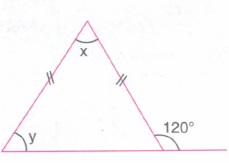
Find angles x and y in each figure.
2.
A diagonal of a quadrilateral is 40 em and the lengths of perpendiculars to it from the opposite vertex are 6.6 em and 8.4 em. Find the area of the quadrilateral.
3.
If the cost price of 6pens is equal to the selling price of 4 pens, Then find the gain per cent.
4.
Consider the following parallelograms with sides 7 cm and 5 cm each
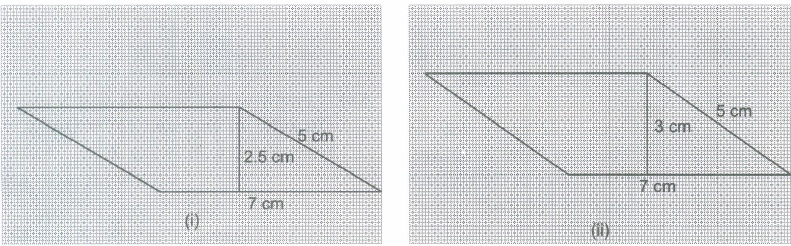
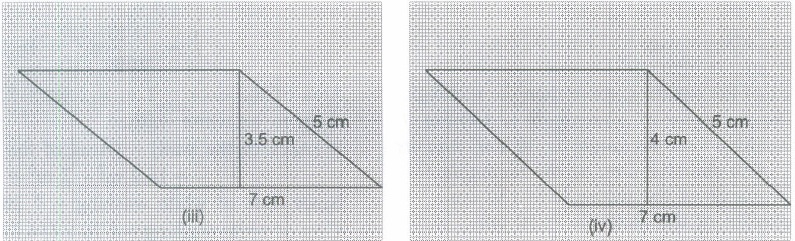
Find the perimeter and area of each of these parallelograms.
5.
Simplify:
(a) \(\frac{12^4\times 9^3\times 4}{6^3\times 8^2\times 27}\)
(b) 23 x a3 x 5a4
6.
5. If (25)n-1 + 100 = 5(2n-1), find the value of n.
7.
How much pure alcohol must be added to 400 ml of a 15% solution to make its strength 32%.
8.
If \(\frac { 2x-3 }{ 5 } +\frac { x+3 }{ 4 } =\frac { 4x+1 }{ 7 } \) , find the value of x.
9.
In an examination, 72% of the total examinees passed. If the number of failures is 392, find the total number of examinees.
10.
Write four numbers in the following pattern :
\(\frac { -1 }{ 3 } ,\frac { -2 }{ 6 } ,\frac { -3 }{ 9 } '\frac { -4 }{ 12 } ,...\)
1.
(i) x + y = 1200 ...(1)
The exterior angle of a triangle is equal to the sum of its two interior opposite angles
x + y + y = 1800
Base angles opposite to the equal sides of an isosceles triangle are equal and the sum of the measures of the three angles of a triangle is 1800
\(\Rightarrow\)x + 2y = 1800 ... (2)
Subtracting equation (1) from equation (2),
y = 60°
Put y = 60° in equation (1),
x + 60° = 120°
\(\Rightarrow\)x = 120° - 60°
\(\Rightarrow\)x = 60°
2.
Let ABCD be the quadrilateral in which AC is a diagonal, such that AC = 40 cm
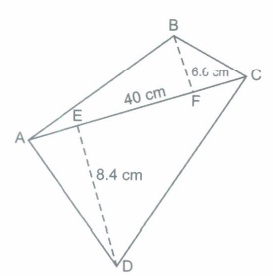
Suppose DE \(\bot \) AC and BF \(\bot \) AC, such that
DE = 8.4 cm and BF = 6.6 cm.
Now, area of the quadrilateral ABCD
= [Area of \(\Delta\)ABC] + [Area of \(\Delta\)ADC]
=\(\left[ \frac { 1 }{ 2 } \times AC\times BF \right] \)+\(\left[ \frac { 1 }{ 2 } \times AC\times DE \right] \)
=\(\left[ \frac { 1 }{ 2 } \times 40cm\times 66cm\right] \)+\(\left[ \frac { 1 }{ 2 } \times 40cm\times 8.4cm\right] \)
=\(\left[ \frac { 1 }{ 2 } \times 40\times \frac { 66 }{ 10 } { cm }^{ 2 } \right] \)+\(\left[ \frac { 1 }{ 2 } \times 40\times \frac { 84 }{ 10 } { cm }^{ 2 } \right] \)
= [2 x 66 cm2] + [2 x 84 cm2]
= 132 cm2 + 168 cm2 = 300 cm2
Thus, the area of the quadrilateral ABCD = 300 cm2.
3.
Let the cost price of each pen be Rs.1.
∴ CP of 6 pens = Rs.6
CP of 4 pens =Rs.4
∴ SP of 4 pens = [CP of 6 pens] = Rs.6
⇒Gain = Rs.6 - Rs.4 = Rs.2
Gain per cent = \({2\over 4}\times100\%\)
[∵ Gain% = \({gain\over CP}\)x 100%]]
\(={2\times25\over1}\%=50\%\)
4.
| Parallelogram | Perimeter | Area |
| (i) (ii) (iii) (iv) |
2(7 + 5) cm = 24 cm 2(7 + 5) cm = 24 cm 2(7 + 5) cm = 24 cm 2(7 + 5) cm = 24 cm |
7 x 2.5 sq. cm = 17.5 sq. cm 7 x 3 sq. cm = 21 sq. cm 7 x 3.5 sq. cm = 24.5 sq. cm 7 x 4 sq. em = 28 sq. cm |
Here, we observe that the parallelogram having same perimeters ean have different areas.
5.
(a) \(\frac{12^4\times 9^3\times 4}{6^3\times 8^2\times 27} =\frac{(3\times 2^2)^4\times (3^2)^3\times 2^2}{(2\times 3)^3\times (2^3)^2\times 3^3}\)
\(=\frac{3^4\times 2^8\times 3^6\times 2^2}{2^3\times3^3\times2^6\times3^3}\)
\(=\frac{2^{8+2}\times 3^{6+4}}{2^{6+3}\times 3^{3+3}}\)
\(=\frac{2^{10}\times 3^{10}}{2^9\times 3^6}=2^{10-9}\times 3^{10-6}\)
= 2 x 34 = 2 x 81 = 162.
(b) 23 x a3 x 5a4
= 8 x a3 x 5 x a4
= 8 x 5 x a3 x a4
= 40 x a3 + 4
= 40 x a7
= 40a7.
6.
(25)n-1 + 100 = 5(2n-1)
⇒ (52)n-1 + 100 = 5(2n-1)
⇒ 52n-2 + 100 = 52n-1
⇒ 52n-2 - 52n-1 = - 100
⇒ 52n - 1 - 52n- 2 = 100
⇒ 52n-2 x (5 -1) = 100
⇒ 52n-2 x 4 = 100
\(⇒\ 5^{2n-2}={100\over 4}=25\)
Thus, 52n- 2 = 52
As base is same on both the sides
∴ 2n-2 = 2
⇒ 2n=2+2
⇒ 2n = 4
\(⇒\ n={4\over 2}=2\)
7.
Quantity of pure alcohol in 400 ml. of 15% = 400 \(\times \frac { 15 }{ 100 } \)
= 60 ml
Now, we add x ml of pure alcohol to the sample.
So, total pure alcohol = (60 + x) ml.
But volume of new sample = (400 + x) ml.
\(\therefore\) Percentage of pure alcohol in new sample \(=\frac { (60+x) }{ (400+x) } \times 100\)
which is equal to 32%
\(\Rightarrow \quad \frac { 60+x }{ 400+x } \times 100=32\)
\(\Rightarrow \quad \frac { 60+x }{ 400+x } =\frac { 32 }{ 100 } \)
\(\Rightarrow\) 100(60 + x) = 32 (400 + x)
\(\Rightarrow\) 100x + 6000 = 32x + 12800
\(\Rightarrow\) 100x-32x = 12800 - 6000
\(\Rightarrow\) 68x = 6800
\(\Rightarrow \ x=\frac { 6800 }{ 68 } =100\ ml\)
8.
Given, \(\frac { 2x-3 }{ 5 } +\frac { x+3 }{ 4 } =\frac { 4x+1 }{ 7 } \)
\(\Rightarrow \quad \frac { 4(2x-3) }{ 5\times 4 } +\frac { 5(x+3) }{ 5\times 4 } =\frac { 4x+1 }{ 7 } \)
\(\Rightarrow \quad \frac { 8x-12 }{ 20 } +\frac { 5x+15 }{ 20 } =\frac { 4x+1 }{ 7 } \)
\(\Rightarrow \quad \frac { 8x-12+5x+15 }{ 20 } =\frac { 4x+1 }{ 7 } \)
\(\Rightarrow \quad \frac { 13x+3 }{ 20 } =\frac { 4x+1 }{ 7 } \)
\(\Rightarrow\) 7(13x + 3) = 20(4x + 1)
\(\Rightarrow\) 91x + 21 = 80x + 20
\(\Rightarrow\) 91x - 80x = 20 - 21
\(\Rightarrow\) 11x = -1
Thus, \(x=-\frac { 1 }{ 11 } \)
9.
Let the number of students = 100
Passed students = 12
Hence, failed students = 100 - 12 = 28
\(\because \) When failed are 28, then total no. of students
=100
\(\because \)When failed are 392, then total no. of students
=\(\frac { 100 }{ 28 } \times \)392
=1400
10.
Given pattern is
\(-\frac { 1 }{ 3 } ,\frac { 2 }{ 6 } ,\frac { 3 }{ 9 },-\frac { 4 }{ 12 } ...\)
Here, \(-\frac { 1 }{ 3 } =\frac { (-1)\times 1 }{ 3\times 1 } \)
\(-\frac { 2 }{ 6 } =\frac { (-1)\times 2 }{ 3\times 2 } \)
\(-\frac { 3 }{ 9 } =\frac { (-1)\times 3 }{ 3\times 3 } \)
and \(-\frac { 4 }{ 12 } =\frac { (-1)\times 4 }{ 3\times 4 } \)
Hence, next four numbers are
\(\frac { (-1)\times 5 }{ 3\times 5 } =-\frac { 5 }{ 15 } \)
\(\frac { (-1)\times 6 }{ 3\times 6 } =-\frac { 6 }{ 18 } \)
\(\frac { (-1)\times 7 }{ 3\times 7 } =-\frac { 7 }{ 21 } \)
\(\frac { (-1)\times 8 }{ 3\times 8 } =-\frac { 8 }{ 24 } \).

7th Standard CBSE Syllabus & Materials
7th Standard CBSE
CBSE 7th Social Science Theme B - New Beginnings : Cities and States - New Sample Question Papers Study Material - QB365 Set A
NEW7th Standard CBSE
CBSE 7th Social Science Theme A - Climates of India - New Sample Question Papers Study Material - QB365 Set A
NEW7th Standard CBSE
CBSE 7th Social Science Theme A - Geographical Diversity of India - New Sample Question Papers Study Material - QB365 Set A
NEW7th Standard CBSE
CBSE 7th Science Earth, Moon and the Sun - New Sample Question Papers Study Material - QB365 Set A



CBSE 7th Standard CBSE Subjects
CBSE Standards




