
 100% FREE ACCESS
7th Standard CBSE Syllabus & Materials
7th Standard CBSE
CBSE 7th Social Science Theme E - Understanding Market - New Sample Question Papers Study Material - QB365 Set A
NEW7th Standard CBSE
CBSE 7th Social Science Theme E - From Barter to Money - New Sample Question Papers Study Material - QB365 Set A
NEW7th Standard CBSE
CBSE 7th Social Science Theme D - The Constitution of India- An Introduction - New Sample Question Papers Study Material - QB365 Set A
NEW7th Standard CBSE
CBSE 7th Social Science Theme D - From the Rulers to the Ruled : Types of Governments - New Sample Question Papers Study Material - QB365 Set A
NEW7th Standard CBSE
CBSE 7th Social Science Theme B - The Age of Reorganisation - New Sample Question Papers Study Material - QB365 Set A
NEW7th Standard CBSE
CBSE 7th Social Science Theme B - The Rise of Empires - New Sample Question Papers Study Material - QB365 Set A

Published on: 03/10/2019
Light
Download CBSE Class 7th Standard CBSE Science question papers, sample papers, important questions, and previous year solved papers in PDF format. Get free study materials, NCERT solutions, and exam preparation resources for Class 7th Standard CBSE Science
Questions + Answers key
Take MCQ Science Test
1.
Draw the ray diagrams formed by a concave mirror under three different positions of the objects.
2.
A jug placed facing a plane mirror. Draw the position or image of jug.
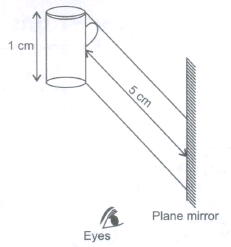
Answer the following questions:
(i) What is the size of the image of the jug?
(ii) What is the distance between image of jug and mirror?
3.
Give one use of all mirrors and lenses.
4.
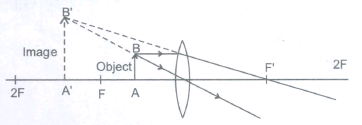
Draw the ray diagram formed by a convex lens under three different positions of the object.
5.
Give the properties of the images formed by the following:
(i) Plane mirror
(ii) Concave mirror
(iii) Convex mirror
(iv) Concave lens
(v) Convex lens.
6.
Last Sunday Girish's mother, Priyanka was preparing the dinner in her kitchen for Girish and his father. Both of them were feeling so much hungry and they sat ideally on their respective chairs and having empty plates and spoons on their dinning table. They were shouting like a 5 years old child that they wanted the dinner so much eagerly in order to fulfil their stomach. At the sometime, Girish's mother served the cooked food to both of them and the moment, when Girish was just about to eat the rice with the help of spoon, he noticed that the spoon has such a shining surface that it reflected the light rays incident on it.
(a) Explain the importance of shining surface in the reflection of light.
(b) Name the type of spherical mirror represented by the shining steel spoon.
(c) Mention the values shown by Priyanka here towards her family.
7.
One day, Ramesh's friend was performing their respective experiments given by their teacher. While sitting in the practical lab instead of performing experiment, Ramesh was playing with his meter scale. All the sudden, he held the scale in his hand and started moving in front of tubelight, then he observed the seven colours of white light. After sometimes, he got scolded by his lab teacher for not performing the experiment.
(a) Give the name of phenomenon that leads to the formation of band of seven colours.
(b) Name the constituent colours of white light.
(c) Mention the values shown by Ramesh here.
8.
Namit was driving a car and suddenly became aware of a loud sound coming from behind. He looked through his rear view mirror and saw an ambulance. He recalled reading that such emergency vehicles often have their name written in the mirror (AMBULANCE) or writing,
i.e. 3 J VI A J U 8 M A.
He quickly made way for the ambulance, murmuring a quick prayer for the speedy recovery of the patient inside the ambulance.
(a) Name the type of mirror which is used as a rear view mirror and why?
(b) Mention values did Namit exhibit.
9.
You are given three mirrors of different types. How will you identify each one of them?
10.
It was observed that when the distance between an object and a lens decreases, the size of the image increases. What is the nature of this lens? If you keep on decreasing the distance between the object and the lens, will you still able to obtain the image on the screen? Explain
1.
(a) When the object is far away from the mirror.
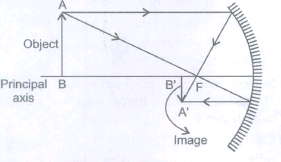
The image is inverted, real and smaller in size.
(b) When the object is little away from focal point.
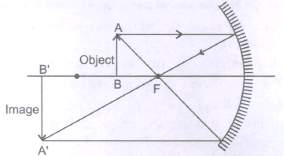
The image is real, inverted and magnified.
(c) When the object is between focal point and centre of mirror.
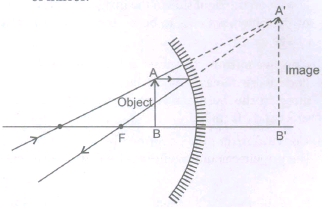
2.
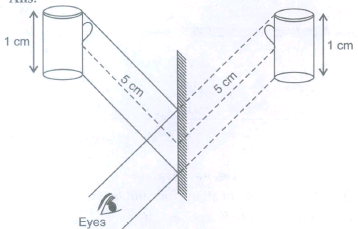
(i) Size of image of jug is 1cm.
(ii) Distance between image of jug and mirror is 5 cm.
3.
(a) Plane Mirror
It is used as a looking glass. It is used as reflector in solar cookers.
(b) Concave Mirror
(i) Doctors use concave mirror for examining eyes, ears, nose and throat.
(ii) Concave mirrors are also used by dentists to see an enlarged image of the teeth.
(iii) The reflectors of torches, headlights of cars and scooters are concave in shape.
(c) Convex Mirror
Convex mirror is used as a side view mirror. These help the drivers to see the traffic behind them.
(d) Convex Lens
(i) It is used as a magnifying glass in microscopes, telescopes etc.
(ii) Used in spectacles to correct far sightedness.
(e) Concave Lens
(i) It can be used to correct short sightedness in spectacles.
4.
(a) When the object is far away the image is real, inverted and smaller in size.
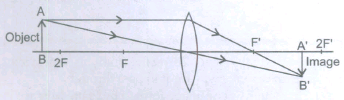
(b) When the object is between F and radius lens, the image is real, inverted but bigger in size.
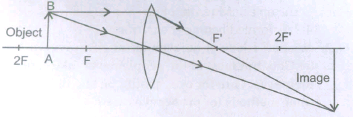
(c) When the object is near to the lens. The image is real, inverted and much bigger (magnified).
5.
(i) Plane mirror:
The image formed by a plane mirror is always erect. It is virtual and is of the same size as the object. The image is at the same distance behind the mirror as the object is in front of it. In an image formed by a mirror, the left side of the object is seen on the right side in the image, and right side of the object appears to be on the left side in the image.
(ii) Concave mirror:
A concave mirror can form a real and inverted image. When the object is placed very close to the mirror, the image formed is virtual, erect and magnified.
(iii) Convex mirror:
Image formed by a convex mirror is erect, virtual and smaller in size than the object.
(iv) Concave lens:
A concave lens always forms erect, virtual and smaller in than the object.
(v) Convex lens:
A convex lens can form real and inverted image. When the object is placed very close to the lens, the image formed is virtual, erect and magnified. When used to see magnified objects, the convex lens is called a magnifying glass.
The image is virtual, erect and magnified.
6.
(a) As we know that the extent of reflection depends upon the shining of surface. So, greater the shining of the surface, more will be the reflection.
(b) Both convex and concave mirrors are represented by the shining steel spoon.
(c) The values shown by Priyanka here is concern and a satisfaction that she gets after serving the cooked food to her son
and her husband.
7.
(a) Dispersion of white light is the name of phenomenon which leads to the formation of band of seven colours.
(b) There are seven constituent colours of white light, they are Violet, Indigo, Blue, Green, Yellow, Orange, Red (i.e. VIBGYOR).
(c) Ramesh seems to be quite innovative with respect to the scientific methods and also very eager to learn science regarding phenomena.
8.
(a) Convex mirror is a mirror which is used as a rearview mirror. It is used to get a wide view of traffic behind.
(b) The values exhibit by Namit here is courtesy concerned for other, sympathy, knowledgeable.
9.
We can identify the mirrors by forming image of an object.
(i) Plane mirror In case of plane mirror, image will be virtual, erect and of same size as that of object.
(ii) Concave mirror In case of concave mirror, image may be real, virtual and magnified or diminished.
(iii) Convex mirror In case of convex mirror, image formed will always be virtual, erect and diminished.
10.
On decreasing the distance between the object and lens, the size of the image increases, the nature of the lens will be convex type.
If the distance between object and lens is less than the focus of the lens, then it forms a virtual image and this image cannot be obtained on a screen but formed on the same side of the object.

7th Standard CBSE Syllabus & Materials
7th Standard CBSE
CBSE 7th Social Science Theme B - New Beginnings : Cities and States - New Sample Question Papers Study Material - QB365 Set A
NEW7th Standard CBSE
CBSE 7th Social Science Theme A - Climates of India - New Sample Question Papers Study Material - QB365 Set A
NEW7th Standard CBSE
CBSE 7th Social Science Theme A - Geographical Diversity of India - New Sample Question Papers Study Material - QB365 Set A
NEW7th Standard CBSE
CBSE 7th Science Earth, Moon and the Sun - New Sample Question Papers Study Material - QB365 Set A



CBSE 7th Standard CBSE Subjects
CBSE Standards




