
 100% FREE ACCESS
7th Standard CBSE Syllabus & Materials
7th Standard CBSE
CBSE 7th Social Science Theme E - Understanding Market - New Sample Question Papers Study Material - QB365 Set A
NEW7th Standard CBSE
CBSE 7th Social Science Theme E - From Barter to Money - New Sample Question Papers Study Material - QB365 Set A
NEW7th Standard CBSE
CBSE 7th Social Science Theme D - The Constitution of India- An Introduction - New Sample Question Papers Study Material - QB365 Set A
NEW7th Standard CBSE
CBSE 7th Social Science Theme D - From the Rulers to the Ruled : Types of Governments - New Sample Question Papers Study Material - QB365 Set A
NEW7th Standard CBSE
CBSE 7th Social Science Theme B - The Age of Reorganisation - New Sample Question Papers Study Material - QB365 Set A
NEW7th Standard CBSE
CBSE 7th Social Science Theme B - The Rise of Empires - New Sample Question Papers Study Material - QB365 Set A

Published on: 03/10/2019
Respiration in Organisms
Download CBSE Class 7th Standard CBSE Science question papers, sample papers, important questions, and previous year solved papers in PDF format. Get free study materials, NCERT solutions, and exam preparation resources for Class 7th Standard CBSE Science
Questions + Answers key
Take MCQ Science Test
1.
A group of people were smoking cigarettes in a restaurant. The atmosphere was full of smoke. An old man sitting next to the group asked them to stop smoking while sitting in the premise or move out. They agreed to do so and promised not to repeat then mistake.
Answer the following questions.
(a) Write any three hazards of smoking.
(b) Can smoking also affect the person who does not smoke?
(c) Do you support the group's decision to not smoke in public or indiviually. What values do we understand from here.
2.
A person put some warm water in an aquarium having fish during winter season. He thought that fish will be more comfortable in luke warm water than cold water. But he observed that fishes in the aquarium died. Why the fishes died in warm water?
3.
Palak wants to be a great cyclist. She cycles daily for about 2 hours followed by some exercises. Today, she thought she will cycle for longer and managed it for 4Y2 hours. Now she is feeling cramped up and her breathing is disturbed. Her mother took her to hospital where the doctor examined and told her not to push herself more than necessary. Palak understood and promised herself to move show and steadily.
(a) Why did Palak had cramps in her legs?
(b) Is breathing rate also affected after doing long hour of exercise. Why?
(c) When there is not enough oxygen supply, what happens to body and process of respiration? What values you learn from this?
4.
List some animals around you. Now group them as follows:
(a) Animals that can breathe only through skin.
(b) The animal that can breathe through skin as well as through lungs.
(c) The animal that can breathe through lungs.
(d) Animals that can breathe through gills.
(e) Animals that can breathe through spiracle and tracheae?
5.
Observe the given figures as A and Band answer the following questions
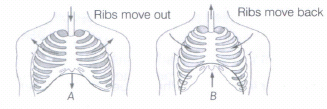
(a) Among both figures identity which A or B indicates the process of inhalation and which shows the process of exhalation?
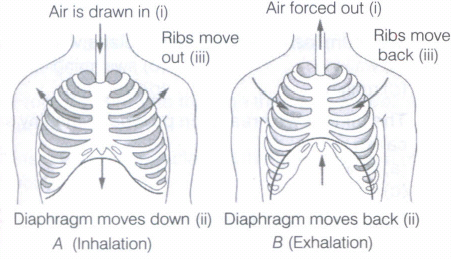
(b) In the figure label the arrows and indicate the direction of
(i) movement of air (ii) movement of diaphragm (iii) movement of ribs
6.
(a) Respiratory process occurs in two phases, what are those two major steps of respiration? Describe each one.
(b) Define the term breathing rate.
7.
Observe the figures carefully and answer the following questions.
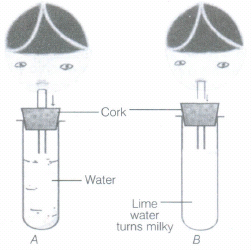
(a) Which process is being tested in the activity?
(b) What is the result of the activity? Give reasons.
8.
It is not wise to sleep under a tree during night. Why?
9.
Paheli participated in a 400 m race competition held at her school and won the race. When she came home she had mixed feelings of joy and pain as she had cramps in her leg muscles. After a massage, she was relieved of the pain. Answer the following questions related to the situation.
(a) What can be the possible reasons for the pain in her legs?
(b) Why did she fell comfortable after a massage?
10.
(a) Plants lack a specialised respiratory system. How do they carry out respiratory process? Explain.
(b) The plant roots being underground respire by using which mechanism?
1.
(a) Smoking is very injurious for the respiratory system. It harms lungs.
(i) It causes blockage in the respiratory tract.
(ii) It leads to lung cancer.
(iii) It can cause disease like asthma and heart diseases.
(b) Yes, smoking affects people who are passive smokers, i.e. those present nearby smokers.
(c) Yes, the people should bot smoke in public areas as it can cause discomfort to others. The values we understand are obedience, respect elders and healthy habits.
2.
The fishes have special type of organs for respiration called gills. These gills absorbs oxygen dissolved in water and through blood vessels, this oxygen is passed to all the parts of the body. The amount of dissolved oxygen is comparatively less in water than the amount of oxygen in air. Therefore, the rate of breathing is also high in aquatic animals.
If we add warm water, to the aquarium the dissolved oxygen will dissociate and move into the atmosphere again, leaving the least percentage of oxygen into the water (as it is known that the solubility of gases in water goes down as the temperature rises). Therefore, fishes will have difficulty in breathing in the absence of oxygen and will die.
3.
(a) Due to extensive exercise, formation of lactic acid occurred as muscles starts to respire anaerobically.
(b) Yes, breathing rate will be faster. Normally we are breathing at a slower rate but during physical activities, to make sufficient amount of O2 reaching cells we breathe faster.
(c) The body starts respiring anaerobically in the absence of sufficient oxygen. Glucose is partially broken into lactic acid which causes body cramps. Values learned - We should not force ourselves exercise but not over burn yourself discipline.
4.
(a) Animals that can breathe only through skin are earthworm and leech.
(b) Animals that can breathe through skin as well as through lungs are frogs.
(c) Animals that can breathe through lungs are buffaloes, human, and dolphins.
(d) Animals that can breathe through gills are tadpole and fish.
(e) Animals that can breathe through spiracles and tracheae are grasshopper, cockroaches, ants, housefly and mosquito.
5.
(a) Figure A indicates inhalation and figure B indicates exhalation.
(b) Movement of air, diaphragm and ribs are indicated in below figure
6.
(a) Respiration is the process of breakdown of food to produce energy for performing various functions. It involves two major steps:
(i) Inhalation is the process of taking in of air which is rich in oxygen, inside our body.
(ii) Exhalation is the process of giving out of air which is rich in carbon dioxide from our body to the external environment.
(b) The number of times a person breathes, in a minute is called as breathing rate. An adult human being can inhale or exhale 15-18 times in a minute. It is the average breathing rate of an adult human being. Breathing rate is not constant always.
7.
(a) Exhalation process of respiration is being tested in the activity.
(b) The lime water in test tube B turns milky but water in test tube A remains unchanqed Because CO2 is present in the exhaled air, it mixes with lime water in test tube B and turns it milky.
8.
During day, plants photosynthesise in the presence of sunlight and uses CO2 produced during respiration. During this process O2 is released as a byproduct and a balance between O2 and CO2 is maintained in the atmosphere. But in the night. plants do not photosynthesise. Plants are unable to use CO2 during night and produces CO2 and takes O2 during respiration. This leads to the increase in the proportion of CO2 in the air.
So, if one sleeps under a tree at night. he will have problems in breathing as the amount of CO2 in the air around will certainly be more than oxygen. Therefore, it is not advisable to sleep under trees during night because the person will suffer from suffocation and feel excess weight on chest.
9.
(a) Paheli had cramps in her leg muscles after running. She felt pain in her legs because of accumulation of lactic acid in the leg muscles. Lactic acid is formed due to anaerobic respiration in the muscle cells after heavy exercise or running. After heavy exercise, we require large amount of energy.
To produce more energy to meet the oxygen requirement of muscles, muscle cells perform anaerobic respiration for a short duration. Lactic acid is formed due to partial breakup of glucose. It gets accumulated in the muscle cells and causes pain and muscle cramps.
(b) The massage or hot water bath gives the relief from muscle cramp or pain, because it improves the circulation of blood leading to increase supply of oxygen to the muscle cells . It helps in complete breakdown of lactic acid into carbon dioxide and water
10.
(a) The plants do not possess any respiratory system still plants respire. The various parts of the plants like leaves, roots, etc., carry out respiration independently.
These parts take in oxygen from air in different manner and utilise it to obtain energy and give out CO2, The leaves of plants possess tiny pores on their surface which is called as stomata. The gaseous exchange during respiration takes place through their stomata.
(b) Roots of the plants respire under the ground. Root cells get oxygen from the air present in the space between the soil particles.
There are several root hairs present on the roots of a plant.
The oxygen from the air (between soil particle) diffuses into root hair and reaches to the cells of the roots. This oxygen is utilised for respiration.

7th Standard CBSE Syllabus & Materials
7th Standard CBSE
CBSE 7th Social Science Theme B - New Beginnings : Cities and States - New Sample Question Papers Study Material - QB365 Set A
NEW7th Standard CBSE
CBSE 7th Social Science Theme A - Climates of India - New Sample Question Papers Study Material - QB365 Set A
NEW7th Standard CBSE
CBSE 7th Social Science Theme A - Geographical Diversity of India - New Sample Question Papers Study Material - QB365 Set A
NEW7th Standard CBSE
CBSE 7th Science Earth, Moon and the Sun - New Sample Question Papers Study Material - QB365 Set A



CBSE 7th Standard CBSE Subjects
CBSE Standards




