
 100% FREE ACCESS
7th Standard CBSE Syllabus & Materials
7th Standard CBSE
CBSE 7th Social Science Theme E - Understanding Market - New Sample Question Papers Study Material - QB365 Set A
NEW7th Standard CBSE
CBSE 7th Social Science Theme E - From Barter to Money - New Sample Question Papers Study Material - QB365 Set A
NEW7th Standard CBSE
CBSE 7th Social Science Theme D - The Constitution of India- An Introduction - New Sample Question Papers Study Material - QB365 Set A
NEW7th Standard CBSE
CBSE 7th Social Science Theme D - From the Rulers to the Ruled : Types of Governments - New Sample Question Papers Study Material - QB365 Set A
NEW7th Standard CBSE
CBSE 7th Social Science Theme B - The Age of Reorganisation - New Sample Question Papers Study Material - QB365 Set A
NEW7th Standard CBSE
CBSE 7th Social Science Theme B - The Rise of Empires - New Sample Question Papers Study Material - QB365 Set A

Published on: 03/10/2019
Soil
Download CBSE Class 7th Standard CBSE Science question papers, sample papers, important questions, and previous year solved papers in PDF format. Get free study materials, NCERT solutions, and exam preparation resources for Class 7th Standard CBSE Science
Questions + Answers key
Take MCQ Science Test
1.
Explain the soil profile
2.
A soil sample having mass of 200 g was taken from garden.This soil was dried completely in the oven and again weight. The weight of the soil now was found to be 170 g. Calculate the percentage of water or moisture content present in the sample soil.
3.
During a field trip, some students visited an agricultural farm and saw a few birds eating earthworms. They enjoyed the scene and then they also started picking and killing the earthworms for pleasure. Seeing the crowd of students in a corner, the teacher rushed to them to see the matter and objected to their action. Anshul, one of the student asked the reason.
Teacher smiled and explained him that an earthworm living in the soil is very beneficial for farmers. Anshul wondered whether there were other organisms also in the soil. The teacher appreciated him and explained.
(a) Mention the importance of earthworm.
(b) List some organisms living in soil.
(c) What are the values shown by Anshul?
4.
The raw and baked soil differs from each other. How they are different? How can you prepare matkas from soil?
5.
Soil erosion does not occur easily where the land is covered by vegetation. Do you agree? Explain.
6.
In towns and cities, generally, the borewells have to be dug very deep to get water as compared to borewells dug in villages. Give suitable reasons.
7.
(a) Soil has various important component. Write them.
(b) Arrange the following rock particles which occur in soil in the increasing order. Silt, clay, gravel, sand.
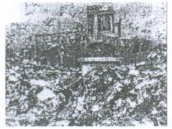
(c) Observe the following figure. What does this figure show?
8.
A soil sample was taken from an agricultural land and was weighed. The mass of the soil was found to be 50 g. 100 mL of water was taken in a measuring cylinder and added into the soil sample. The soil absorbed 80 mL of water and rest left in the measuring cylinder. Calculate the absorption rate of water by the soil.
9.
The contamination of soil with waste materials causes soil pollution. Does the use of pesticides in agriculture also contribute to the soil pollution? Explain.
10.
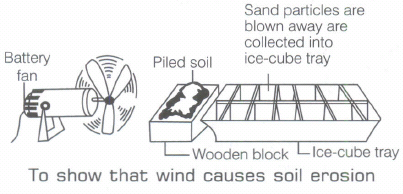
Design an activity to show the soil erosion on a barren land.
1.
The upper crust of the earth, which is capable of supporting vegetation is called soil. We usually see the surface of the soil. The sides of trench sides of a hill or steep river banks are clearly visible different zones or layers. The side-view of soil zones or layer is known as soil profile.
The upper most layer of the soil is called the A-horizon or top soil. It absorbs maximum water. The top soil consists of soil particles, minerals, water and humus. The decomposed organic matter (decayed plant and animal) remains forms a spongy and brownish or blackish material known as humus. The humus makes the soil very fertile. It also increases water holding capacity of the soil. Worms, insects, algae and fungi are found in the top soil. You will also find roots of plants in this layer. Plants get essential nutrients from the top through roots.
The second layer, called B-horizon, is more compact and harder than the top soil. It consists of sand, silt and clay. This layer contains very little organic matter. It is rich in soluble minerals and iron oxides.
The third zone, called C-horizon, consists of weathered rock. It is made up of small lumps of rocks with cracks and crevices. Below the C-horizon is found the bedrock.
2.
The moisture content of the soil can be calculated by the formula as follows
= \(\frac { mass\quad of\quad water\quad in\quad soil }{ original\quad mass\quad of\quad soil } \times 100\)
Given, Original mass of soil = 200 g
Mass of soil after drying = 170 g
Then mass of water in soil will
= 200 - 170 = 30 g
The percentage of water in soil will be
\(\frac { 30g }{ 200g } \times 100=15%\)
3.
(a) An earthworm helps in making the rich humus in soil.
(b) Ant, earthworm, termites, milipede, centipede, etc.
(c) Curiosity to learn and scientific attitude
4.
Raw soil differs from baked soil. The raw soil is white or dull blackish coloured soil. It contains water and air in it and can be moulded.
Baked soil is the heated raw soil which lost its water molecule due to heating and becomes red. Once the soil gets heated, it cannot be moulded into other form. Clay soil is used for making matkas, toys, pots, etc. The soil is kneaded along with horse dung to make best quality of raw clay soil. This kneaded soil is then placed on the wheel and appropriate shape is given. The final shape of the material is given with hands. The pots and matkas are then kept for drying for three days. These items are baked at high temperature after drying in air and then coloured.
5.
Ans. Yes, soil erosion does not occur easily where the land is covered by vegetation (trees and other plants). It occurs easily in those areas of land which are not covered by vegetation (trees and other plants) or have very little vegetation. If there is vegetation on land,
(i) then the roots of vegetation growing in the soil bind the particles of topsoil firmly. Due to this, the blowing wind and flowing rainwater are not able to carry away topsoil and hence soil erosion does not occur.
(ii) then much of the falling rain hits the trees and plants before it hits the soil. In this way, the cover of vegetation softens the effect of heavy rains on the soil
6.
The borewells have to be dug very deep to get water as compared to those in villages because
(i) excessive use of water depletes the groundwater.
(ii) towns and cities have asphalted roads and vast areas of soil are concreted. As a result, rainwater cannot percolate to recharge groundwater and the groundwater level further decreases. Villages have larger areas of open soil surface and fewer asphalted roads and concrete surfaces.
Thus, larger soil surface area is available for rainwater to percolate into the soil easily and recharge the groundwater. As a result, even shallow borewells yield
water.
7.
(a) The various important component of soil are air, water, rock particles, minerals,
humus and living organisms like bacteria fungi, worms (earthworm), rodents, insects (ant and beetle), etc.
(b) The increasing order of rock particles are
Clay \(\rightarrow\) Silt \(\rightarrow\) Sand \(\rightarrow\) Gravel
(c) The figure shows waste rnaterial like polythene bags, plastics, glass and metal objects are dumped which causes soil pollution.
8.
The absorption rate of water by soil can
be calculated by the formula as follows:
Absorption rate = - (V1) initial volume of water
(V2)final = \(\frac { volume\quad of\quad water }{ mass\quad of\quad soil(w) } x100\)
\(\frac { { V }_{ 1 }-{ V }_{ 2 } }{ w } \times 100\)
Given, initial volume of water = 100 mL
Final volume of water = 80 mL
Mass of the soil from agricultural land = 50 9
Therefore, the percentage absorbed
\(\frac { { V }_{ 1 }-{ V }_{ 2 } }{ w } \times 100=\frac { 100-80 }{ 50 } \times 100=\frac { 20 }{ 50 } \times 100=40%\)
40% of the water has been absorbed by the soil.
9.
The contamination of soil with waste materials especially used polythene bags and plastics, pesticides, fertilisers, acid rain industrial chemical wastes, etc., is called soil pollution
Pesticides are the poisonous chemical substances which are sprayed on standing crops to save them from the harmful insects and diseases. Some of these pesticides also mix up with the soil in the fields and pollute it. The grains, fruits and vegetables grown in this polluted soil contain pesticides. When we eat such contaminated grains, fruits or vegetables, the pesticides present in them damage our health also.
10.
Strong wind and rain can cause soil erosion from the barren land. This can be shown by performing an activity.
Take a wooden block and place some soil or sand on it. Keep an ice-cube tray at one end of the wooden black. Take a small battery-operated fan or hair dryer and hold it at the other end of the black near sand so that it blows the sand into the tray.
We will observe that when the fan blows it causes sand or soil particles to move and these get land in the various compartment of the ice-cube tray. This activity shows that the wind blows the soil on a barren land and may cause soil erosion.

7th Standard CBSE Syllabus & Materials
7th Standard CBSE
CBSE 7th Social Science Theme B - New Beginnings : Cities and States - New Sample Question Papers Study Material - QB365 Set A
NEW7th Standard CBSE
CBSE 7th Social Science Theme A - Climates of India - New Sample Question Papers Study Material - QB365 Set A
NEW7th Standard CBSE
CBSE 7th Social Science Theme A - Geographical Diversity of India - New Sample Question Papers Study Material - QB365 Set A
NEW7th Standard CBSE
CBSE 7th Science Earth, Moon and the Sun - New Sample Question Papers Study Material - QB365 Set A



CBSE 7th Standard CBSE Subjects
CBSE Standards




