
 100% FREE ACCESS
7th Standard CBSE Syllabus & Materials
7th Standard CBSE
CBSE 7th Social Science Theme E - Understanding Market - New Sample Question Papers Study Material - QB365 Set A
NEW7th Standard CBSE
CBSE 7th Social Science Theme E - From Barter to Money - New Sample Question Papers Study Material - QB365 Set A
NEW7th Standard CBSE
CBSE 7th Social Science Theme D - The Constitution of India- An Introduction - New Sample Question Papers Study Material - QB365 Set A
NEW7th Standard CBSE
CBSE 7th Social Science Theme D - From the Rulers to the Ruled : Types of Governments - New Sample Question Papers Study Material - QB365 Set A
NEW7th Standard CBSE
CBSE 7th Social Science Theme B - The Age of Reorganisation - New Sample Question Papers Study Material - QB365 Set A
NEW7th Standard CBSE
CBSE 7th Social Science Theme B - The Rise of Empires - New Sample Question Papers Study Material - QB365 Set A

Published on: 03/10/2019
Transpiration in Animals and Plants
Download CBSE Class 7th Standard CBSE Science question papers, sample papers, important questions, and previous year solved papers in PDF format. Get free study materials, NCERT solutions, and exam preparation resources for Class 7th Standard CBSE Science
Questions + Answers key
Take MCQ Science Test
1.
Pappu's grandpa felt a mild chest pain and was taken to a renowned cardiologist who immediately took ECG and set up a team to take proper care of grandpa. He got out of danger. Based on this passage answer the following questions:
(i) What might be the problem due to which grandpa suffered from chest pain?
(ii) What is the approximate size of our heart?
(iii) Why is he colour of blood red?
(iv) Which value is promoted by the doctor?
2.
What is blood?
(a) Write any two function of blood.
(b) Name the various component of blood.
3.
Explain the composition of blood.
4.
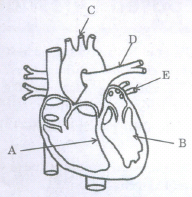
Label five parts (A to E) of heart and state their functions.
5.
Describe in brief the process of formation of urine and its elimination.
6.
Record your own pulse rate and heartbeat and that of your friends while resting and after running and record in Table.
7.
Read the following terms given below.
| root hairs | xylem | urethra |
| arteries | kidneys | veins |
| atria | capillaries | heart |
| ureter | phloem | urinary bladder |
Group the terms on the basis of the categories given below.
(a) Circulatory system of animals.
(b) Excretory system in human.
(c) Transport of substances in plants.
8.
While riding a bike, Mason fell from it due to loss of balance. He got up and realised that he was bleeding from several wounds badly. He panicked and started to run but Mansi who was looking at him, stopped him and told him to clean his wound with a clean cloth and that blood will stop coming in a while. Mason noticed that he has stopped bleeding after sometime and a hard covering was appearing on his wounds.
(a) Why did the bleeding stop after a while?
(b) What is blood and what type of cells are responsible for clotting?
(c) What of values do you think Mansi have?
9.
While learning to ride a bicycle, Boojho lost his balance and fell. He got bruises on his knees and it started bleeding. However, the bleeding stopped after sometime.
(a) Why did the bleeding stop?
(b) What would be the colour of the wounded area and why?
(c) Which type of blood cells are responsible for clotting of blood?
10.
Priya's grandfather was taken to the hospital as he was unable to perform excretory processes. Priya heard a nurse talking to her father that her grandfathers has kidney failure and needs to undergo dialysis. Priya later asked her father as to what is dialysis process and why does grandpa needs it. Her father smiles and tells her all the facts associated with this process.
(a) What do you mean by dialysis?
(b) Why is there a need for dialysis in some people?
(c) Excretion is an important life process. How?
(d) Which is the major excretory organ in humans?
(e) What values do you observe in Priya?
1.
(i) Problem might be in the blood circulation through the heart from different body organs and vice-versa.
(ii) Approximately the heart is of the size of our fist.
(iii) Blood is red in colour due to the red pigment known as haemoglobin.
(iv) Though it is the professional ethics, still as a human the doctor showed his awareness, application of common sense and above all his knowledge to save one's life.
2.
Blood is a fluid which flows in blood vessels.
(a) Functions of blood :
(i) It transports digested food from small intestine to all parts of the body.
(ii) It carries oxygen from lungs to cell.
(b) Components of blood:
(i) Fluid: Plasma
(ii) Cells: RBC,WBC, Platelets.
3.
Blood is a liquid which is composed of following two parts:
(i) Plasma: The fluid part of the blood is called plasma.
(ii) Cells: There are three kinds of cells suspended in the plasma of blood
(a) Red Blood cells (RBC): These cells contain a red pigment called haemoglobin. Haemoglobin binds with oxygen and transports it to all the parts of the body and ultimately to all cells. It will be difficult to provide oxygen efficiently to all the cells of the body without haemoglobin. Due to the presence of haemoglobin the blood appears red.
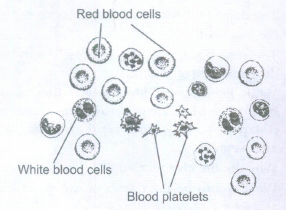
(b) Platelets: The third type of cells found in the blood are platelets. Their function is to form clot to prevent loss of blood when we are injured.
(c) White Blood Cells (WBC): WBCs fight against germs that may enter our body and thus protect us from infection.
4.
A-Septum between right and left side of heart. It prevents mixing of oxygenated and deoxygenated blood.
B-Left ventricle,which pumps oxygenated blood to body parts.
C-Aorta is the main artery emerging from left ventricle. It gives rise to other arteries which carry blood to different body parts.
D-Left auricles, which receives oxygenated blood from lungs and pushes it into left ventricle.
E-Pulmonary vein brings oxygenated blood from lungs to left auricle.
5.
Kidney have coiled structures (nephrons) surrounded by blood capillaries. When blood passes from them, all useful and harmful substance are filtered from blood. While passing through the capillaries all the useful substance present in filtered fluid are reabsorbed by blood. The waste product urine is then passed into urinary bladder through ureter. When the bladder is full, the same is removed through urethra.
6.
| Name of the student | While resting | After running | ||
| Heart beat | Pulse rate | Heart beat | Pulse rate | |
| Rekha | 70 | 70 | 90 | 90 |
| Raman | 71 | 71 | 95 | 95 |
| Priya | 70 | 70 | 89 | 89 |
| Madhu | 70 | 70 | 100 | 100 |
| Kusum | 72 | 72 | 110 | 110 |
| Alka | 70 | 70 | 96 | 96 |
7.
The terms on the basis of the categories can be grouped as follows
(a) Circulatory system of human
Arteries, atria, capillaries, veins, heart.
(b) Excretory system in human
Urethra, kidneys, ureter, urinary bladder.
(c) Transport of substances in plants
Root hairs, xylem, phloem.
8.
(a) Bleeding stops after some time because some specialised cells start forming a hard covering called clot at the site of wound.
(b) Bleeding is a fluid connective tissue present in all parts of the body. Platelets are responsible for formation of clot.
(c) Mansi is helpful, knowledgeable and interested in science subject.
9.
(a) When a cut or wound starts bleeding after some time, a clot is formed which plugs the cut and bleeding stops.
(b) Wounded area becomes dark red in colour due to clotting of blood.
(c) The blood clot is formed due to the presence of the cells called platelets in the blood.
10.
(a) Dialysis is the process used for cleaning of the blood by separating the waste products in an artificial medium.
(b) Dialysis is needed when the excretory organ of humans, i.e. kidney becomes damaged on unfunctional due to some injury or infection.
(c) Excretion process removes the waste products released in body after the utilisation of food and other components. These products are toxic and may harm us if not removed from our body.
(d) Kidney
(e) Priya is curious, sincere and aware eager to acquire new knowledge.

7th Standard CBSE Syllabus & Materials
7th Standard CBSE
CBSE 7th Social Science Theme B - New Beginnings : Cities and States - New Sample Question Papers Study Material - QB365 Set A
NEW7th Standard CBSE
CBSE 7th Social Science Theme A - Climates of India - New Sample Question Papers Study Material - QB365 Set A
NEW7th Standard CBSE
CBSE 7th Social Science Theme A - Geographical Diversity of India - New Sample Question Papers Study Material - QB365 Set A
NEW7th Standard CBSE
CBSE 7th Science Earth, Moon and the Sun - New Sample Question Papers Study Material - QB365 Set A



CBSE 7th Standard CBSE Subjects
CBSE Standards




