
 100% FREE ACCESS
7th Standard CBSE Syllabus & Materials
7th Standard CBSE
CBSE 7th Social Science Theme E - Understanding Market - New Sample Question Papers Study Material - QB365 Set A
NEW7th Standard CBSE
CBSE 7th Social Science Theme E - From Barter to Money - New Sample Question Papers Study Material - QB365 Set A
NEW7th Standard CBSE
CBSE 7th Social Science Theme D - The Constitution of India- An Introduction - New Sample Question Papers Study Material - QB365 Set A
NEW7th Standard CBSE
CBSE 7th Social Science Theme D - From the Rulers to the Ruled : Types of Governments - New Sample Question Papers Study Material - QB365 Set A
NEW7th Standard CBSE
CBSE 7th Social Science Theme B - The Age of Reorganisation - New Sample Question Papers Study Material - QB365 Set A
NEW7th Standard CBSE
CBSE 7th Social Science Theme B - The Rise of Empires - New Sample Question Papers Study Material - QB365 Set A

Published on: 31/10/2025
Download CBSE Class 7th Standard CBSE Science question papers, sample papers, important questions, and previous year solved papers in PDF format. Get free study materials, NCERT solutions, and exam preparation resources for Class 7th Standard CBSE Science
Questions + Answers key
Take MCQ Science Test
1.
What do you mean by soil treatment?
2.
Write three differences between an organic acid and a mineral acid.
3.
You are provided with liquids A, Band C. One contains NaOH, another contains HCI and third is sugar solution. You are given phenolphthalein solution. How will you identify these solutions?
4.
Which of the following are acidic and which are basic?
Lime water, Vinegar, Toothpaste, Stomach juices, Lemon juice, Baking soda solution, Milk of magnesia, Ammonia solution.
5.
Three liquids are given to you. One is hydrochloric acid, another is sodium hydroxide and third is a sugar solution. How will you identify them? You have only turmeric indicator.
6.
Sahyog wanted to taste the chemicals in the science lab to match their taste with that what is written in the textbook. Quickly his friend Pratik approaches the teacher and Sahyog was stopped to do so. Now answer the following questions:
(i) Why was Sahyog stopped to taste the chemicals?
(ii) What may happen if you directly put the unknown substance into your mouth unknowingly?
(iii) Which value of Pratik you can see here?
7.
What is litmus? How is it prepared?
8.
How will you test the presence of an acid in a substance?
9.
Form a sentence using the following words: baking soda, ant bite, moist, effect, neutralised, rubbing.
10.
Name the reaction when an acid is mixed with base.
11.
You are provided with four test tubes containing sugar solution, baking soda solution, tamarind solution, salt solution. Write down an activity to find the nature (acidic/basic/neutral) of each solution.
12.
Explain the following with examples:
(a) Acidic oxides
(b) Basic oxides
(c) Amphoteric oxides
(d) Neutral oxides
13.
State the nature of following solution and give effects of these solution on litmus paper.
(i) Detergent solution
(ii) Lime water
(iii) Soft drink
(iv) Sugar solution
(v) Vinegar.
14.
One day Rahul's mother after taking meal felt pain and irritation in her stomach. His father was out of station. Rahul was an intelligent boy. He remembered his teacher's statement and gave his mother some baking soda solution which gave her a relief from pain and irritation of the stomach.
Read the above passage and answer the following questions.
(a) Which information given by Rahul's teacher that helped him to select the baking soda as a remedy?
(b) Why he selects baking soda as a cure?
(c) What values are shown by Rahul?
15.
Boojho, Paheli and their friend Golu were provided with a test, each containing China rose solution which was pink in colour. Boojho added 2 drops of solution 'A' in his test tube and got dark pink colour. Paheli added 2 drops of solution '8'to her test tube and got green colour. Golu added 2 drops of solution 'C' but could not get any change in colour. Suggest the possible cause for the variation in their results.
16.
Neutralisation reaction is a
physical and reversible change
physical change that cannot be reversed
chemical and reversible change
chemical change that cannot be reversed
17.
Bases turn turmeric_______________.
18.
Acid + Metal⟶ Salt +_____________.
19.
Phenolphthalein gives ___________ colour with lime water.
20.
Lemon juice and vinegar taste _________ because they contain __________
21.
Lemon water is basic in nature.
22.
Turmeric
23.
What are organic acids?
24.
What are deliquescent salts?
25.
Name two substances which changes red litmus blue.
1.
When a farmer uses excessive chemical fertilisers in the soil then the soil becomes acidic. Plants do not grow well when the soil is either too acidic or too basic. When soil is too acidic, it is treated with bases. If the soil is basic, organic manure is added to it. Organic manure release acids which neutralise the basic nature of the soil.
2.
| Organic acid | Mineral acid |
|---|---|
| These acids are naturally occurring acids and are found in plants and animals. These contain- COOH as functional group as reactive part. These acids are week. Examples: Lactic acid, acetic acid, citric.acid. |
These are derived from the mineral of the earth These contain H+ ions as reactive part. These acids are strong. Examples: Hydrochloric acid, sulphuric acid, nitric acid. |
3.
Add a drop of phenolphthalein separately in liquids A, B and C. The one which turns pink is sodium hydroxide, let it be A. Divide this into two parts. Now add a few drops of other solutions in the above solution taken into parts. The solution which again turns solution A colourless is hydrochloric acid. Let it be B. Then solution left is sugar.
4.
| Acidic in nature | Basic in nature |
| Vinegar | Lime water |
| Stomach juices | Toothpaste |
| Lemon juice | Baking soda solution |
| Milk of magnesia | |
| Ammonia solution |
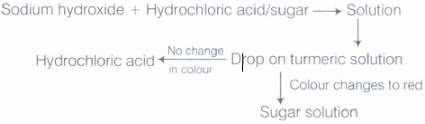
5.
We will put a drop each of hydrochloric acid, sodium hydroxide and sugar solution on the turmeric indicator. The liquid which changes the colour of turmeric indicator to red is basic in nature that is sodium hydroxide. Now, we will put a drop of sodium hydroxide on a drop of each of the other two liquids separately.
After that, we will put the drops of their mixtures on turmeric indicator. The drop which will change the colour of the turmeric indicator to red contains sugar solution.
This is because the mixture of base and the neutral solution is basic in nature. On the other hand, the drop which will not change the colour of turmeric indicator contains hydrochloric acid because hydrochloric acid reacts with sodium hydroxide forms a neutral solution.
6.
(i) As all the chemicals present in lab may not be preferred to taste because they are harmful if you consume them.
(ii) Unknown substances may be responsible to burn the skin inside our mouth or in any other way it may harm our digestive system.
(iii)Pratik is cooperative, helpful and aware about scientific facts
7.
The most commonly used natural indicator is litmus. It is extracted from lichens. It has a purple colour in distilled water. It is available in the form of a solution or in the form of strips of paper. It is available as red and blue litmus paper.
8.
Place a drop of the liquid/a crystal of solid of the given acid on a moist blue litmus paper. If the colour changes from blue to red, it is an acid. Also metallic sodium gives hydrogen with brisk effervescence on reaction with an acid.
9.
The effect of an ant bite can be neutralised by rubbing moist baking soda.
10.
Neutralisation reaction.
11.
Use both red and blue litmus solution and predict the colours in each case. In acidic medium, blue litmus solution turns to red. In basic medium, red litmus solution turns to blue
12.
(a) Acidic oxides: Non-metals burn in oxide and form acidic oxides. These form an acid on treatment with water. Such oxides turn blue litmus red. For example, carbon dioxide (CO2), sulphur dioxide (SO2)
(b) Basic oxides: These are also called metallic oxides. These oxides form bases on treatment with water. These are generally basic in nature and turn red litmus blue. For example, sodium oxide (Na2O), magnesium oxide (MgO).
(c) Amphoteric oxides: These oxides show properties of both acidic oxides and basic oxides. For example, aluminium oxide (Al2O3), silicon dioxide (SiO2).
(d) Neutral oxides: These are neither acidic nor basic and have no effect on litmus paper. For example, water (H2O).
13.
(i) Detergent solution-Basic solution, gives blue colour with litmus paper.
(ii) Lime water-Basic solution, gives blue colour with litmus paper.
(iii) Soft drinks-Acidic solution, gives red colour with litmus paper.
(iv) Sugar solution-Neutral solution, gives purple colour with litmus paper.
(v)Vinegar-Acidic solution, gives red colour with litmus paper.
14.
(a) Rahul knows that our stomach contains hydrochloric acid. It helps us to digest food. But, too much acid in the stomach causes indigestion. Sometimes, indigestion is painful and some mild base should be taken to relief from this pain. So, this information given by his teacher helped him.
(b) He gave her mother baking soda solution which was available in the kitchen easily. He selects baking soda because it is a mild base and neutralises the excess acid in the stomach and it will give relief from pain.
(c) Rahul is very intelligent and caring boy.
15.
China rose (gudhal) is an acid-base indicator.
China rose solution in different medium shows following changes:
China rose + acid \(\longrightarrow\) Give dark pink colour, hence A is an acidic solution.
China rose + base \(\longrightarrow\) give green colour, hence B is a basic solution.
China rose + neutral \(\longrightarrow\) No change in colour, hence C is a neutral solution.
16.
(d)
chemical change that cannot be reversed
17.
()
reddish brown
18.
()
hydrogen
19.
()
Pink
20.
()
sour, acids
21.
(b)
22.
()
is used as indicator
23.
()
Acids derived from plants and animals are called organic acids. These contain -COOH group
24.
()
Deliquescent salts absorb moisture from air and change into liquids. Example: magnesium chloride
25.
()
Sodium hydroxide, magnesium hydroxide

7th Standard CBSE Syllabus & Materials
7th Standard CBSE
CBSE 7th Social Science Theme B - New Beginnings : Cities and States - New Sample Question Papers Study Material - QB365 Set A
NEW7th Standard CBSE
CBSE 7th Social Science Theme A - Climates of India - New Sample Question Papers Study Material - QB365 Set A
NEW7th Standard CBSE
CBSE 7th Social Science Theme A - Geographical Diversity of India - New Sample Question Papers Study Material - QB365 Set A
NEW7th Standard CBSE
CBSE 7th Science Earth, Moon and the Sun - New Sample Question Papers Study Material - QB365 Set A



NCERT Books

Syllabus

Exam Pattern

Sample Question Papers

Previous year Question Papers

Important Notes

MCQ Practice test

NCERT Exemplers

Case study Questions

Image Based Questions

Passage based Questions

HOT Questions

Value Based Questions

Model Questions Papers
NCERT ( Book Back ) Questions

Assertion and Reason
Important Questions And Answers

CBSE 7th Standard CBSE Subjects
CBSE Standards


