
 100% FREE ACCESS
7th Standard CBSE Syllabus & Materials
7th Standard CBSE
CBSE 7th Social Science Theme E - Understanding Market - New Sample Question Papers Study Material - QB365 Set A
NEW7th Standard CBSE
CBSE 7th Social Science Theme E - From Barter to Money - New Sample Question Papers Study Material - QB365 Set A
NEW7th Standard CBSE
CBSE 7th Social Science Theme D - The Constitution of India- An Introduction - New Sample Question Papers Study Material - QB365 Set A
NEW7th Standard CBSE
CBSE 7th Social Science Theme D - From the Rulers to the Ruled : Types of Governments - New Sample Question Papers Study Material - QB365 Set A
NEW7th Standard CBSE
CBSE 7th Social Science Theme B - The Age of Reorganisation - New Sample Question Papers Study Material - QB365 Set A
NEW7th Standard CBSE
CBSE 7th Social Science Theme B - The Rise of Empires - New Sample Question Papers Study Material - QB365 Set A

Published on: 31/10/2025
Download CBSE Class 7th Standard CBSE Science question papers, sample papers, important questions, and previous year solved papers in PDF format. Get free study materials, NCERT solutions, and exam preparation resources for Class 7th Standard CBSE Science
Questions + Answers key
Take MCQ Science Test
1.
Which of the following are acidic and which are basic?
Lime water, Vinegar, Toothpaste, Stomach juices, Lemon juice, Baking soda solution, Milk of magnesia, Ammonia solution.
2.
While playing in a park, a child was stung by a wasp. Some elders suggested applying a paste of baking soda and others lemon juice as a remedy. Which remedy do you think is appropriate and why?
3.
Look at the figure which shows solutions taken in test tubes A, B, C and D. What colour is expected, when a piece of red litmus paper is dropped in each test tube? Nature of the solutions is given in the table for your help.
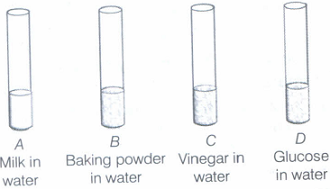
| Test tube | Nature of solution | Change in colour of red litmus |
| A | Neutral | |
| B | Basic | |
| C | Acidic | |
| D | Neutral |
4.
Write the characteristics of acids by which we can identify acids.
5.
Explain why
(a) an antacid tablet is taken when you suffer from acidity?
(b) calamine solution is applied on the skin when an ant bites?
(c) Is factory waste neutralised before disposing it into the water bodies?
6.
Dorji has a few bottles of soft drink in his restaurant. But unfortunately, these are not labelled. He has to serve the drinks on the demand of customers. One customer wants the acidic drink, another wants basic and third one wants the neutral drink. How will Dorji decide which drink is to be served to whom?
7.
When the soil is too basic, plants do not grow well in it. To improve its quality, what must be added to the soil?
Organic matter
Quicklime
Slaked lime
Calamine solution
8.
Turmeric is a natural indicator. On adding its paste to acid and base separately, which colours would be observed?
Yellow in both acid and base
Yellow in acid and red in base
Pink in acid and yellow in base
Red in acid and blue in base
9.
Products of a neutralisation reaction are always
an acid and a base
an acid and a salt
a salt and water
a salt and a base
10.
The correct way of making a solution of acid in water is to
add water to acid
add acid to water
mix acid and water simultaneously
add water to acid in a shallow container
11.
Consider the following statements:
(i) Both acids and bases change colour of all indicators.
(ii) If an indicator gives a colour change with an acid, it does not give a change with a base.
(iii) If an indicator changes colour with a base, it does not change colour with an acid.
(iv) Change of colour with an acid and a base depends on the type of the indicator.
Which of the above statements is/are correct?
Only (iv)
(i) and (iv)
(ii) and (iii)
All of these
12.
Name the reaction when an acid is mixed with base.
13.
Name a substance which is used to cure the discomfort caused by indigestion due to over eating.
14.
Name the acid present in lemon juice and tomato.
15.
Write the name of two indicators which occur naturally.
16.
What name is given to those substances which do not change the colour of either red or blue litmus paper?
17.
What is the test for acids and bases using litmus paper?
18.
Boojho, Paheli and their friend Golu were provided with a test, each containing China rose solution which was pink in colour. Boojho added 2 drops of solution 'A' in his test tube and got dark pink colour. Paheli added 2 drops of solution '8'to her test tube and got green colour. Golu added 2 drops of solution 'C' but could not get any change in colour. Suggest the possible cause for the variation in their results.
19.
You are provided with three test tubes A, B and C as shown in the figure with different liquids.
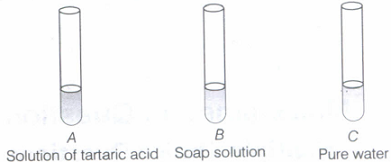
What will you observe when you put
(a) a piece of blue litmus paper in each test tube?
(b) a piece of red litmus paper in each test tube?
(c) a few drops of phenolphthalein solution to each test tube?
20.
A farmer was unhappy because of his low crop yield. He discussed the problem with an agricultural scientist and realised that the soil of his field was either too acidic or too basic. What remedy would you suggest the farmer to neutralise the soil?
1.
| Acidic in nature | Basic in nature |
| Vinegar | Lime water |
| Stomach juices | Toothpaste |
| Lemon juice | Baking soda solution |
| Milk of magnesia | |
| Ammonia solution |
2.
Wasp sting inject a liquid in the skin which is acidic in nature. Hence, bakil]g soda is the appropriate remedy as it is basic in nature and neutralises the acid.
3.
Nature of solution is given below:
| Test tube | Nature of solution | Change in colour of red litmus |
| A | Neutral | No change |
| B | Basic | Turn blue |
| C | Acidic | No change |
| D | Neutral | No change |
4.
Characteristics of acids are
(i) They are sour in taste.
(ii) They turn blue litmus paper/solution to red.
(iii) Dilution of acid in water is an exothermic reaction, i.e. heat energy is evolved.
5.
(a) We take an antacid tablet such as milk of magnesia to neutralises the excessive acid released in the stomach.
(b) When an ant bites, it injects the formic acid into the skin. The effect of acid can be neutralised by applying calamine solution that contains zinc carbonate.
(c) The factory wastes contain acids if they are allowed to flow into the water bodies, the acid will kill fishes and other organisms. The factory wastes are thus neutralised by adding basic substances.
6.
Dorji will decide which drink is to be served to whom (customer) by doing the following litmus paper tests:
(i) If the drink turns blue litmus paper to red, then the drink is acidic and hence will be served to the first customer who wants the acidic drink.
(ii) If the drink turns red litmus paper to blue, then the drink is basic and hence will be served to another customer who wants the basic drink.
(iii) If the drink shows no change in colour with litmus paper, then it will be neutral drink. Thus, it will be served to the third customer.
Since the soft drinks are edible. Dorji can take the decision by tasting the drinks. Acidic drinks will be sour to taste whereas basic drinks will be bitter to taste and neutral drinks will have no taste.
7.
(a)
Organic matter
8.
(b)
Yellow in acid and red in base
9.
(c)
a salt and water
10.
(b)
add acid to water
11.
(a) All indicators do not change colour with acids as well as bases, e.g. turmeric changes its colour to pink with the base but it remains yellow with acid.
Therefore, statement (i) is incorrect. There are some indicators which change colour with both acid and base, e.g. methyl orange, litmus, thus statement (ii) and (iii) are also incorrect. Statement (iv) is the correct conclusion about indicators.
12.
Neutralisation reaction.
13.
Milk of magnesia which contains magnesium hydroxide (base) is used to neutralise the effect of excessive acid in stomach.
14.
The citric acid in lemon juice and oxalic acid in tomato.
15.
(i) Turmeric
(ii) China rose
16.
The solutions or substances which do not change the colour of either red or blue litmus paper are neutral.
17.
Acids turn blue litmus paper red while bases turn red litmus paper blue.
18.
China rose (gudhal) is an acid-base indicator.
China rose solution in different medium shows following changes:
China rose + acid \(\longrightarrow\) Give dark pink colour, hence A is an acidic solution.
China rose + base \(\longrightarrow\) give green colour, hence B is a basic solution.
China rose + neutral \(\longrightarrow\) No change in colour, hence C is a neutral solution.
19.
| Test tube | Effect on blue litmus paper | Effect on red litmus paper | Effect on phenolphthalein solution |
| A | Turns red | Remains red | Colourless |
| B | Remains blue | Turns blue | Pink colour |
| C | Remains blue | Remains red | Colourless |
20.
The reason for low crop yield in farmer's field was that the soil at a place is either too acidic or too basic. The soil may be acidic or basic naturally. The excessive use of fertilisers in the fields also makes the soil too acidic. When the soil is too acidic, it is treated with base such as quicklime (calcium oxide) or slaked lime (calcium hydroxide) which neutralises the excess acid present in the soil and reduces its acidic nature. If the soil is too basic, then decaying organic matter (called manure or compost) is added it. The decaying organic matter releases acid which neutralises the excess bases present in the soil and reduces its basic nature.

7th Standard CBSE Syllabus & Materials
7th Standard CBSE
CBSE 7th Social Science Theme B - New Beginnings : Cities and States - New Sample Question Papers Study Material - QB365 Set A
NEW7th Standard CBSE
CBSE 7th Social Science Theme A - Climates of India - New Sample Question Papers Study Material - QB365 Set A
NEW7th Standard CBSE
CBSE 7th Social Science Theme A - Geographical Diversity of India - New Sample Question Papers Study Material - QB365 Set A
NEW7th Standard CBSE
CBSE 7th Science Earth, Moon and the Sun - New Sample Question Papers Study Material - QB365 Set A



NCERT Books

Syllabus

Exam Pattern

Sample Question Papers

Previous year Question Papers

Important Notes

MCQ Practice test

NCERT Exemplers

Case study Questions

Image Based Questions

Passage based Questions

HOT Questions

Value Based Questions

Model Questions Papers
NCERT ( Book Back ) Questions

Assertion and Reason
Important Questions And Answers

CBSE 7th Standard CBSE Subjects
CBSE Standards


