
 100% FREE ACCESS
7th Standard CBSE Syllabus & Materials
7th Standard CBSE
CBSE 7th Social Science Theme E - Understanding Market - New Sample Question Papers Study Material - QB365 Set A
NEW7th Standard CBSE
CBSE 7th Social Science Theme E - From Barter to Money - New Sample Question Papers Study Material - QB365 Set A
NEW7th Standard CBSE
CBSE 7th Social Science Theme D - The Constitution of India- An Introduction - New Sample Question Papers Study Material - QB365 Set A
NEW7th Standard CBSE
CBSE 7th Social Science Theme D - From the Rulers to the Ruled : Types of Governments - New Sample Question Papers Study Material - QB365 Set A
NEW7th Standard CBSE
CBSE 7th Social Science Theme B - The Age of Reorganisation - New Sample Question Papers Study Material - QB365 Set A
NEW7th Standard CBSE
CBSE 7th Social Science Theme B - The Rise of Empires - New Sample Question Papers Study Material - QB365 Set A

Published on: 31/10/2025
Download CBSE Class 7th Standard CBSE Science question papers, sample papers, important questions, and previous year solved papers in PDF format. Get free study materials, NCERT solutions, and exam preparation resources for Class 7th Standard CBSE Science
Questions + Answers key
Take MCQ Science Test
1.
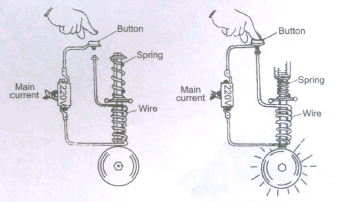
Explain the working of electric bell with diagram
2.
What is an electromagnet? Write its uses.
3.
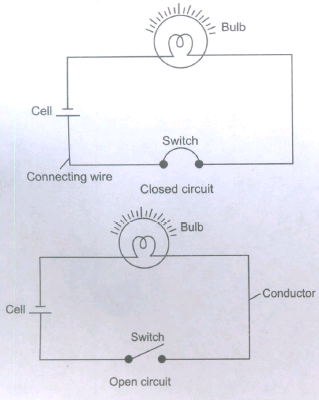
What do you understand by electric circuit? Write its components
4.
Last Sunday, Pulpit was playing videotape in his room. While playing, the electricity of his house went off due to which he could not able to see anything around him. Then anyhow, he managed to get his mobile in his hand and with the help of its light, he went outside of his room to check if there was any problem in the electric circuit board of his house.
At the same time, his father suggested him to maintain the distance from the circuit board and decided to call some electrician to check the problem.
(a) Explain, what happens when live wire and neutral wire touches each other directly?
(b) State the values here showed by Pulkit's father.
5.
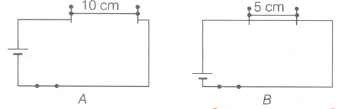
Paheli took a wire of length 10 cm. Boojho took a wire of 5 cm of the same material and thickness both of them connected with wires as shown in the circuit given in figure. The current flowing in both the circuits is the same.
(a) Will the heat produced in both the cases be equal? Explain.
(b) Will the heat produced be the same, if the wires taken by them are of equal lengths but of different thickness? Explain.
6.
State one measure to avoid overloading in an electrical circuit. Also mention the name given to a situation in which the live and the neutral wires accidently come in contact. Describe the role of a safety device in this situation.
7.
One day, Pinki was ironing the clothes in her room. After half an iron of ironing, the light went off and Pinki went outside to the lobby of her house to check it there was any problem in the household circuit. At the same time, she listened the voice of her 4 years old daughter from the same room where she was ironing the clothes. Her daughter was about to touch the hot electric iron but at the same moment, Pinki entered in the room and pushed her daughter back from that place.
(a) On which effect of electric current, does the electric iron works?
(b) Mention the values showed by Pinki here.
8.
(i) What is the heating effect of electric current?
(ii) Name two appliances that make use of heating effect of electric current.
(iii) Name the safety device based on the heating effect of electric current.
9.
(a) Why does a glowing electric bulb become warm?
(b) Mention any two effects of electric current.
(c) Why does a glowing CFL not become warm?
10.
What are CFLs ? Why are CFLs preferred over electric bulbs ?
1.
Electric bell consists of an iron hammer around which a wire is wound. When current is passed by pressing the button, the wire turns into a temporary magnet. The hammer is attracted towards gong to make sound. When this strikes, the current is disconnected automatically. It happens due to shift arrangement in it. The magnetic property of wire is lost and it comes back to its original position through a spring. In this way, we get separated hammering, resulting in ringing of an electric bell
2.
When current is passed through a coil of wire then the coil behaves like a magnet. One end of coil acts as north pole and other end acts as south pole When the electric current is swithed off, the coil generally loses its magnetism. Such coils are called electromagnets. The electromagnets are very strong and their power can be increased so they are very important.
Two important applications (uses)of electromagnets are:
(i)They are used in electric bells, telegraphs telephones and speakers etc
(ii) They are used in cranes to lift heavy loads of scrap iron or iron sheets
3.
Electric circuit: The path along which an electric current can flow is called electric circuit. The components of an electric circuit are
(i) The cell or battery-The source of electrical energy,
(ii) The connecting wires or conductors,
(iii) The bulb-that uses the current,
(iv) Switch-to close or open the circuit.
The simplified circuit diagram is given below with components and their symbols:
4.
(a) When live and neutral wire touches each other directly then it leads to short circuit in which the large amount of current flows through the household wiring and this large current may heat the wires to a dangerously high temperature and a fire may be started.
(b) Pulkit's father seems very sensible in taking the decisions and he showed a very great concern towards his son.
5.
(a) No, the amount of heat produced in both the wires will be different because amount of heat produced in a wire on passing electric current depends on the length of wire and here length is different for both the wires.
(b) No, the amount of heat produced in the wire of same length but different thickness cannot be same because amount of heat produced in a wire also depends on the thickness of the wire.
6.
Overloading can be avoided if too many appliances are not connected to a single socket. Short circuiting is a name given to a situation in which the live and the neutral wires accidently come in contact.
Electric fuse is a safety device. When a short circuit takes place or when overloading takes place, then the current becomes large and heats the fuse wire too much and thus, it gets melted and circuit breaks which prevents the damage of the wiring and electrical appliances.
7.
(a) The electric iron works on the basis of heating effect of electric current.
(b) The values showed by Pinki here is a great concern and love towards her own 4 years old daughter.
8.
(i) The wire gets hot when electric current passes through it. This property of electric current is called as heating effect of current.
(iii) Electric Bulb and Hair Dryer
(iii) Electric Fuse
9.
(a) Part of electricity supplied produced heating effect.
(b) Electricity produces two effects:
(i) Heating effect.
(ii) Magnetic effect.
(c)The electricity supplied is mostly used to produce light and heating effect is minimum.
10.
An electric bulb is used for light but it also gives heat. This is not desirable. This results in the wastage of electricity. This wastage can be reduced by using fluorescent tube lights (CFLs)in place of the bulbs. CFLs are also used to reduce wastage of electricity. There are compact fluorescent lamps. These can be fixed in ordinary bulbs holders.

7th Standard CBSE Syllabus & Materials
7th Standard CBSE
CBSE 7th Social Science Theme B - New Beginnings : Cities and States - New Sample Question Papers Study Material - QB365 Set A
NEW7th Standard CBSE
CBSE 7th Social Science Theme A - Climates of India - New Sample Question Papers Study Material - QB365 Set A
NEW7th Standard CBSE
CBSE 7th Social Science Theme A - Geographical Diversity of India - New Sample Question Papers Study Material - QB365 Set A
NEW7th Standard CBSE
CBSE 7th Science Earth, Moon and the Sun - New Sample Question Papers Study Material - QB365 Set A



NCERT Books

Syllabus

Exam Pattern

Sample Question Papers

Previous year Question Papers

Important Notes

MCQ Practice test

NCERT Exemplers

Case study Questions

Image Based Questions

Passage based Questions

HOT Questions

Value Based Questions

Model Questions Papers
NCERT ( Book Back ) Questions

Assertion and Reason
Important Questions And Answers

CBSE 7th Standard CBSE Subjects
CBSE Standards


