
 100% FREE ACCESS
7th Standard CBSE Syllabus & Materials
7th Standard CBSE
CBSE 7th Social Science Theme E - Understanding Market - New Sample Question Papers Study Material - QB365 Set A
NEW7th Standard CBSE
CBSE 7th Social Science Theme E - From Barter to Money - New Sample Question Papers Study Material - QB365 Set A
NEW7th Standard CBSE
CBSE 7th Social Science Theme D - The Constitution of India- An Introduction - New Sample Question Papers Study Material - QB365 Set A
NEW7th Standard CBSE
CBSE 7th Social Science Theme D - From the Rulers to the Ruled : Types of Governments - New Sample Question Papers Study Material - QB365 Set A
NEW7th Standard CBSE
CBSE 7th Social Science Theme B - The Age of Reorganisation - New Sample Question Papers Study Material - QB365 Set A
NEW7th Standard CBSE
CBSE 7th Social Science Theme B - The Rise of Empires - New Sample Question Papers Study Material - QB365 Set A

Published on: 31/10/2025
Download CBSE Class 7th Standard CBSE Science question papers, sample papers, important questions, and previous year solved papers in PDF format. Get free study materials, NCERT solutions, and exam preparation resources for Class 7th Standard CBSE Science
Questions + Answers key
Take MCQ Science Test
1.
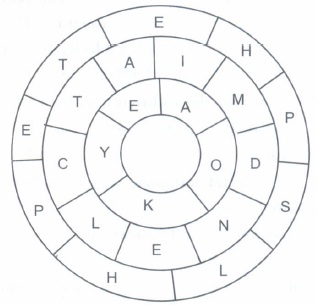
Figure shows three rings of circles with letters in them. Some of these letters in each ring can form the name of one wool yielding animal. Find the names of these animals.
2.
What are the three grades of silk produced?
3.
What is carding of wool? How is woollen yarn obtained from the carded wool?
4.
What is raw silk? How is it produced?
5.
Give in brief the life history of silk moth.
6.
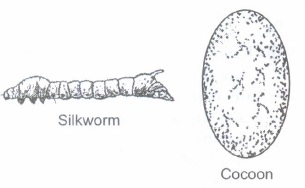
Make sketches of the two stages in the life history of the silk moth which are directly related to the production of silk.
7.
Given below is a sequence of step in the processing of wool. Which are the missing steps? Add them. Shearing _______, sorting _______, and______ into yarn.
8.
Name the most common silk moth. What are the characteristics of silk fibres obtained from the Cocoons of this silk moth?
9.
Radhika wanted to buy a silk frock and went to the market with her mother. There they found that the artificial (synthetic) silk was much cheaper and wanted to know why? Do you. know why? Find out.
10.
Name different types of silk. Which variety of silk is most common and how it is obtained?
11.
Cocoon is used to obtain silk thread. How?
12.
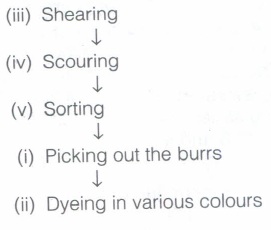
Various steps involved to obtain wool from fleece are given here.
(i) Picking out the burrs
(ii) Dyeing in various colours
(iii) Shearing
(iv) Scouring
(v) Sorting
Write the above steps in the correct sequence in which they are carried out.
13.
Sorter's disease is an occupational hazard. Explain.
14.
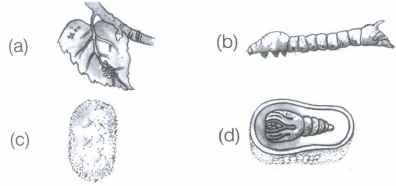
Write a caption for each of the figures given as figure (a-d).
15.
Sheep are herbivores, so which type of feed (or food) is provided by shepherds?
1.
Yak, camel and Sheep.
2.
Three grades of silk obtained from a cocoon are :
(a) Reeled silk: It is the unwound fibres and form the finest quality of silk.
(b) Spun silk: It is the carded or combed silk from left overs after the reeled silk. It constitutes an inferior quality. It is slightly honey coloured.
(c)Nail silk: Still shorter fibres left behind after carding constitute an even inferior quality of silk.It is a richly textured rough silk.
3.
The wool fibres are dried and then disentangled. They are then combed and straightened by a cardinal machine. This is called carding.
In the cardinal machine, the disentangled woollen fibres are passed between a pair of rotating cylinders covered with a material called carding cloth, which contains fine, pliable wire teeth. The wool emerges from the rollers in the form of thin wire called web.
4.
After brushing, filaments from four to eight cocoons are joined and twisted. About 48 such twisted filaments are joined to make a thread that is wound on a reel. This thread is called raw silk.
5.
Life history of silk moth:
(i) Female moth lays eggs on leaves.
(ii) Eggs hatch into larvae called caterpillars or silkworms.
(iii) Silkworms feed on mulberry leaves and grow in size and stage of Pupa is reached.
(iv) Pupa holds itself by weaving a net around its body by swinging its head from side to side in the form of 8 (eight). During these movements, it secrets fibre and completely covers itself. This covering is called cocoon.
(v) Silk is obtained from cocoon. Some cocoon develop into adult moth.
6.
7.
Shearing, scouring, sorting, dyeing and rolling into yarn
8.
The most common silk moth is the mulberry silk moth. The silk obtained from the Cocoons of mulberry silk moth is called mulberry silk. Mulberry silk is soft, lustrous (shiny) and elastic and can be dyed in different colours.
9.
Artificial (synthetic) silk called rayon is obtained from wood pulp and it is made of modified plant material cellulose. Synthetic silk can be prepared at a large scale in factories/mills. So, it is cheap. For obtaining pure silk, we have to rear silk moth, their larvae to get pupa.
To get silk thread, we have to dip Cocoon in hot water to get silk thread which is wrapped over the Cocoon. The pupa inside the Cocoon dies. To obtain silk for commercial purposes, a large number of Cocoons (containing living pupa) are killed. As a result, natural silk is costly.
10.
Different types of silk are mulberry silk, tassar silk, mooga silk and kosa silk.
The most common variety of silk is mulberry silk. It is obtained from the CoCoons of mulberry silkworm and is made up of protein. It is a natural silk and is an animal fibre.
11.
A pile of cocoon is used for obtaining silk fibre. The Cocoon are kept under the sun, boiled water or exposed to steam. The silk fibres separate out. The process of taking, out threads from the Cocoon for use as silk is called reeling the silk.
12.
Correct sequence is
13.
Wool industry is an important source of livelihood for many people in our country. The people who do the job of sorting (separating) the fleece of sheep into fibres of different qualities are called sorters. The sorter's job is very risky because sometimes, they get infected by the bacteria called 'anthrax' which cause a deadly blood disease called sorter's disease.
14.
(a) Eggs of silk moth on mulberry leaves
(b) Silkworm
(c) Cocoon
(d) Cocoon with developing moth
15.
Sheep are herbivores, and prefer grass and leaves of various trees. Their food also contain a mixture of pulses, corn, jowar, oil cakes (material left after taking out oil from seeds) and minerals.

7th Standard CBSE Syllabus & Materials
7th Standard CBSE
CBSE 7th Social Science Theme B - New Beginnings : Cities and States - New Sample Question Papers Study Material - QB365 Set A
NEW7th Standard CBSE
CBSE 7th Social Science Theme A - Climates of India - New Sample Question Papers Study Material - QB365 Set A
NEW7th Standard CBSE
CBSE 7th Social Science Theme A - Geographical Diversity of India - New Sample Question Papers Study Material - QB365 Set A
NEW7th Standard CBSE
CBSE 7th Science Earth, Moon and the Sun - New Sample Question Papers Study Material - QB365 Set A



NCERT Books

Syllabus

Exam Pattern

Sample Question Papers

Previous year Question Papers

Important Notes

MCQ Practice test

NCERT Exemplers

Case study Questions

Image Based Questions

Passage based Questions

HOT Questions

Value Based Questions

Model Questions Papers
NCERT ( Book Back ) Questions

Assertion and Reason
Important Questions And Answers

CBSE 7th Standard CBSE Subjects
CBSE Standards


