
 100% FREE ACCESS
7th Standard CBSE Syllabus & Materials
7th Standard CBSE
CBSE 7th Social Science Theme E - Understanding Market - New Sample Question Papers Study Material - QB365 Set A
NEW7th Standard CBSE
CBSE 7th Social Science Theme E - From Barter to Money - New Sample Question Papers Study Material - QB365 Set A
NEW7th Standard CBSE
CBSE 7th Social Science Theme D - The Constitution of India- An Introduction - New Sample Question Papers Study Material - QB365 Set A
NEW7th Standard CBSE
CBSE 7th Social Science Theme D - From the Rulers to the Ruled : Types of Governments - New Sample Question Papers Study Material - QB365 Set A
NEW7th Standard CBSE
CBSE 7th Social Science Theme B - The Age of Reorganisation - New Sample Question Papers Study Material - QB365 Set A
NEW7th Standard CBSE
CBSE 7th Social Science Theme B - The Rise of Empires - New Sample Question Papers Study Material - QB365 Set A

Published on: 31/10/2025
Download CBSE Class 7th Standard CBSE Science question papers, sample papers, important questions, and previous year solved papers in PDF format. Get free study materials, NCERT solutions, and exam preparation resources for Class 7th Standard CBSE Science
Questions + Answers key
Take MCQ Science Test
1.
Explain how root system of plants help in the prevention of flood?
2.
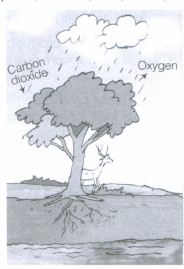
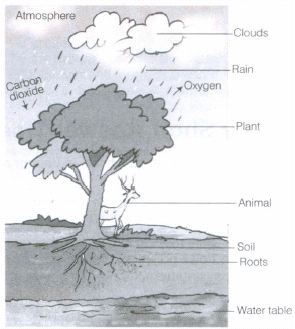
In figure, the artist has forgotten to put the labels and directions on the arrows. Mark the directions on the arrows and label the diagram using the labels:
clouds, rain, atmosphere, carbon dioxide, oxygen, plant, animal, soil, roots, water table.
3.
List five products we get from forests.
4.
Explain why there is no waste in a forest.
5.
Explain how animals dwelling in the forest help it to grow and regenerate.
6.
Deforestation may lead to floods. Why?
7.
Name any four useful products other than wood, which we get from forests.
8.
Draw any simple food chain in a pond.
9.
Give the reason behind variations found in the forests of different regions.
10.
List some animals which live in deeper areas of the forest.
11.
Sachin lives in a village, this village is surrounded by a forest. One day he noticed that in nearby pond sedimentation is increased so much that water has become muddy, streams are drying up. There is scarcity of fuel wood. He soon realised that he has to raise the issue of forest protection from cutting down trees, etc. Soon he involved the nearby village people and made an organisation to take an initiative.
Now, answer the following questions
(a) What changes might have Sachin noticed in his area?
(b) Give the porbable reason for such changes mentioned above.
(c) What are the values shown by Sachin?
12.
People say that nothing goes waste in a forest. Can you explain how?
13.
Which one of the following is an animal product?
Gum
Catechu
Honey
Rubber
14.
Which of the following is not a correct statement?
Forest trees are cut down to obtain timber
Forest trees are cut down to obtain paper
Forest trees are cut down to obtain natural rubber
Forest trees are cut down to obtain firewood
15.
Forests are not responsible for
providing medicinal plants
maintaining the flow of water into the streams
creating flood conditions
absorbing rainwater and maintaining water table
16.
The first link in all food chains are
herbivores
carnivores
green plants
None of these
17.
Pick the option which gives the names of a tree and an animal respectively from the following.
Semal and hornbill
Sal and khair
Chinkara and blue bull
Neem and Palash
18.
The lowest layer in the understorey is formed by
shrubs
herbs
trees
tall grasses
19.
Which of the following statements is not correct?
Forests protect the soil form erosion
Plants and animals in a forest are not dependent on one another
Forests influence the climate and water cycle
Soil helps forests to grow and regenerate
20.
Microorganisms act upon the dead plants to produce
sand
mushroom
humus
wood
21.
We get various products from forests.
22.
Various components of forests are not interdependent on each other.
23.
Plants release CO2 in the process of photosynthesis.
24.
Plants are saprotrophs.
1.
The root system helps water to seep down in the ground. It helps to maintain the water table throughout the year. Roots of trees normally bind the soil together and stop the erosion of soil.
2.
The given figure completely explains the exchange of gases between plants and animals.
3.
(i) Fruits
(ii) Vegetables
(iii) Medicines
(iv) Oxygen
(v) Cereals
4.
There is no waste in a forest because microorganisms act on the wastes and convert them into humus. The humus ensures that the nutrients are returned back to the soil.
5.
The animals in forests are of various types. These could be herbivores, carnivores, microorganisms, etc. These play an important role in maintaining the food chains.
(i) Microorganisms convert the dead plants and animals into humus. This humus helps in returning the nutrients back to the soil. These are absorbed by plants.
(ii) The animals also help in dispersing the seeds of certain plants.
(iii) The decaying animal dung provides nutrients.
All these activities of animals dwelling in the forest help it to grow and regenerate.
6.
Deforestation leads to floods as lesser number of trees will be available due to deforestation. In the absence of trees, the soil will not hold water leading to floods.
7.
Four useful products other than wood which we get from forests are gum, spices, fodder for animals and medicinal plants.
8.
A typical food chain in a pond is Algae ⟶ Small fishes ⟶ Large fishes.
9.
The variation in the type of plants and animals is found in different forests because of the climatic conditions of that particular area.
10.
Boars, bisons, jackals, porcupines, elephants, etc., live in the deeper areas of the forest.
11.
(a) Sachin noticed the disturbance in the water cycle in his area like stream drying up. Pond water getting muddy, less availability of fuel wood, etc.
(b) Deforestation.
(c) Love for nature and environmental consciousness.
12.
Nothing goes waste in a forest because of the following reasons
(i) Dry leaves and remains of dead animals are converted to a dark coloured substance called humus. This provides nutrients to the plants.
(ii) Dead animals become food for vultures, crows, jackals and insects.
(iii) Broken branches of trees are used as fuel by the people living in the vicinity of the forest.
13.
(c)
Honey
14.
(c)
Forest trees are cut down to obtain natural rubber
15.
(c)
creating flood conditions
16.
(c)
green plants
17.
(a)
Semal and hornbill
18.
(b)
herbs
19.
(b)
Plants and animals in a forest are not dependent on one another
20.
(c)
humus
21.
(a)
22.
(b)
23.
(b)
24.
(b)

7th Standard CBSE Syllabus & Materials
7th Standard CBSE
CBSE 7th Social Science Theme B - New Beginnings : Cities and States - New Sample Question Papers Study Material - QB365 Set A
NEW7th Standard CBSE
CBSE 7th Social Science Theme A - Climates of India - New Sample Question Papers Study Material - QB365 Set A
NEW7th Standard CBSE
CBSE 7th Social Science Theme A - Geographical Diversity of India - New Sample Question Papers Study Material - QB365 Set A
NEW7th Standard CBSE
CBSE 7th Science Earth, Moon and the Sun - New Sample Question Papers Study Material - QB365 Set A



NCERT Books

Syllabus

Exam Pattern

Sample Question Papers

Previous year Question Papers

Important Notes

MCQ Practice test

NCERT Exemplers

Case study Questions

Image Based Questions

Passage based Questions

HOT Questions

Value Based Questions

Model Questions Papers
NCERT ( Book Back ) Questions

Assertion and Reason
Important Questions And Answers

CBSE 7th Standard CBSE Subjects
CBSE Standards


