
 100% FREE ACCESS
7th Standard CBSE Syllabus & Materials
7th Standard CBSE
CBSE 7th Social Science Theme E - Understanding Market - New Sample Question Papers Study Material - QB365 Set A
NEW7th Standard CBSE
CBSE 7th Social Science Theme E - From Barter to Money - New Sample Question Papers Study Material - QB365 Set A
NEW7th Standard CBSE
CBSE 7th Social Science Theme D - The Constitution of India- An Introduction - New Sample Question Papers Study Material - QB365 Set A
NEW7th Standard CBSE
CBSE 7th Social Science Theme D - From the Rulers to the Ruled : Types of Governments - New Sample Question Papers Study Material - QB365 Set A
NEW7th Standard CBSE
CBSE 7th Social Science Theme B - The Age of Reorganisation - New Sample Question Papers Study Material - QB365 Set A
NEW7th Standard CBSE
CBSE 7th Social Science Theme B - The Rise of Empires - New Sample Question Papers Study Material - QB365 Set A

Published on: 31/10/2025
Download CBSE Class 7th Standard CBSE Science question papers, sample papers, important questions, and previous year solved papers in PDF format. Get free study materials, NCERT solutions, and exam preparation resources for Class 7th Standard CBSE Science
Questions + Answers key
Take MCQ Science Test
1.
Heat is :
A form of energy
A type of matter
Neither energy nor matter
None of these
2.
Circuit breaker device which can be used in place of fuse in domestic electric wiring is called
DCB
MCD
MCB
BCM
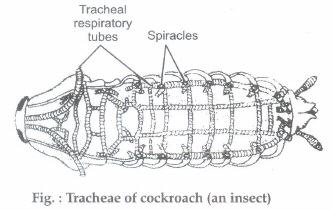
3.
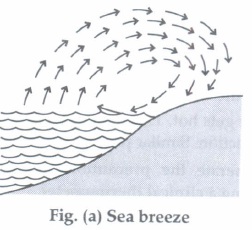
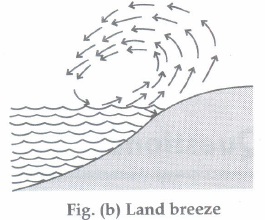
Heat always flows
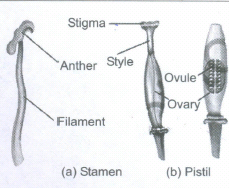
from a colder object to a hotter object
from a hotter object to a colder object
in both the directions
None of the above
4.
Which of the following can be used to form a real image?
Only concave mirror
Only plane mirror
Only convex mirror
Both concave and convex mirrors
5.
If an object is placed at a distance of 0.5 m in front of a plane mirror, the distance between the object and the image formed by the mirror will be
2 m
1 m
0.5 m
0.25 m
6.
The reproductive part of a plant is the
leaf
stem
root
flower
7.
The mountaineers carry oxygen with them because
at an altitude of more than 5 km, there is no air
the amount of air available to a person is less than that available on the ground
the temperature of air is higher than that on the ground
the pressure of air is higher than that on the ground
8.
The organ which controls the blood circulation in body is
Liver
Lungs
Heart
Kidney
9.
During heavy exercise, we get cramps in the legs due to the accumulation of
carbon dioxide
lactic acid
alcohol
water
10.
Water absorption through roots can be increased by keeping the plants
in the shade
in dim light
under the fan
covered with a polythene bag
11.
Distinguish between an open circuit and a closed circuit.
12.
Differentiate between two modes of transfer of heat, i.e. convection and conduction.
13.
Name any two effects of electric current.
14.
How does the process of fertilisation take place in flowers?
15.
After we work hard or perform physical activity, we feel hungry. Explain why
16.
The internal structure of heart has four chambers.
(a) Name the upper chambers of heart.
(b) Name the lower chambers of heart.
17.
Observe given figure and answer the given questions.
.png)
(a) Name the instrument.
(b) Label the parts A, B and C.
18.
State the characteristics of the image formed by a plane mirror.
19.
What makes the blood look red?
20.
Explain anaerobic respiration
21.
What are insulators?
22.
If the filament of the bulb is broken, would the circuit be complete? Would the bulb still glow?
23.
Mention the name of the two devices that work on the basis of magnetic effects of current.
24.
If a pan is removed from the fire, then why does it cool down?
25.
Mention the mode of reproduction in the following plants
(a) Spirogyra
(b) Yeast
(c) Money plants.
26.
Floor of chest cavity refers to which organ of respiration?
27.
What are the end products of aerobic respiration.
28.
Is the image formed by a plane mirror is always upright?
29.
Circulatory system consists of three major organs. Name those organs.
30.
Explain the respirating system in cockroach
31.
Explain the sea breeze and land breeze.
32.
(a) What is the asexual reproduction? Name any two method of asexual reproduction with one example each.
(b) Sketch the reproductive parts of a flower.
33.
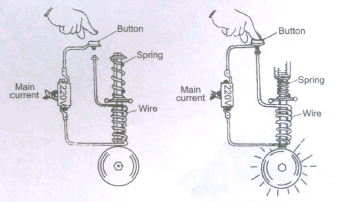
Explain the working of electric bell with diagram
34.
What is blood?
(a) Write any two function of blood.
(b) Name the various component of blood.
1.
(a)
A form of energy
2.
(c)
MCB
3.
(b)
from a hotter object to a colder object
4.
(a)
Only concave mirror
5.
(b)
1 m
6.
The reproductive part of a plant is the flower.
7.
(b)
the amount of air available to a person is less than that available on the ground
8.
(c)
Heart
9.
Lactic acid It is produced during heavy exercise as sufficient oxygen is not available to muscles.
10.
Water absorption through roots can be increased by keeping the plants under the fan.
11.
Difference between an open circuit and a closed circuit
| Open (Electric) circuit | Closed (Electric) circuit |
| An open electric circuit is or electric path which begins from the positive terminal of a battery or cell, gets broken at some point. | A closed circuit is an electric path which begins from the positive terminal of a cell or battery and terminates at its negative terminal without any break. |
12.
Difference between convection and conduction
| Conduction | Convection |
|---|---|
| The mode of transfer of heat from the hotter part of a material to its colder part or from a hot material to a cold material in contact with it without the movement of material as a whole. So, this phenomenon is known as conduction. |
The mode of transfer of heat from the hotter part a fluid to its colder parts by the movement of liquid itself. So, this phenomenon is known as convection. |
| In all the solids, heat is transferred by the process of conduction. |
In all the liquids and gases, heat is transferred by the process of convection. |
13.
The two effects of electric current are
(i) Heating effect
(ii) Magnetic effect
14.
The steps involved in the process of fertilisation are
(i) After pollination, pollen grains start growing into a pollen tube on the stigma passing through pistil.
(ii) The tube extends through the style and reaches to the ovules.
(iii) The pollen tube carries the male gametes called pollen grains.
(iv) Male gametes fuse with the egg (female gamete) present inside ovule and forms a zygote. This process is called fertilisation.
(v) Later zygote develops into an embryo and ovules develop into a seed.
(vi) Thus, seed carries an embryo with stored food and is covered by a hard protective covering called seed coat.
15.
When we work hard or perform physical activity (like running, swimming, cycling), we need more energy. To fulfil the energy requirement, we breathe faster. Fast breathing helps in supply of more oxygen to our cells. Due to this, rate of breakdown of food increases and more energy is released. The rapid breakdown of food makes us to feel more hungry.
16.
The vertical section of heart shows that heart is divided into four compartments called as chambers.
(a) The upper two chambers of heart are called atria or atrium.
(b) The lower two chambers of heart are called ventricles.
17.
(a) The name of the given instrument is stethoscope.
(b) Labelled diagram of stethoscope.
.png)
18.
Characteristics of the image formed by the plane mirror are
(i) It is virtual.
(ii) It is erect.
(iii) It is same in size.
(iv) It is at same distance from the mirror as the distance of an object from the mirror.
19.
The red pigment (haemoglobin) present in the red blood cells of the blood makes the blood look red. The haemoglobin carries oxygen and transports it to all the parts of the body.
20.
The process of respiration which takes place in the absence of oxygen is called anaerobic respiration. In this process, glucose (food) is broken down into alcohol or lactic acid, carbon dioxide and energy. The organisms that can survive in the absence of air are called anaerobes like yeast.
Glucose\(\xrightarrow[of\ CO_2]{absence}\) Alcohol + CO2 + Energy.
21.
Materials which do not allow heat to pass through them easily are poor conductors of heat and are called insulators. e.g., wood, plastic.
22.
If the filament of the bulb is broken, the circuit will not be complete.
So, the bulb will not glow.
23.
The devices that work on the basis of magnetic effects of current are loudspeaker and electric bell.
24.
When a pan is removed from the fire, it loses heat to the surroundings by radiation and it cools down.
25.
(a) Spirogyra - fragmentation
(b) Yeast - budding
(c) Money plant - Vegetative propagation.
26.
Diaphragm is known as the floor of chest cavity
27.
During aerobic respiration, carbon dioxide and water are released along with a large amount of energy.
\(glucose\overset { { O }_{ 2 } }{ \longrightarrow } { O }_{ 2 }+water+Energy\)
28.
Yes, the image formed by the plane mirror is always upright.
29.
The circulatory system consists of three major organs, i.e., blood, blood vessels and heart.
30.
A cockroach has small opening on the side of its body. These openings are called spiracles. Insects have a network or air tubes called tracheae for gas exchange, oxygen rich air rushes through spiracles into the tracheal tubes, diffuses into the body tissues and reaches every cell of the body. Similarly carbon dioxide from the cells goes into the tracheal tubes and moves out through spiracles. These air tubes or tracheae are found only in insects
31.
At sea-shore during the day cold air from the sea moves towards the beach because the land gets more heated than the sea water. Hot air above the land rises up, and cold air from the sea moves towards the land beach. This is called sea breeze as shown in fig. (a).
During the night, cold air from the land moves towards the sea because the land cools more quickly than the sea water. So hot air above the sea rises up and cold air from the land moves towards the sea. This is called land breeze as shown in fig.(b).
32.
(a) Asexual reproduction is a type of reproduction in plants in which new plants are obtained from old ones without the production of seeds.
Two methods of asexual reproduction:
Vegetative Production, Spore Formation, Budding, Fragmentation (any two).
(b) Reproductive Parts of Flower:
33.
Electric bell consists of an iron hammer around which a wire is wound. When current is passed by pressing the button, the wire turns into a temporary magnet. The hammer is attracted towards gong to make sound. When this strikes, the current is disconnected automatically. It happens due to shift arrangement in it. The magnetic property of wire is lost and it comes back to its original position through a spring. In this way, we get separated hammering, resulting in ringing of an electric bell
34.
Blood is a fluid which flows in blood vessels.
(a) Functions of blood :
(i) It transports digested food from small intestine to all parts of the body.
(ii) It carries oxygen from lungs to cell.
(b) Components of blood:
(i) Fluid: Plasma
(ii) Cells: RBC,WBC, Platelets.

7th Standard CBSE Syllabus & Materials
7th Standard CBSE
CBSE 7th Social Science Theme B - New Beginnings : Cities and States - New Sample Question Papers Study Material - QB365 Set A
NEW7th Standard CBSE
CBSE 7th Social Science Theme A - Climates of India - New Sample Question Papers Study Material - QB365 Set A
NEW7th Standard CBSE
CBSE 7th Social Science Theme A - Geographical Diversity of India - New Sample Question Papers Study Material - QB365 Set A
NEW7th Standard CBSE
CBSE 7th Science Earth, Moon and the Sun - New Sample Question Papers Study Material - QB365 Set A



NCERT Books

Syllabus

Exam Pattern

Sample Question Papers

Previous year Question Papers

Important Notes

MCQ Practice test

NCERT Exemplers

Case study Questions

Image Based Questions

Passage based Questions

HOT Questions

Value Based Questions

Model Questions Papers
NCERT ( Book Back ) Questions

Assertion and Reason
Important Questions And Answers

CBSE 7th Standard CBSE Subjects
CBSE Standards


