
 100% FREE ACCESS
7th Standard CBSE Syllabus & Materials
7th Standard CBSE
CBSE 7th Social Science Theme E - Understanding Market - New Sample Question Papers Study Material - QB365 Set A
NEW7th Standard CBSE
CBSE 7th Social Science Theme E - From Barter to Money - New Sample Question Papers Study Material - QB365 Set A
NEW7th Standard CBSE
CBSE 7th Social Science Theme D - The Constitution of India- An Introduction - New Sample Question Papers Study Material - QB365 Set A
NEW7th Standard CBSE
CBSE 7th Social Science Theme D - From the Rulers to the Ruled : Types of Governments - New Sample Question Papers Study Material - QB365 Set A
NEW7th Standard CBSE
CBSE 7th Social Science Theme B - The Age of Reorganisation - New Sample Question Papers Study Material - QB365 Set A
NEW7th Standard CBSE
CBSE 7th Social Science Theme B - The Rise of Empires - New Sample Question Papers Study Material - QB365 Set A

Published on: 31/10/2025
Download CBSE Class 7th Standard CBSE Science question papers, sample papers, important questions, and previous year solved papers in PDF format. Get free study materials, NCERT solutions, and exam preparation resources for Class 7th Standard CBSE Science
Questions + Answers key
Take MCQ Science Test
1.
What precautions are needed while reading a laboratory thermometer?
2.
Why is the handle of a metallic kettle covered with strips of cane?
3.
Show that air transfers heat via convection.
4.
Show that water is a bad conductor of heat.
5.
Enumerate the precautions to be taken while reading a clinical thermometer.
6.
Describe the mode of heat transfer in water or gases.
7.
Explain the reason for wrapping of ice in gunny bags.
8.
Describe briefly about the direction of the convection current during ventilation.
9.
Explain the reason for serving of tea in China clay cup and plates.
10.
Instead of water explain the reason, why do the mercury is used in the thermometer?
11.
The freezer is located at the top of the refrigerator. Explain why.
12.
Differentiate between two modes of transfer of heat, i.e. convection and conduction.
13.
The handle of a pressure cooker is covered with the thick plastic. Explain why.
14.
Give two examples each of conductors and insulators of heat.
15.
State similarities and differences between the laboratory thermometer and the clinical thermometer.
1.
(i) The thermometer should be kept upright not tilted.
(ii) Bulb should be surrounded from all sides by the substance by which the temperature is to be measured.
(iii) The bulb should not touch the surface of the container.
2.
Handle of a metallic kettle is covered with strips of cane because when kettle is heated, the heat does not pass through strips of cane. The strips of cane are bad conductor of heat and we may hold the handle with our bare hands.
3.
Take a rectangular box with a glass front. Make a small window on one of its sides and a hole on the top. Fix a paper pipe into the hole of the top to form a chimney. Now keep a candle in the box below the chimney. Keep your hand above the chimney. It will be observed that hot air is coming out of chimney. Now put a lighted incense stick near the window. Soon you will notice that incense smoke comes out of the window. This happens due to the convection current set up inside the box.
4.
Take a test-tube. Half fill it with cold water. Now drop in it a cube of ice wrapped in a wire gauze. It sinks to the bottom. Hold the top end of the test-tube with a test-tube holder. Heat it over a flame. It will be noticed that water starts boiling but ice is not fully melted. It means that heat has been transferred through the molecules of water. This shows that water is a bad conductor of heat.
5.
The following precautions are to be taken while reading a clinical thermometer:
(a)Thermometer should be washed before or after use, preferably with an antiseptic solution.
(b) By giving a jerk, ensure that before use, the mercury level is below 35°C.
(c) Keep the thermometer below the tongue of the person for 30-60 seconds.
(d) Read the thermometer keeping the level of mercury along the line of sight.
(e) Do not hold the thermometer by the bulb while reading the temperature.
6.
Take water in a flask and heat it. It is seen that water near the flame gets hot and it rises up. The cold water from the side moves down, towards the source of heat. This water also
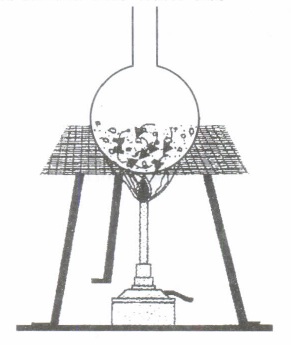
gets hot and rises and more water moves down from the side. This process continues till the whole water gets hot. This mode of heat transfer is called convection. Similar process happens in gases.
7.
Since, we know that gunny bags consist of number of fine pores which are filled with air. As air is a bad conductor of heat, so due to this reason, it does not allow the external heat to move inside and melts the ice.
8.
Since, with the help of ventilators, warm air being higher get rises up and leaves the room. Even the fresh air enters the room from outside through the doors and windows.
9.
Tea is generally served in China clay cup and plates because China clay is a bad conductor of heat which do not allow the heat to pass through it and hence keep the tea hot.
10.
Due to following reasons, mercury is used in the thermometers instead of water
(i) When the thermometer breaks, the mercury can be easily collected.
(ii) Mercury can has more expansion than the water.
(iii) Also, mercury do not stick on the walls of thermometer like water.
11.
The freezer is located at the top of the refrigerator. It is because the air inside and around the compartments of freezer gets cool and move downwards and on the other side, the lesser cool air moves upward to get cooled.
So, as a result of this, convection of heat are setup in the air and the lower section of the refrigerator also gets cooled faster.
12.
Difference between convection and conduction
| Conduction | Convection |
|---|---|
| The mode of transfer of heat from the hotter part of a material to its colder part or from a hot material to a cold material in contact with it without the movement of material as a whole. So, this phenomenon is known as conduction. |
The mode of transfer of heat from the hotter part a fluid to its colder parts by the movement of liquid itself. So, this phenomenon is known as convection. |
| In all the solids, heat is transferred by the process of conduction. |
In all the liquids and gases, heat is transferred by the process of convection. |
13.
As we know that plastic is a bad conductor of heat due to which the heat from the cooker does not flow to its handle and we can hold it easily.
So, this is a reason because of which the handle of a pressure cooker is covered with the thick plastic.
14.
Examples of conductors are metal and steel and examples of insulators are wood and plastic.
15.
Similarities Both thermometers are used to measure temperature and both of them use mercury.
Differences Clinical thermometer is used to measure human body temperature whereas laboratory thermometer is used to measure temperature of other object which has higher temperature than human body temperature.

7th Standard CBSE Syllabus & Materials
7th Standard CBSE
CBSE 7th Social Science Theme B - New Beginnings : Cities and States - New Sample Question Papers Study Material - QB365 Set A
NEW7th Standard CBSE
CBSE 7th Social Science Theme A - Climates of India - New Sample Question Papers Study Material - QB365 Set A
NEW7th Standard CBSE
CBSE 7th Social Science Theme A - Geographical Diversity of India - New Sample Question Papers Study Material - QB365 Set A
NEW7th Standard CBSE
CBSE 7th Science Earth, Moon and the Sun - New Sample Question Papers Study Material - QB365 Set A



NCERT Books

Syllabus

Exam Pattern

Sample Question Papers

Previous year Question Papers

Important Notes

MCQ Practice test

NCERT Exemplers

Case study Questions

Image Based Questions

Passage based Questions

HOT Questions

Value Based Questions

Model Questions Papers
NCERT ( Book Back ) Questions

Assertion and Reason
Important Questions And Answers

CBSE 7th Standard CBSE Subjects
CBSE Standards


