
 100% FREE ACCESS
7th Standard CBSE Syllabus & Materials
7th Standard CBSE
CBSE 7th Social Science Theme E - Understanding Market - New Sample Question Papers Study Material - QB365 Set A
NEW7th Standard CBSE
CBSE 7th Social Science Theme E - From Barter to Money - New Sample Question Papers Study Material - QB365 Set A
NEW7th Standard CBSE
CBSE 7th Social Science Theme D - The Constitution of India- An Introduction - New Sample Question Papers Study Material - QB365 Set A
NEW7th Standard CBSE
CBSE 7th Social Science Theme D - From the Rulers to the Ruled : Types of Governments - New Sample Question Papers Study Material - QB365 Set A
NEW7th Standard CBSE
CBSE 7th Social Science Theme B - The Age of Reorganisation - New Sample Question Papers Study Material - QB365 Set A
NEW7th Standard CBSE
CBSE 7th Social Science Theme B - The Rise of Empires - New Sample Question Papers Study Material - QB365 Set A

Published on: 31/10/2025
Download CBSE Class 7th Standard CBSE Science question papers, sample papers, important questions, and previous year solved papers in PDF format. Get free study materials, NCERT solutions, and exam preparation resources for Class 7th Standard CBSE Science
Questions + Answers key
Take MCQ Science Test
1.
"Vision" is one of the wonderful gifts given to us by God. But most of the people never take care of their eyes. Care for eyes should be taken, suggest some methods for proper eye care?
2.
Rajiv neighbour got heart attack. He immediately extended help and called for an ambulance. Due to the rush of vehicles on road and the fact that people were not giving way to ambulance, the patient could not reach hospital in time and died. Rajiv felt bad and started spreading awareness among people to be sensitive regarding this issue.
(a) Which value is being promoted by Rajiv?
(b) Why is word "Ambulance" written in its mirror image form?
(c) Write any four characteristics of image formed by plane mirror.
3.
Mention differences between real and virtual image.
4.
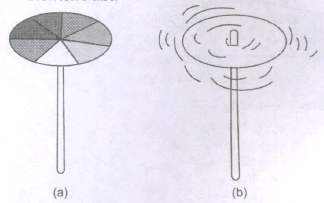
Describe an activity to show that seven colours can be mixed to get white light.
5.
How will you prove that light travels in straight line?
6.
Given below is a ray diagram of an experiment done with a mirror.
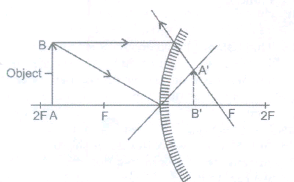
Answer the following questions:
(i) Name the mirror used.
(ii) What are the characteristics of the image formed?
(iii) How will the position of image change if the position of object is changed?
7.
Consider the following ray diagram.
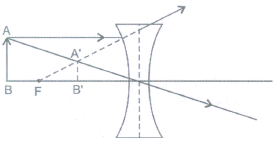
Answer the following question:
(i) Which lens is used?
(ii) What is the characteristics of the image formed?
(iii) How will the position of image change if position of image is changed?
8.
State the uses of different kinds of mirrors.
9.
Assume, a person is standing in front of a plane mirror. The distance between the mirror and his image is 6 m. If the person moves 2 m towards the plane mirror, what would be the distance between the person and his image?
10.
Briefly explain why in ambulance words are written laterally inverted.
11.
Boojho made light from a laser torch to fall on a prism. Will he be able to observe a band of seven colours? Explain with a reason.
12.
Mention the type of image
(a) which can be formed on the screen.
(b) which cannot be formed on the screen.
13.
The concave reflecting surface of a torch got rusted. What effect would this have on the beam of light from the torch?
14.
Differentiate between a plane mirror, concave mirror and a convex mirror without touching them.
15.
Which type of lens forms always a virtual image?
1.
(i) Don't Rub eyes.
(ii) Wash them properly and softly.
(iii) Get your eyes checked regularly by doctors.
2.
(a) Humanitarian value of giving way to AMBULANCE so that any patient can immediately reach to the hospital.
(b) Because any person driving the vehicle which is ahead of the Ambulance van, can see the laterally inverted alphabets correctly from his rear view mirror & make way for it to pass through.
(c) Characteristics of Image formed by Plane Mirror:
(1) Virtual & Erect.
(2) It is of the same shape & size.
(3) It is at the same distance behind the mirror as the object is in front of it.
(4)It is formed behind the mirror.
3.
Difference between real and virtual image:
| Real Image | Virtual Image | |
|---|---|---|
| 1. | It can be taken on the screen. | It cannot be taken on the screen. |
| 2. | It is formed by actual intersection of two rays | There is no actual intersection of two rays. |
| 3. | It is always inverted | It is always erect |
4.
Take a circular cardboard disc of about 10 cm diameter. Divide this disc into seven segments. Paint each segment with the seven rainbow colours, as shown in the following figure. Make a small hole at the centre of the disc. Fix the disc loosely on the tip of a refill of a ball pen. Rotate the disc at a high speed. All the colours get mixed up and the disc will appear whitish. Such a disc is popularly known as Newton's disc.
5.
Take three cardboards of similar size and make a hole in the centre of each. Make sure that the size and position of the hole is the same in each cardboard.
Now put the three cardboards in vertical position with the help of bricks in such a way that the holes in the three cardboards are in a straight line. Place a lighted candle in front of the cardboard no. 1 as shown in Fig. Look through the hole of the last cardboard no. 3.
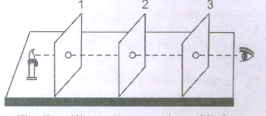
The flame can be seen clearly through the holes. When one of the cardboards is slightly raised, no flame can be seen. This shows that light travels in a straight line. No flame can be seen when the holes of the three cardboards are not in a straight line because light can not bend.
6.
(i) Convex mirror.
(ii) The image formed is virtual, erect and smaller than the size of the object.
(iii) The size of the image will increase as the object is moved closer to the convex mirror but is never larger than the size of the object.
7.
(i) Concave lens.
(ii) The image formed is erect, virtual and diminished.
(iii) The characteristics of the image will not change on changing the position of object.
8.
(a) Plane mirrors are used as looking glasses. They are also used in solar cookers, periscopes and kaleidoscopes.
(b) Concave mirrors are used as reflectors in the headlights of automobiles. As these give erect and magnified images, these are used by doctors to examine parts of bodies, such as ear, nose, throat etc.
(c) Convex mirrors can be used to view a much larger area than is possible with a plane mirror. These are therefore used as rear view or side view mirrors in cars and scooters.
9.
Since, the image is 6m away from the plane mirror. So, it means that the object is also 6m away from the mirror.
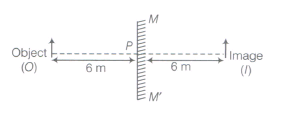
[Because OP = PI]
So, when the person moves 2m towards the plane mirror, then the distance between the person and the plane mirror will be equal to (6 m- 2 m)= 4 m, this means that distance between the image and the mirror will be 4m.
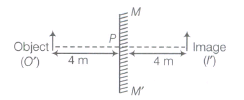
The distance between the person and his image = PO'+ PI' = 4 + 4 = 8 m
10.
In case of mirror, the image formed by it is laterally inverted, i.e. left seems to be right and right seems to be left. So, in ambulance there is emergency for patients to reach hospital and by viewing in rear mirror, it can be easily identified of a vehicle and everyone give him a way.
11.
No, he will not observe band of seven colours because laser light consists of monochromatic light of single colour. But seven colours of bands are only observed, when a white light is passed through a prism and dispersion takes place.
12.
(a) The image which can be formed on the screen is real image.
(b) The image which cannot be formed on the screen is virtual image.
13.
If the reflecting surface of a torch got rusted, it produces diffused light with lower intensity and the objects are not clearly visible in this diffused and lower intensity of light.
14.
These mirrors can be differentiated by bringing our face close to each mirror turn by turn. Since, a plane mirror will produce an image of the same size as our face while a concave mirror will produce a magnified image and our face will look much bigger and on other sides, a convex mirror will produce a diminished image and our face will look much smaller like a small child.
15.
A concave lens always forms a virtual image

7th Standard CBSE Syllabus & Materials
7th Standard CBSE
CBSE 7th Social Science Theme B - New Beginnings : Cities and States - New Sample Question Papers Study Material - QB365 Set A
NEW7th Standard CBSE
CBSE 7th Social Science Theme A - Climates of India - New Sample Question Papers Study Material - QB365 Set A
NEW7th Standard CBSE
CBSE 7th Social Science Theme A - Geographical Diversity of India - New Sample Question Papers Study Material - QB365 Set A
NEW7th Standard CBSE
CBSE 7th Science Earth, Moon and the Sun - New Sample Question Papers Study Material - QB365 Set A



NCERT Books

Syllabus

Exam Pattern

Sample Question Papers

Previous year Question Papers

Important Notes

MCQ Practice test

NCERT Exemplers

Case study Questions

Image Based Questions

Passage based Questions

HOT Questions

Value Based Questions

Model Questions Papers
NCERT ( Book Back ) Questions

Assertion and Reason
Important Questions And Answers

CBSE 7th Standard CBSE Subjects
CBSE Standards


