
 100% FREE ACCESS
7th Standard CBSE Syllabus & Materials
7th Standard CBSE
CBSE 7th Social Science Theme E - Understanding Market - New Sample Question Papers Study Material - QB365 Set A
NEW7th Standard CBSE
CBSE 7th Social Science Theme E - From Barter to Money - New Sample Question Papers Study Material - QB365 Set A
NEW7th Standard CBSE
CBSE 7th Social Science Theme D - The Constitution of India- An Introduction - New Sample Question Papers Study Material - QB365 Set A
NEW7th Standard CBSE
CBSE 7th Social Science Theme D - From the Rulers to the Ruled : Types of Governments - New Sample Question Papers Study Material - QB365 Set A
NEW7th Standard CBSE
CBSE 7th Social Science Theme B - The Age of Reorganisation - New Sample Question Papers Study Material - QB365 Set A
NEW7th Standard CBSE
CBSE 7th Social Science Theme B - The Rise of Empires - New Sample Question Papers Study Material - QB365 Set A

Published on: 31/10/2025
Download CBSE Class 7th Standard CBSE Science question papers, sample papers, important questions, and previous year solved papers in PDF format. Get free study materials, NCERT solutions, and exam preparation resources for Class 7th Standard CBSE Science
Questions + Answers key
Take MCQ Science Test
1.
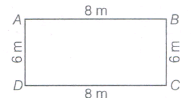
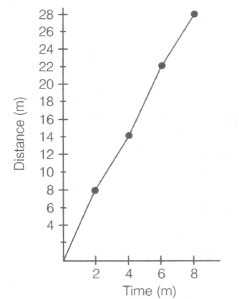
Starting from A, Paheli moves along a rectangular path ABCD as shown in figure. She takes 2 min to travel each side. Plot a distance-time graph and explain whether the motion is uniform or non-uniform.
2.
Differentiate between a uniform and non-uniform motion.
3.
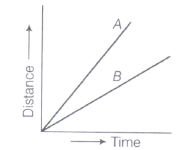
Figure shows the distance-time graph for the motion of two vehicles A and B. Which one of them is moving faster?
4.
Classify the following as motion along a straight line, circular or oscillatory motion.
(a) Motion of your hands while running.
(b) Motion of a horse pulling a cart on a straight road.
(c) Motion of a child in a merry-go-round.
(d) Motion of a child on a see-saw.
(e) Motion of the hammer of an electric bell.
(f) Motion of a train on a straight bridge.
5.
Boojho walks to his school which is at a distance of 3 km from his home in 30 min. On reaching, he finds that the school is closed and comes back by a bicycle with his friend and reaches home in 20 min. His average speed in km/h is
8.3
7.2
5
3.6
6.
The correct symbol to represent the speed of an object is
5 m/s
5 mp
5 m/s-1
5 s/m
7.
How will you convert the speed given in km/h to m/s?
By multiplying with 5/16
By multiplying with 6/5
By multiplying with 18/5
By multiplying with 5/18
8.
What is the relation between distance and speed?
Distance = Speed \(\times\) Time
Distance = Speed/Time
Distance = Time/Speed
None of the above
9.
Which of the following relations is correct?
Speed = Distance \(\times\) Time
\(Speed=\frac{Distance}{Time}\)
\(Speed=\frac{Time}{Distance}\)
\(Speed=\frac{1}{Distance\times\ Time}\)
10.
Name the different types of graphs.
11.
Out of the two given clocks, a pendulum clock or a quartz clock. Mention which of the clock between the given ones requires an electric cell for its working?
12.
If you did not have a clock, how would you decide what time of the day is?
13.
Paheli and Boojho have to cover different distances to reach their school but they take the same time to reach the school. What can you say about their speed?
14.
Distance between Bholu's and Golu's house is 9 km. Bholu has to attend Golu's birthday party at 7 0' clock. He started his journey from his home at 6 0' clock on his bicycle and covered a distance of 6 km in 40 min. At that point, he met Chintu and he spoke to him for 5 min and reached Golu's birthday party at 7 0' clock. With what speed, did he cover the second part of the journey? Calculate his average speed for the entire journey.
15.
Explain by giving example that how can we choose a suitable scale.
16.
The unit of speed is ..................
17.
Motion and__________are relative terms
18.
The distance-time graph for the motion of an object moving with a constant speed is a____________.
19.
The symbols of all units are written in_____________
20.
The distance covered by an object in a________________is called its speed.
21.
Periodic events are used for the measurement of time.
22.
The basic unit of speed is km/h.
23.
The basic unit of time is second.
24.
Faster vehicle has a higher speed.
25.
The motion of a spinning top is rotational motion.
26.
Movement of object in unit time
27.
Odometer
28.
Speedometer
29.
Microseconds
30.
Second
31.
How can you define 60 km/hr ?
32.
What is a simple pendulum ?
33.
Define speed
1.
Since, the distance covered per unit time for the entire distance covered is not the same, the motion is a non-uniform motion
2.
When a body travels equal distance in an equal interval of time, then the body is said to be in a uniform motion.
When a body travels unequal distance in an equal interval of time, then the body is said to be in non-uniform motion.
3.
As, from the given graph, slope of A is greater than B, i.e. distance covered by A in same time with respect to B is greater. So, A is moving with faster speed than B.
4.
(a) Oscillatory
(b) Straight line
(c) Circular
(d) Oscillatory
(e) Oscillatory
(f) Straight line
5.
(b)
7.2
6.
(a)
5 m/s
7.
(d)
By multiplying with 5/18
8.
(a)
Distance = Speed \(\times\) Time
9.
(b)
\(Speed=\frac{Distance}{Time}\)
10.
Different types of graphs are
(i) Line graph
(ii) Pie chart
(iii) Bar graph
11.
A quartz clock requires an electric cell for its working.
12.
We can decide time of the day without clock by seeing shadow formed by the sun, e.g. at noon, shadow formed by the sun is shorter than at evening.
13.
They do not have equal speed because they cover unequal distance in equal intervals of time. One of them has higher speed whom has to cover larger distance with respect to other.
14.
From the question, Bholu covers 3 km distance in 15 min
speed of Bholu \(=\frac{3}{15}\times60=12\ km/h\) \((1\ min=\frac{1}{60}h)\)
Now, average speed is given by
\(=\frac{Total\ distance\ travelled}{Total\ time\ taken}=\frac{9}{1}=9\ km/h\)
15.
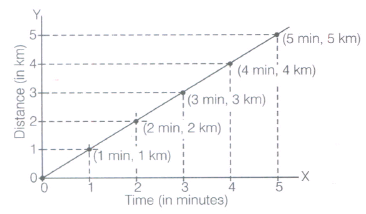
While choosing the most suitable scale for drawing a graph, we should keep the following points in mind
(i) The difference between the highest and lowest values of each quantity.
(ii) The intermediate values of each quantity so that with the scale chosen, it is easy to mark the values on the graph.
(iii) To utilise the maximum part of the paper on which the graph is to be drawn, assume that we have a graph paper of size 25 cm \(\times\) 25 cm and we have to accommodate following data:
| Tim (AM) | Odometer reading | Distance from the starting point |
| 8:00 AM | 36540 km | 0 km |
| 8:30 AM | 36560 km | 20 km |
| 9:00 AM | 36580 km | 40 km |
| 9:30 AM | 36600 km | 60 km |
| 10:00 AM | 36620 km | 80 km |
Since, one of the scales will be
Distance 5 km = 1 cm and Time 6 min = 1 cm
16.
()
m/s
17.
()
Rest
18.
()
straight line
19.
()
singular
20.
()
unit time
21.
(a)
22.
(b)
23.
(a)
24.
(a)
25.
(a)
26.
()
Speed
27.
()
Device to measure distance travelled by vehicle
28.
()
Device to measure speed
29.
()
in scientific research
30.
()
time to complete 100 m race
31.
()
It means 60 km distance travelled by an object in an hour.
32.
()
A simple pendulum consists of a small nonmagnetic ball like body suspended by a light string
33.
()
Speed is the distance covered by a body in a unit time or it is equal to distance travelled divided by time S = \(\frac { d }{ t } \)

7th Standard CBSE Syllabus & Materials
7th Standard CBSE
CBSE 7th Social Science Theme B - New Beginnings : Cities and States - New Sample Question Papers Study Material - QB365 Set A
NEW7th Standard CBSE
CBSE 7th Social Science Theme A - Climates of India - New Sample Question Papers Study Material - QB365 Set A
NEW7th Standard CBSE
CBSE 7th Social Science Theme A - Geographical Diversity of India - New Sample Question Papers Study Material - QB365 Set A
NEW7th Standard CBSE
CBSE 7th Science Earth, Moon and the Sun - New Sample Question Papers Study Material - QB365 Set A



NCERT Books

Syllabus

Exam Pattern

Sample Question Papers

Previous year Question Papers

Important Notes

MCQ Practice test

NCERT Exemplers

Case study Questions

Image Based Questions

Passage based Questions

HOT Questions

Value Based Questions

Model Questions Papers
NCERT ( Book Back ) Questions

Assertion and Reason
Important Questions And Answers

CBSE 7th Standard CBSE Subjects
CBSE Standards


