
 100% FREE ACCESS
7th Standard CBSE Syllabus & Materials
7th Standard CBSE
CBSE 7th Social Science Theme E - Understanding Market - New Sample Question Papers Study Material - QB365 Set A
NEW7th Standard CBSE
CBSE 7th Social Science Theme E - From Barter to Money - New Sample Question Papers Study Material - QB365 Set A
NEW7th Standard CBSE
CBSE 7th Social Science Theme D - The Constitution of India- An Introduction - New Sample Question Papers Study Material - QB365 Set A
NEW7th Standard CBSE
CBSE 7th Social Science Theme D - From the Rulers to the Ruled : Types of Governments - New Sample Question Papers Study Material - QB365 Set A
NEW7th Standard CBSE
CBSE 7th Social Science Theme B - The Age of Reorganisation - New Sample Question Papers Study Material - QB365 Set A
NEW7th Standard CBSE
CBSE 7th Social Science Theme B - The Rise of Empires - New Sample Question Papers Study Material - QB365 Set A

Published on: 31/10/2025
Download CBSE Class 7th Standard CBSE Science question papers, sample papers, important questions, and previous year solved papers in PDF format. Get free study materials, NCERT solutions, and exam preparation resources for Class 7th Standard CBSE Science
Questions + Answers key
Take MCQ Science Test
1.
One day, a five years old boy, Chintoo was playing with his toys in his room. After few minutes, he saw a wristwatch on his study table, so after seeing it, he got crazy and so much in eager to play with that watch. Then, for 2 to 3 min, he was trying to analyse it that whether its a toy or something else, then suddenly, he was just about to throw it but at the same his mother entered into the room and take the watch back immediately from his hand.
(a) State the benefit of a wriswatch.
(b) Briefly mention the values showed by Chintoo's mother here.
2.
Briefly mention how many types of motion are there. Also, name all of them.
3.
Differentiate between a uniform and non-uniform motion.
4.
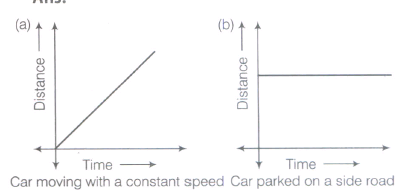
Show the shape of the distance-time graph for the motion in the following cases:
(a) A car moving with a constant speed.
(b) A car parked on a side road.
5.
The odometer of a car reads 57321 km when the clock shows the time 08:30 AM. What is the distance moved by the car, if at 08:50 AM, the odometer reading has changed to 57336 km? Calculate the speed of the car in km/min during this time. Express the speed in km/h also.
6.
Figure shows an oscillating pendulum.
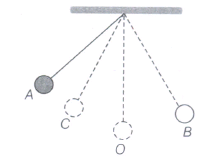
Time taken by the bob to move from A to C is t1 and from C to 0 is t2. The time period of this simple pendulum is
(t1+ t2)
2 (t1+ t2)
3(t1+ t2)
4(t1+ t2)
7.
How will you convert the speed given in km/h to m/s?
By multiplying with 5/16
By multiplying with 6/5
By multiplying with 18/5
By multiplying with 5/18
8.
What is the relation between distance and speed?
Distance = Speed \(\times\) Time
Distance = Speed/Time
Distance = Time/Speed
None of the above
9.
The basic unit of speed is
km/min
m/min
km/h
m/s
10.
Which of the following relations is correct?
Speed = Distance \(\times\) Time
\(Speed=\frac{Distance}{Time}\)
\(Speed=\frac{Time}{Distance}\)
\(Speed=\frac{1}{Distance\times\ Time}\)
11.
State the condition under which the distance-time graph of an object is a horizontal line parallel to the axis of time.
12.
Explain how time was measured when pendulum clocks were not available.
13.
Briefly explain how will decide which object is moving fast and which one is moving slow.
14.
Name the axis that represents dependent variable.
15.
Mention which is the most common thing in almost all the clocks.
16.
Distance between Bholu's and Golu's house is 9 km. Bholu has to attend Golu's birthday party at 7 0' clock. He started his journey from his home at 6 0' clock on his bicycle and covered a distance of 6 km in 40 min. At that point, he met Chintu and he spoke to him for 5 min and reached Golu's birthday party at 7 0' clock. With what speed, did he cover the second part of the journey? Calculate his average speed for the entire journey.
17.
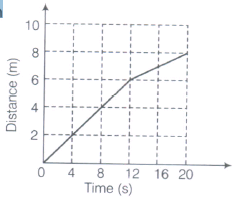
Given below as a figure is the distance-time graph of the motion of an
(a) What will be the position of the object at 20 s?
(b) What will be the distance travelled by the object in 12 s?
(c) What is the average speed ofthe object?
18.
The distance-time graph for the motion of an object moving with a constant speed is a____________.
19.
Motion of objects can be represented in the pictorial form by their__________graph.
20.
The symbols of all units are written in_____________
21.
In a simple pendulum, the metallic ball suspended by thread is called its______________.
22.
The distance covered by an object in a________________is called its speed.
23.
Periodic events are used for the measurement of time.
24.
All the clocks make use of some periodic motion.
25.
The motion of a spinning top is rotational motion.
26.
The symbols of all units are written in singular.
27.
The motion of a spinning top is rotational motion.
1.
(a) The wristwatch can be handled very easily to check the time in comparison to the wall clock.
(b) The values showed by Chintoo's mother here is the concern towards her four years old child and also the concern towards that wristwatch while considering the importance of money.
2.
Different types of motion are there and they can be named as follows
(i) Periodic motion
(ii) Rolling motion
(iii) Rotatory motion
(iv) Oscillatory and vibratory motions
(v) Translatory motion
3.
When a body travels equal distance in an equal interval of time, then the body is said to be in a uniform motion.
When a body travels unequal distance in an equal interval of time, then the body is said to be in non-uniform motion.
4.
5.
As, we know that
\(Speed=\frac{Distance\ covered}{Time\ taken}\)
Given, distance covered = 57336 - 57321=15km
Time taken = 8: 50 AM- 8: 30 AM= 20min
\(Speed=\frac{15}{20}=\frac{3}{4}km/min\)
Now, speed in km/h is given by \(\frac{3}{4}\times60\)
= 45 km/h \([1min=\frac{1}{60}h]\)
6.
(d)
4(t1+ t2)
7.
(d)
By multiplying with 5/18
8.
(a)
Distance = Speed \(\times\) Time
9.
(d)
m/s
10.
(b)
\(Speed=\frac{Distance}{Time}\)
11.
When the object is at rest, then the distance-time graph of an object is a horizontal line parallel to the axis of time.
12.
Before the discovery of pendulum clocks, sundials, water clocks and sand clocks were used.
13.
If an object covers more distance in equal intervals of time with respect to other, then we can say that object is moving faster with respect to the other object.
14.
y-axis represents the dependent variable.
15.
The most common thing in almost all the clocks is that all of them shows periodic motion.
16.
From the question, Bholu covers 3 km distance in 15 min
speed of Bholu \(=\frac{3}{15}\times60=12\ km/h\) \((1\ min=\frac{1}{60}h)\)
Now, average speed is given by
\(=\frac{Total\ distance\ travelled}{Total\ time\ taken}=\frac{9}{1}=9\ km/h\)
17.
(a) From the graph, it is clear that the distance at 20 s is 8 m.
(b) Distance travelled by the body object in 12 s is 6 m.
(c) \(Average\ speed=\frac{Total\ distance}{Total\ time}=\frac{8}{20}=0.4m/s\)
18.
()
straight line
19.
()
distance-time
20.
()
singular
21.
()
bob
22.
()
unit time
23.
(a)
24.
(a)
25.
(a)
26.
(a)
27.
(a)

7th Standard CBSE Syllabus & Materials
7th Standard CBSE
CBSE 7th Social Science Theme B - New Beginnings : Cities and States - New Sample Question Papers Study Material - QB365 Set A
NEW7th Standard CBSE
CBSE 7th Social Science Theme A - Climates of India - New Sample Question Papers Study Material - QB365 Set A
NEW7th Standard CBSE
CBSE 7th Social Science Theme A - Geographical Diversity of India - New Sample Question Papers Study Material - QB365 Set A
NEW7th Standard CBSE
CBSE 7th Science Earth, Moon and the Sun - New Sample Question Papers Study Material - QB365 Set A



NCERT Books

Syllabus

Exam Pattern

Sample Question Papers

Previous year Question Papers

Important Notes

MCQ Practice test

NCERT Exemplers

Case study Questions

Image Based Questions

Passage based Questions

HOT Questions

Value Based Questions

Model Questions Papers
NCERT ( Book Back ) Questions

Assertion and Reason
Important Questions And Answers

CBSE 7th Standard CBSE Subjects
CBSE Standards


