
 100% FREE ACCESS
7th Standard CBSE Syllabus & Materials
7th Standard CBSE
CBSE 7th Social Science Theme E - Understanding Market - New Sample Question Papers Study Material - QB365 Set A
NEW7th Standard CBSE
CBSE 7th Social Science Theme E - From Barter to Money - New Sample Question Papers Study Material - QB365 Set A
NEW7th Standard CBSE
CBSE 7th Social Science Theme D - The Constitution of India- An Introduction - New Sample Question Papers Study Material - QB365 Set A
NEW7th Standard CBSE
CBSE 7th Social Science Theme D - From the Rulers to the Ruled : Types of Governments - New Sample Question Papers Study Material - QB365 Set A
NEW7th Standard CBSE
CBSE 7th Social Science Theme B - The Age of Reorganisation - New Sample Question Papers Study Material - QB365 Set A
NEW7th Standard CBSE
CBSE 7th Social Science Theme B - The Rise of Empires - New Sample Question Papers Study Material - QB365 Set A

Published on: 31/10/2025
Download CBSE Class 7th Standard CBSE Science question papers, sample papers, important questions, and previous year solved papers in PDF format. Get free study materials, NCERT solutions, and exam preparation resources for Class 7th Standard CBSE Science
Questions + Answers key
Take MCQ Science Test
1.
Seema's family is shifted from Masouri to Mumbai, She saw the outer walls of their house were painted white. Moreover, she noticed that it is better when she is out of the house in comparison to inside of the house. Her mother gave her some light cotton clothes to wear.
On the basis of the situation answer the following:
(i) How does the heat reach us from the Sun?
(ii) Why is the wall painted white but not with any other colour?
(iii) Why did her mother prefer cotton clothes?
2.
What precautions are needed while reading a laboratory thermometer?
3.
Why is the handle of a metallic kettle covered with strips of cane?
4.
Show that water is a bad conductor of heat.
5.
How does heat travel in air ? Give any two such instances.
6.
Describe the mode of heat transfer in water or gases.
7.
Soil is very important for the living beings? Justify.
8.
What are chemical fertilizers? Write their harmful effects
9.
Show that dry soil also contains some amount of water
10.
Describe in brief the steps followed in making earthen pots.
11.
As Rishab is fond of eating chocolates, his mother always discusses about the importance of teeth in our life and to take care of it. Rishab is reluctant to follow the instructions given by his mother. One day while bitting guava he saw blood patch on it. He became afraid and asked his mother the following questions:
(i) Which is the problem coming in my teeth which cause toothache?
(ii) How can I get rid of it?
(iii) Which value is promoted by Rishab's mother?
12.
What do you mean by salivary digestion?
13.
Write various components of food.
14.
What happens with the carbohydrates like starch in our body which are taken by us?
15.
Explain the process of rumination in the ruminant animals.
16.
Write the three components and their functions of juice secreted by the inner wall of the stomach
17.
Write various components of food.
18.
What do you mean by tooth decay? Explain its process.
19.
Draw a labelled diagram of human digestive system to show various organs associated with it.
20.
Write three functions of tongue
1.
(i) The radiation of the Sun gives us heat which do not require any medium.
(ii) White colour absorbs less heat coming from Sun and more it reflects. The temperature of any object increases due to absorbed part of the heat, in case of white colour it is least.
(iii) Her mother preferred cotton clothes as they are light and porous through which air can pass easily and make our body cool, as the climate of Mumbai is temperate.
2.
(i) The thermometer should be kept upright not tilted.
(ii) Bulb should be surrounded from all sides by the substance by which the temperature is to be measured.
(iii) The bulb should not touch the surface of the container.
3.
Handle of a metallic kettle is covered with strips of cane because when kettle is heated, the heat does not pass through strips of cane. The strips of cane are bad conductor of heat and we may hold the handle with our bare hands.
4.
Take a test-tube. Half fill it with cold water. Now drop in it a cube of ice wrapped in a wire gauze. It sinks to the bottom. Hold the top end of the test-tube with a test-tube holder. Heat it over a flame. It will be noticed that water starts boiling but ice is not fully melted. It means that heat has been transferred through the molecules of water. This shows that water is a bad conductor of heat.
5.
The air near the heat source gets hot and rises. The cold air from sides takes its place. In this way, air gets heated. This gives interesting phenomenon in coastal regions.
(i) During the day, land gets heated faster than water. The air over the land becomes hotter and rises up. The cooler air from sea rushes in towards the land to take its place. The warm air from land moves towards sea to complete the cycle. The air from sea is cool and is called sea breeze.
(ii) At night, it is exactly the reverse. The water cools down more slowly than land. So, the cool air from land moves towards sea. This is called land breeze.
6.
Take water in a flask and heat it. It is seen that water near the flame gets hot and it rises up. The cold water from the side moves down, towards the source of heat. This water also
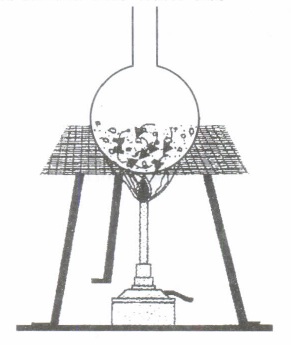
gets hot and rises and more water moves down from the side. This process continues till the whole water gets hot. This mode of heat transfer is called convection. Similar process happens in gases.
7.
Soil is one of the most important natural resources because
(a) It supports the growth of plants by holding the roots firmly and supplying water and nutrients.
(b) It is the home for many organisms.
(c) Soil is essential for agriculture. Agriculture provides food, clothing and shelter for all.
(d) Soil is thus an inseparable part of our life
8.
The chemical substances which are rich in nutrients and used to maintain fertility are called fertilizers. They also produce harmful effects. They ramain in soil and spoil the porous structure of the soil which is essential for plant growth. They also kill the soil organisms like earthworms. Earthworms burrows and loosens the soil and makes it porous.
9.
Take a boiling tube. Take some amount of soil in it. Now heat tube on a flame and observe. On heating, water in the soil evaporates, moves up and condenses on the cooler inner walls of the upper part of the boiling tube. This activity shows that dry soil also contains water.
10.
For making earthen pots, following steps are followed:
(i) Soil is collected from barren lands and place in a tank. It is cleared of all pebbles etc., and soaked for about 8 hours.
(ii) The soil is then kneaded after mixing horse dung in it.
(iii) The kneaded soil is given appropriate shape by placing on the wheel. Then the final shape is given by hand.
(iv) The items are coloured after three days of drying. Then all the items are baked in high temperature.
11.
(i) The problem is of tooth decay which causes toothache.
(ii) One should clean the teeth with a toothbrush twice a day. Chocolates should be avoided.
(iii) She is aware and concerned about the problems arising in the teeth especially of younger children.
12.
The food enters into the buccal cavity through mouth. It is chewed by the teeth and mixed with saliva. Saliva contains an enzyme called ptyalin (salivary amylase) which converts complex carbohydrates like starch into sugar. That is why the bread taste becomes sweet after chewing. This type of digestion is called salivary digestion.
13.
The various components of food are as following:
(i) Carbohydrates
(ii) Fats
(iii) Proteins
(iv) Vitamins
(v)Minerals
(vi) Water and Roughage
14.
Carbohydrates are complex substances. These complex substances cannot be utilised as such as we eat. They are broken down into simpler substances like glucose. This process is called digestion of carbohydrates.
15.
The animals which have a separate part of stomach (rumen) are called ruminants. In this part the food is partially digested and is called cud. But later the cud returns to mouth in small lumps and the animal chews it. This process is called rumination or chewing cud. These animals are called ruminants.
16.
The inner lining of stomach secretes the following
component:
(i) Mucous: It protects the lining of stomach.
(ii) Hydrochloric acid: It kills the germs and makes the food acidic.
(iii) Digestive juices: They help to break the proteins into simple substances.
17.
The various components of food are as following:
(i) Carbohydrates
(ii) Fats
(iii) Proteins
(iv) Vitamins
(v)Minerals
(vi) Water and Roughage
18.
If we do not clean our teeth and mouth after eating, many harmful bacteria start to live in it. These bacteria breakdown the sugars present from the leftover food and release acids. The acids gradually damage the teeth. This is called tooth decay. It causes tooth loss in many cases.
19.
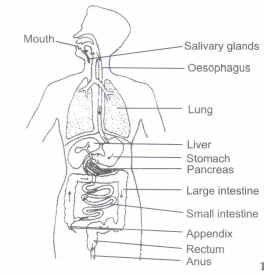
20.
(i) It helps in talking.
(ii) It helps to mix saliva with the food.
(iii)It also helps in swallowing food.

7th Standard CBSE Syllabus & Materials
7th Standard CBSE
CBSE 7th Social Science Theme B - New Beginnings : Cities and States - New Sample Question Papers Study Material - QB365 Set A
NEW7th Standard CBSE
CBSE 7th Social Science Theme A - Climates of India - New Sample Question Papers Study Material - QB365 Set A
NEW7th Standard CBSE
CBSE 7th Social Science Theme A - Geographical Diversity of India - New Sample Question Papers Study Material - QB365 Set A
NEW7th Standard CBSE
CBSE 7th Science Earth, Moon and the Sun - New Sample Question Papers Study Material - QB365 Set A



NCERT Books

Syllabus

Exam Pattern

Sample Question Papers

Previous year Question Papers

Important Notes

MCQ Practice test

NCERT Exemplers

Case study Questions

Image Based Questions

Passage based Questions

HOT Questions

Value Based Questions

Model Questions Papers
NCERT ( Book Back ) Questions

Assertion and Reason
Important Questions And Answers

CBSE 7th Standard CBSE Subjects
CBSE Standards


