
 100% FREE ACCESS
7th Standard CBSE Syllabus & Materials
7th Standard CBSE
CBSE 7th Social Science Theme E - Understanding Market - New Sample Question Papers Study Material - QB365 Set A
NEW7th Standard CBSE
CBSE 7th Social Science Theme E - From Barter to Money - New Sample Question Papers Study Material - QB365 Set A
NEW7th Standard CBSE
CBSE 7th Social Science Theme D - The Constitution of India- An Introduction - New Sample Question Papers Study Material - QB365 Set A
NEW7th Standard CBSE
CBSE 7th Social Science Theme D - From the Rulers to the Ruled : Types of Governments - New Sample Question Papers Study Material - QB365 Set A
NEW7th Standard CBSE
CBSE 7th Social Science Theme B - The Age of Reorganisation - New Sample Question Papers Study Material - QB365 Set A
NEW7th Standard CBSE
CBSE 7th Social Science Theme B - The Rise of Empires - New Sample Question Papers Study Material - QB365 Set A

Published on: 31/10/2025
Download CBSE Class 7th Standard CBSE Science question papers, sample papers, important questions, and previous year solved papers in PDF format. Get free study materials, NCERT solutions, and exam preparation resources for Class 7th Standard CBSE Science
Questions + Answers key
Take MCQ Science Test
1.
As Rishab is fond of eating chocolates, his mother always discusses about the importance of teeth in our life and to take care of it. Rishab is reluctant to follow the instructions given by his mother. One day while bitting guava he saw blood patch on it. He became afraid and asked his mother the following questions:
(i) Which is the problem coming in my teeth which cause toothache?
(ii) How can I get rid of it?
(iii) Which value is promoted by Rishab's mother?
2.
Write various components of food.
3.
What happens with the carbohydrates like starch in our body which are taken by us?
4.
Draw a labelled diagram of human digestive system to show various organs associated with it.
5.
Write three functions of tongue
6.
Solve the crossword given as Figure:
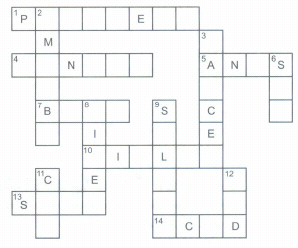
Across
1. Cream-coloured digestive gland
3. Undigested excretory solid residues
4. Organ that mixes saliva with the food
5. Point of defecation
7. Stored in gall bladder.
10. Finger-like outgrowth in the small intestine
13. Kind of taste buds
14. Kills bacteria in the stomach
Down
2. Feeds with the help of pseudopodia
6. Total number of molars in one jaw of an adult
8. largest gland
9. Watery secretion in the mouth
11. A ruminant
12. Form of food chewed by ruminants.
7.
Recall and name the main organs of the digestive system in our body.
8.
Cellulose rich food substances are good source of roughage in human beings. Justify.
9.
Is there any role of liver in digestion of fats? Explain.
10.
Explain how assimilation is different from absorption.
11.
The swallowed food moves downwards in the alimentary canal. Explain.
12.
Gastric glands in stomach release hydrochloric acid, enzyme pepsin and mucus. What will happen if mucus is not secreted by the gastric glands?
13.
Boojho and Paheli were eating their food hurriedly so that they could go out and play during the recess. Suddenly, Boojho started coughing violently. Think of the reasons, why he was coughing and discuss with your friends?
14.
Name the various components of food and their simpler forms.
15.
Can we survive only on raw, leafy vegetables/grass? Discuss.
1.
(i) The problem is of tooth decay which causes toothache.
(ii) One should clean the teeth with a toothbrush twice a day. Chocolates should be avoided.
(iii) She is aware and concerned about the problems arising in the teeth especially of younger children.
2.
The various components of food are as following:
(i) Carbohydrates
(ii) Fats
(iii) Proteins
(iv) Vitamins
(v)Minerals
(vi) Water and Roughage
3.
Carbohydrates are complex substances. These complex substances cannot be utilised as such as we eat. They are broken down into simpler substances like glucose. This process is called digestion of carbohydrates.
4.
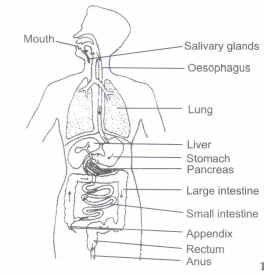
5.
(i) It helps in talking.
(ii) It helps to mix saliva with the food.
(iii)It also helps in swallowing food.
6.
7.
The different organs of the alimentary canal are as follows:
(i) Mouth and mouth cavity
(ii) Oesophagus
(iii) Stomach
(iv) Small intestine
(v) Large intestine
(vi) Anus
8.
Cellulose rich food substances are good source of roughage in human beings. It is because the cellulose digesting bacteria are not present in the body of human beings due to which human beings cannot digest cellulose (present in plant foods).
9.
Yes, liver produces bile which has bile salts. These salts break large fat molecules to fine droplets. These fine droplets are further converted into fatty acids and glycerol.
10.
The process by which nutrients from the digested food are absorbed by the body is called absorption whereas the process by which the absorbed nutrients are utilised by
the body for providing energy is called assimilation.
11.
The swallowed food moves downwards in the alimentary canal because of the alternate relaxation contraction movement of muscles in the wall of foodpipe called peristalsis.
12.
Mucus protects the inner lining of stomach form the action of hydrochloric acid and enzyme pepsin. If mucus is not released, it will lead to erosion of inner lining of stomach leading to acidity and ulcers.
13.
Sometimes when we eat hurriedly, talks or laughs while eating, the flap-like valve (called epiglottis) which closes the passage of windpipe remains open. Therefore, the food may enter into the windpipe. Coughing helps to clear the passage and returns the food particle back to the foodpipe.
14.
The various components of food and their simpler forms are
| Components of food | Simpler form |
| Carbohydrate | Glucose |
| Fats | Fatty acids and glycerol |
| Proteins | Amino acids |
| Vitamins | Vitamins |
| Minerals and water | Minerals and water |
15.
No, we connot survive only on raw, vegetables/grasses. This is due to the absence of cellulose degrading/digesting enzymes. Raw plants, vegetables and grasses, etc, contain chlorophyll, which is digested in ruminants by the action of microorganism but humans do not posses these microorganisms. Therefore, we would not be able to digest cellulose and meet our energy requirements.

7th Standard CBSE Syllabus & Materials
7th Standard CBSE
CBSE 7th Social Science Theme B - New Beginnings : Cities and States - New Sample Question Papers Study Material - QB365 Set A
NEW7th Standard CBSE
CBSE 7th Social Science Theme A - Climates of India - New Sample Question Papers Study Material - QB365 Set A
NEW7th Standard CBSE
CBSE 7th Social Science Theme A - Geographical Diversity of India - New Sample Question Papers Study Material - QB365 Set A
NEW7th Standard CBSE
CBSE 7th Science Earth, Moon and the Sun - New Sample Question Papers Study Material - QB365 Set A



NCERT Books

Syllabus

Exam Pattern

Sample Question Papers

Previous year Question Papers

Important Notes

MCQ Practice test

NCERT Exemplers

Case study Questions

Image Based Questions

Passage based Questions

HOT Questions

Value Based Questions

Model Questions Papers
NCERT ( Book Back ) Questions

Assertion and Reason
Important Questions And Answers

CBSE 7th Standard CBSE Subjects
CBSE Standards


