
 100% FREE ACCESS
7th Standard CBSE Syllabus & Materials
7th Standard CBSE
CBSE 7th Social Science Theme E - Understanding Market - New Sample Question Papers Study Material - QB365 Set A
NEW7th Standard CBSE
CBSE 7th Social Science Theme E - From Barter to Money - New Sample Question Papers Study Material - QB365 Set A
NEW7th Standard CBSE
CBSE 7th Social Science Theme D - The Constitution of India- An Introduction - New Sample Question Papers Study Material - QB365 Set A
NEW7th Standard CBSE
CBSE 7th Social Science Theme D - From the Rulers to the Ruled : Types of Governments - New Sample Question Papers Study Material - QB365 Set A
NEW7th Standard CBSE
CBSE 7th Social Science Theme B - The Age of Reorganisation - New Sample Question Papers Study Material - QB365 Set A
NEW7th Standard CBSE
CBSE 7th Social Science Theme B - The Rise of Empires - New Sample Question Papers Study Material - QB365 Set A

Published on: 31/10/2025
Download CBSE Class 7th Standard CBSE Science question papers, sample papers, important questions, and previous year solved papers in PDF format. Get free study materials, NCERT solutions, and exam preparation resources for Class 7th Standard CBSE Science
Questions + Answers key
Take MCQ Science Test
1.
The swallowed food moves downwards in the alimentary canal because of
force provided by the muscular tongue
the flow of water taken with the food
gravitational pull
the contraction of muscles in the wall of food pipe
2.
Which of the following pair of teeth differ in structure but are similar in function?
Canines and incisors
Molars and premolars
Incisors and molars
Premolars and canines
3.
Hydrochloric acid is secreted by
linings of small intestine
inner lining of stomach
pancreas
lining of liver
4.
Water from the undigested food is absorbed mainly in the
stomach
foodpipe
small intestine
large intestine
5.
Fat is completely digested in the
stomach
mouth
small intestine
large intestine
6.
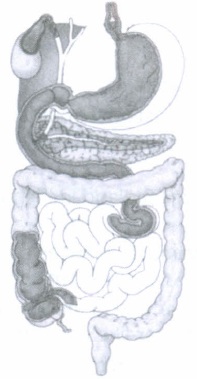
Label the given figure of the digestive system.
7.
Write one similarity and one difference between nutrition in Amoeba and human beings.
8.
Which part of the digestive canal is involved in
(a) absorption of food
(b) chewing of food
(c) killing of bacteria
(d) complete digestion of food
(e) formation of faeces
9.
Why do we get instant energy from glucose?
10.
Name the type of carbohydrate that can be digested by ruminants but not by humans. Give the reason also.
11.
Where is the bile produced? Which component of the food does it help to digest?
12.
Suggest the organ of digestive system where the digestive juices from liver and pancreas is poured.
13.
The long structure of small intestine is accommodated in small space within our body. Comment.
14.
Explain the role of mucus secreted by stomach.
15.
Name the secretions of stomach which digest food.
16.
We should not eat hurriedly. Give reason.
17.
You were blindfolded and asked to identify the drinks provided in two different glasses. You could identify drink A as lime juice and B as bitter gourd juice. How could you do it inspite of being blindfolded?
18.
Jaya returned from school and found that grandmother was scolding her maid, Rani as she did not come yesterday. The maid told that his son was passing watery stools frequently that's why she didn't come. Jaya's mother who was listening the discussion came to them and told Rani not to come for coming 3-4 days. She also suggested her to give his son a solution of sugar and salt in clean water, many times a day for fast recovery. Jaya was surprised. She rushed to her mother and asked the scientific reason for it. Her mother smiled and explained her the importance of this solution.
(a) Name the term used to describe the condition in which a person passes out watery stools.
(b) Name the solution of sugar and salt in water. Why is it given to a person suffering from diarrhoea?
(c) What are the values shown by Jaya?
19.
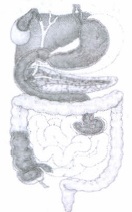
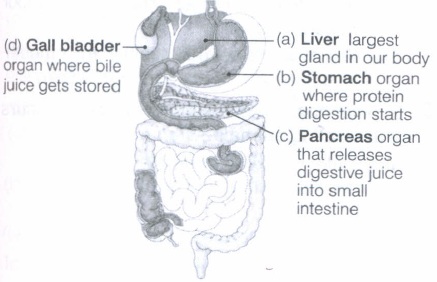
Label the following parts of above figure and name them.
(a) The largest gland in our body.
(b) The organ where protein digestion starts.
(c) The organ that releases digestive juice into the small intestine.
(d) The organ where bile juice gets stored.
20.
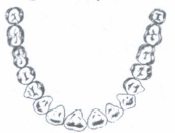
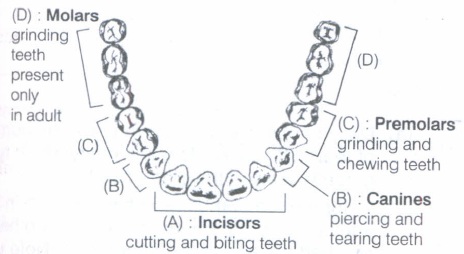
Label the given figure as directed below in A to D and give the name of each type of teeth.
(a) The cutting and biting teeth as A
(b) The piercing and tearing teeth as B
(c) The grinding and chewing teeth as C
(d) The grinding teeth present only in adult as D.
1.
(d)
the contraction of muscles in the wall of food pipe
2.
(b)
Molars and premolars
3.
(b)
inner lining of stomach
4.
Large intestine absorbs the water from undigested food.
5.
Small intestine is the site for complete digestion of fats by the action of bile juice
6.
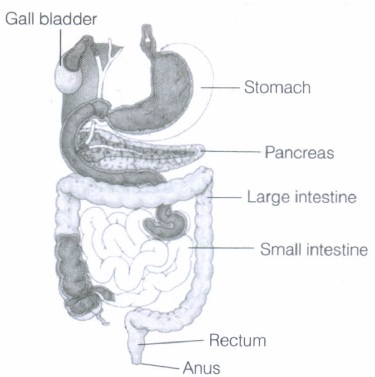
The digestive system is composed of following parts:
7.
Both Amoeba and humans require energy for the growth and maintenance of their bodies. This energy is derived from the food they eat. The food is in a complex form and is therefore broken down into simple forms by the process of digestion. Both these organisms are heterotrophs, i.e. they derive their food from other plants or animals.
Difference between nutrition in Amoeba and human beings are
| Digestion in human | Digestion in Amoeba |
| Humans have mouth and complex digestive system. |
Mouth and digestive system are absent in Amoeba. |
| Digestive juices are secreted in the buccal cavity, stomach and small intestine. |
Digestive juices are secreted in the food vacuole. |
| Digestion of carbohydrates, proteins and fats starts in separate regions. |
All the food components are digested in the food vacuole. |
8.
Parts of digestive canal that are involved in following processes are
(a) small intestine
(b) buccal cavity
(c) stomach
(d) small intestine
(e) large intestine
9.
Glucose is a simple sugar or carbohydrate which is broken down in the presence of oxygen into CO2 and H2O and releases instant energy. Glucose is easily absorbed by the blood, hence provides instant energy to the body.
10.
Cellulose is the carbohydrate that can be digested by ruminants but not by humans because ruminants have a large sac-like structure called rumen which is located between the small intestine and large intestine. Certain bacteria are present in rumen which helps in digesting cellulose.
11.
Bile juice is produced by the liver and stored in gall bladder. It helps in digestion of fats present in food.
12.
The digestive juices from liver and pancreas is poured into small intestine which helps in complete digestion and absorption of food.
13.
The small intestine is about 7.5 metre long It is accommodated in a coiled form inside our body.
14.
The function of mucus is to protect the lining of stomach from the action of hydrochloric acid secreted by stomach lining.
15.
The inner lining of stomach secretes mucous hydrochloric acid and digestive juices.
16.
We should not eat hurriedly because if we ingest food in hurry or we talk or laugh while eating we experience hiccups, coughing or choking sensation.
17.
Inspite of being blindfolded, one could identify two different drinks with the help of taste buds present in the tongue.
18.
(a) Diarrhoea.
(b) Oral Rehydration Solution (ORS). It is given to a person suffering from diarrhoea to prevent the dehydration.
(c) She is sincere, curious and has interest in science.
19.
20.

7th Standard CBSE Syllabus & Materials
7th Standard CBSE
CBSE 7th Social Science Theme B - New Beginnings : Cities and States - New Sample Question Papers Study Material - QB365 Set A
NEW7th Standard CBSE
CBSE 7th Social Science Theme A - Climates of India - New Sample Question Papers Study Material - QB365 Set A
NEW7th Standard CBSE
CBSE 7th Social Science Theme A - Geographical Diversity of India - New Sample Question Papers Study Material - QB365 Set A
NEW7th Standard CBSE
CBSE 7th Science Earth, Moon and the Sun - New Sample Question Papers Study Material - QB365 Set A



NCERT Books

Syllabus

Exam Pattern

Sample Question Papers

Previous year Question Papers

Important Notes

MCQ Practice test

NCERT Exemplers

Case study Questions

Image Based Questions

Passage based Questions

HOT Questions

Value Based Questions

Model Questions Papers
NCERT ( Book Back ) Questions

Assertion and Reason
Important Questions And Answers

CBSE 7th Standard CBSE Subjects
CBSE Standards


