
 100% FREE ACCESS
7th Standard CBSE Syllabus & Materials
7th Standard CBSE
CBSE 7th Social Science Theme E - Understanding Market - New Sample Question Papers Study Material - QB365 Set A
NEW7th Standard CBSE
CBSE 7th Social Science Theme E - From Barter to Money - New Sample Question Papers Study Material - QB365 Set A
NEW7th Standard CBSE
CBSE 7th Social Science Theme D - The Constitution of India- An Introduction - New Sample Question Papers Study Material - QB365 Set A
NEW7th Standard CBSE
CBSE 7th Social Science Theme D - From the Rulers to the Ruled : Types of Governments - New Sample Question Papers Study Material - QB365 Set A
NEW7th Standard CBSE
CBSE 7th Social Science Theme B - The Age of Reorganisation - New Sample Question Papers Study Material - QB365 Set A
NEW7th Standard CBSE
CBSE 7th Social Science Theme B - The Rise of Empires - New Sample Question Papers Study Material - QB365 Set A

Published on: 31/10/2025
Download CBSE Class 7th Standard CBSE Science question papers, sample papers, important questions, and previous year solved papers in PDF format. Get free study materials, NCERT solutions, and exam preparation resources for Class 7th Standard CBSE Science
Questions + Answers key
Take MCQ Science Test
1.
How do ruminants digest the cellulose?
2.
Explain the human digestive system with the help of labelled diagram.
3.
Define oral rehydration solution and when it is given to the patient? How can you prepare ORS at home?
4.
Jaya returned from school and found that grandmother was scolding her maid, Rani as she did not come yesterday. The maid told that his son was passing watery stools frequently that's why she didn't come. Jaya's mother who was listening the discussion came to them and told Rani not to come for coming 3-4 days. She also suggested her to give his son a solution of sugar and salt in clean water, many times a day for fast recovery. Jaya was surprised. She rushed to her mother and asked the scientific reason for it. Her mother smiled and explained her the importance of this solution.
(a) Name the term used to describe the condition in which a person passes out watery stools.
(b) Name the solution of sugar and salt in water. Why is it given to a person suffering from diarrhoea?
(c) What are the values shown by Jaya?
5.
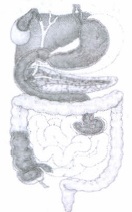
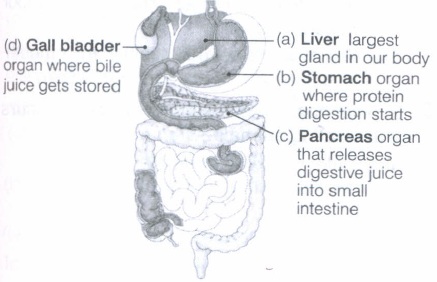
Label the following parts of above figure and name them.
(a) The largest gland in our body.
(b) The organ where protein digestion starts.
(c) The organ that releases digestive juice into the small intestine.
(d) The organ where bile juice gets stored.
6.
As Rishab is fond of eating chocolates, his mother always discusses about the importance of teeth in our life and to take care of it. Rishab is reluctant to follow the instructions given by his mother. One day while bitting guava he saw blood patch on it. He became afraid and asked his mother the following questions:
(i) Which is the problem coming in my teeth which cause toothache?
(ii) How can I get rid of it?
(iii) Which value is promoted by Rishab's mother?
1.
The food of ruminants like grass is rich in cellulose (a type of carbohydrate). Ruminants have a large sac-like structure between the small intestine and large intestine. The cellulose of the food is digested here by the action of certain bacteria which are not present in humans. In this way ruminants can digest the cellulose but many animals including human can not digest cellulose.
2.
When the ingest food in our mouth, salivary glands of the mouth secrete saliva which moistens the food. It also converts the starch into sugar. The tongue helps in chewing by moving the food in various directions. Saliva contains enzyme called salivary amylase which converts starch into sugar.
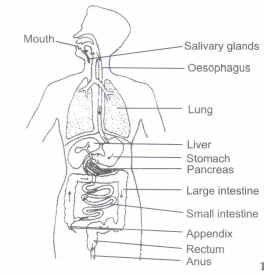
From mouth, food goes into food pipe called oesophagus. As food enters into the food pipe, muscles of its wall starts contraction and relaxation movement. This movement is called peristaltic movement that pushes the food into the stomach. The peristaltic movement occurs throughout the alimentary canal. The oesophagus leads the food to a saclike structure called stomach. The food is churned and partly digested in the stomach. The semi-solid food passes from the stomach to much coiled tube-like structure called the small intestine. The small intestine serves two purposes-digestion and absorption of the digested food. It is about 20 feet long. The inner surface of the small intestine has a large number of finger-like projections called villi. The villi increase the surface area for the absorption of digested food. The absorbed food enters into the blood stream and carried away to various parts of the body for assimilation. The undigested food moves from the small intestine to the large intestine where mainly absorption of water from the undigestion takes place. From the large intestine, the undigested food passes to the rectum which pushes it out of the body through the opening called the anus as faeces.
3.
Oral rehydration solution is the solution of sugar and salt in a particular ratio in the clean water. When a person passes out watery stools frequently, the disease is called diarrhoea. In this condition there is a loss of water and salt from the body of a person.
This is called dehydration which may be fatal if not cured at proper time. In order to prevent dehydration, the person or patient should be given ORS. ORS makes up the loss of water and salts in the body and sugar provides energy which helps in the recovery of disease. It should be given to a patient suffering from diarrhoea at a regular interval.
At home the ORS can be prepared by dissolving a teaspoonful of sugar and pinch of salt in a glass of clean water. The water used for preparing ORS should be first boiled and then cooled so that all the microorganisms or harmful bacteria may be killed.
4.
(a) Diarrhoea.
(b) Oral Rehydration Solution (ORS). It is given to a person suffering from diarrhoea to prevent the dehydration.
(c) She is sincere, curious and has interest in science.
5.
6.
(i) The problem is of tooth decay which causes toothache.
(ii) One should clean the teeth with a toothbrush twice a day. Chocolates should be avoided.
(iii) She is aware and concerned about the problems arising in the teeth especially of younger children.

7th Standard CBSE Syllabus & Materials
7th Standard CBSE
CBSE 7th Social Science Theme B - New Beginnings : Cities and States - New Sample Question Papers Study Material - QB365 Set A
NEW7th Standard CBSE
CBSE 7th Social Science Theme A - Climates of India - New Sample Question Papers Study Material - QB365 Set A
NEW7th Standard CBSE
CBSE 7th Social Science Theme A - Geographical Diversity of India - New Sample Question Papers Study Material - QB365 Set A
NEW7th Standard CBSE
CBSE 7th Science Earth, Moon and the Sun - New Sample Question Papers Study Material - QB365 Set A



NCERT Books

Syllabus

Exam Pattern

Sample Question Papers

Previous year Question Papers

Important Notes

MCQ Practice test

NCERT Exemplers

Case study Questions

Image Based Questions

Passage based Questions

HOT Questions

Value Based Questions

Model Questions Papers
NCERT ( Book Back ) Questions

Assertion and Reason
Important Questions And Answers

CBSE 7th Standard CBSE Subjects
CBSE Standards


