
 100% FREE ACCESS
7th Standard CBSE Syllabus & Materials
7th Standard CBSE
CBSE 7th Social Science Theme E - Understanding Market - New Sample Question Papers Study Material - QB365 Set A
NEW7th Standard CBSE
CBSE 7th Social Science Theme E - From Barter to Money - New Sample Question Papers Study Material - QB365 Set A
NEW7th Standard CBSE
CBSE 7th Social Science Theme D - The Constitution of India- An Introduction - New Sample Question Papers Study Material - QB365 Set A
NEW7th Standard CBSE
CBSE 7th Social Science Theme D - From the Rulers to the Ruled : Types of Governments - New Sample Question Papers Study Material - QB365 Set A
NEW7th Standard CBSE
CBSE 7th Social Science Theme B - The Age of Reorganisation - New Sample Question Papers Study Material - QB365 Set A
NEW7th Standard CBSE
CBSE 7th Social Science Theme B - The Rise of Empires - New Sample Question Papers Study Material - QB365 Set A

Published on: 31/10/2025
Download CBSE Class 7th Standard CBSE Science question papers, sample papers, important questions, and previous year solved papers in PDF format. Get free study materials, NCERT solutions, and exam preparation resources for Class 7th Standard CBSE Science
Questions + Answers key
Take MCQ Science Test
1.
In the absence of photosynthesis, life would be impossible on earth. Is it true or false?
2.
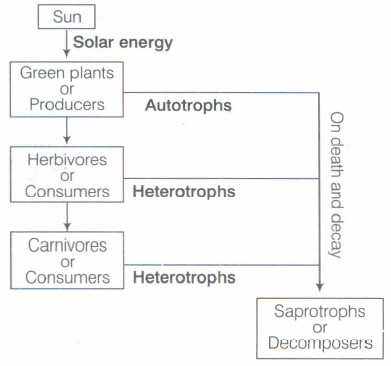
Show with the help of a sketch that the plants are the ultimate source of food.
3.
Give a brief description of the process of synthesis of food in green plants.
4.
How would you test the presence of starch in leaves?
5.
Distinguish between a parasite and a saprotroph.
6.
Why do organisms need to take food?
7.
Organisms which prepare food for themselves using simple naturally available raw materials are referred to as
heterotrophs
autotrophs
parasites
saprophytes
8.
Plants take carbon dioxide from the atmosphere mainly through their
roots
stem
flowers
leaves
9.
Which part of the plant takes in carbon dioxide from the air for photosynthesis?
Root hair
Stomata
Leaf veins
Sepals
10.
The plant which traps and feeds on insects is
Cuscuta
China rose
pitcher plant
rose
11.
Amarbel is an example of
autotroph
parasite
saprotroph
host
12.
Which parts of the plant are called food factories of the plant?
13.
What is the function of guard cells of stomata?
14.
The tiny openings present on the leaf surface. What are they called?
15.
Photosynthesis requires chlorophyll and a few other raw materials. Add the missing raw materials to the list given below: 12. Water, minerals, (a) __________ (b) ____________
16.
Plants prepare their food using a different mode of nutrition than us. What is it?
17.
Potato and ginger are both underground parts that store food. Where is the food prepared in these plants?
18.
Asha went to visit her grandfather in his village. He was having a serious discussion with his fellow members regarding the productivity level of crops for present year. They all were worried about how to increase the productivity of crop Asha listened to this and then suggested to the group that the reason may be decreased level of minerals in soil.
She told her grandfather to plant crops like pulses, gram, beans, etc., for a year then follow with regular crops. This will increase the crop productivity?
(a) What will you name the process suggested by Asha? Why is there decrease in crop productivity?
(b) What are noted benefits of this process? Will the results be as what Asha expressed?
(c) What values are shown by Asha?
19.
Wild animals like tiger, wolf, lion and leopard do not eat plants. Does this mean that they can survive without plants? Can you provide a suitable explanation?
20.
Describe the process by which plants prepare their food using different raw materials.
1.
True, because photosynthesis is important for the existence of life on the earth. Photosynthesis is important process as it is provides food to all living organisms and maintains CO2 - O2 balance of nature.
2.
The following sketch shows that the plants are the ultimate source of food.
3.
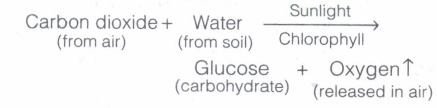
Plants prepare their own food by the process of photosynthesis. Leaves of the plants have green pigment called chlorophyll, which helps them to capture the energy of the sunlight. The plants synthesise their food from carbon dioxide and water in the presence of sunlight. This process is called photosynthesis. The reaction for the process of photosynthesis can be shown as follows:

During photosynthesis, food is synthesised and oxygen is released in the process.
4.
The presence of starch, a carbohydrate in leaves can be tested by iodine test. Iodine turns starch solution into blue-black colour. Pour few drops of dilute iodine solution on a boiled leaf. The leaf becomes blue-black in colour which proves the presence of starch in it.
5.
Differences between parasites and saprotrophs
| Parasites | Saprotrophs |
|---|---|
| These are the organisms that live inside the body of another organism (host) and derive the food from it. | These are the organisms that feed on dead and decaying organic matter. They do not require any host |
| They harm the body of the host. | They are cleaning agents. |
| e.g. Cuscuta | e.g. Fungi |
6.
The organisms need to take food to build their bodies, to grow, to repair damaged part of their bodies and to obtain the energy to carry out life processes. Food provide resistance to fight against diseases and protection from different infections.
7.
(b)
autotrophs
8.
(d)
leaves
9.
(b)
Stomata
10.
(c)
pitcher plant
11.
(b)
parasite
12.
Leaves are referred to as food factories of plants. This is because, leaves synthesise food by the process of photosynthesies.
13.
Guard cells help in controlling the opening and closing of stomata for gaseous exchange.
14.
Stomata are the tiny pores present on the surface of leaves through which gaseous exchange takes place in plants.
15.
(a) Sunlight
(b) Carbon dioxide
16.
The mode of nutrition in plant is autotrophic, i.e. they synthesise their own food.
17.
In both the plants, shoot system and leaves are above ground. They prepare food through photosynthesis and transport it to the underground part for storage.
18.
(a) This process is known as crop rotation. All the plants/crops grown in soil use the minerals present in soil for their own use. This continuous usage depletes the concentration of mineral in soil.
(b) After growing leguminous plants, the mineral content of soil is restored and enriched to new level. Yes, the benefit of leguminous plant is the re-enrichment of soil minerals.
(c) Asha is observant, sincere and interested in applying her knowledge to situations.
19.
Animals like tiger, wolf, lion and leopard are carnivores and do not eat plants. They hunt and eat herbivorous animals like deer, gaur, bison, zebra, giraffe, etc., which are dependent on plants for food.
If there are no plants, herbivorous animals will not survive and ultimately animals like tiger, wolf, lion and leopard will have nothing to eat.
20.
The process by which green plants can prepare their own food is called photosynthesis. Green plants possess chlorophyll in their leaf and utilises carbon dioxide (from air) water, minerals (from soil, through root) as raw material and sunlight as source of energy and convert light energy into chemical energy. The food thus synthesied is in the form of starch (carbohydrate). The overall reaction for photosynthesis can be given as follows:

7th Standard CBSE Syllabus & Materials
7th Standard CBSE
CBSE 7th Social Science Theme B - New Beginnings : Cities and States - New Sample Question Papers Study Material - QB365 Set A
NEW7th Standard CBSE
CBSE 7th Social Science Theme A - Climates of India - New Sample Question Papers Study Material - QB365 Set A
NEW7th Standard CBSE
CBSE 7th Social Science Theme A - Geographical Diversity of India - New Sample Question Papers Study Material - QB365 Set A
NEW7th Standard CBSE
CBSE 7th Science Earth, Moon and the Sun - New Sample Question Papers Study Material - QB365 Set A



NCERT Books

Syllabus

Exam Pattern

Sample Question Papers

Previous year Question Papers

Important Notes

MCQ Practice test

NCERT Exemplers

Case study Questions

Image Based Questions

Passage based Questions

HOT Questions

Value Based Questions

Model Questions Papers
NCERT ( Book Back ) Questions

Assertion and Reason
Important Questions And Answers

CBSE 7th Standard CBSE Subjects
CBSE Standards


