
 100% FREE ACCESS
7th Standard CBSE Syllabus & Materials
7th Standard CBSE
CBSE 7th Social Science Theme E - Understanding Market - New Sample Question Papers Study Material - QB365 Set A
NEW7th Standard CBSE
CBSE 7th Social Science Theme E - From Barter to Money - New Sample Question Papers Study Material - QB365 Set A
NEW7th Standard CBSE
CBSE 7th Social Science Theme D - The Constitution of India- An Introduction - New Sample Question Papers Study Material - QB365 Set A
NEW7th Standard CBSE
CBSE 7th Social Science Theme D - From the Rulers to the Ruled : Types of Governments - New Sample Question Papers Study Material - QB365 Set A
NEW7th Standard CBSE
CBSE 7th Social Science Theme B - The Age of Reorganisation - New Sample Question Papers Study Material - QB365 Set A
NEW7th Standard CBSE
CBSE 7th Social Science Theme B - The Rise of Empires - New Sample Question Papers Study Material - QB365 Set A

Published on: 31/10/2025
Download CBSE Class 7th Standard CBSE Science question papers, sample papers, important questions, and previous year solved papers in PDF format. Get free study materials, NCERT solutions, and exam preparation resources for Class 7th Standard CBSE Science
Questions + Answers key
Take MCQ Science Test
1.
Heat from sun reaches us by :
Conduction
Radiation
Convection
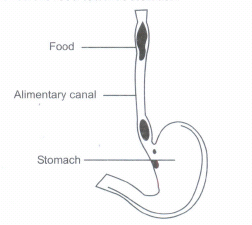
All of these
2.
The device which is used to measure the degree of coldness or hotness of an object:
Manometer
Barometer
Thermometer
Voltmeter
3.
Heat is :
A form of energy
A type of matter
Neither energy nor matter
None of these
4.
Which effect of current is used in an electric bulb?
Heating
Magnetic
Electrical
Chemical
5.
A battery is a group of
Only two cells
Two more cells
Only single cell
All of above
6.
The medicine used for treating indigestion is:
Antibiotic
Anti-acid
Antacid
Analgesic
7.
Raw mango is sour in taste due to presence of
Tartaric acid
Citric acid
Formic acid
Oxalic acid
8.
Neutralisation is a reaction between
Two acids
Two bases
One acid and one base
One acid and one neutral substance
9.
Which one of the following is not a step of nutrition?
Ingestion
Digestion
Absorption
Excretion
10.
Saliva converts starch into:
Fats
Sugar
proteins
Minerals
11.
The term that is used for the mode of nutrition in yeast, mushroom and bread-mould is :
autotrophic
insectivorous
saprophytic
parasitic
12.
Algae is:
Parasite
Saprotroph
Autotroph
None of these
13.
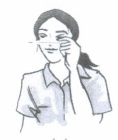
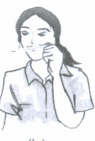
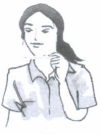
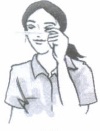
Figure (a, b, c, d) shows a student reading of a doctor's thermometer. Which of the figure indicates the correct method of reading temperature?
14.
The coil of wire contained in heater is known as
circuit
component
spring
element
15.
Heat always flows
from a colder object to a hotter object
from a hotter object to a colder object
in both the directions
None of the above
16.
Which of the following raw material is available in the air for photosynthesis?
Oxygen
Carbon dioxide
Nitrogen
Hydrogen
17.
Two organisms are good friends and live together. One provides shelter, water and nutrients while the other prepares and provides food. Such an association of organisms is termed as
saprophyte
parasite
autotroph
symbiosis
18.
The finger-like projection presents on the inner lining of small intestine is called
villi
stomach
rumen
diarrhoea
19.
The enzymes present in the saliva convert
fats into fatty acids and glycerol
starch into simple sugars
proteins into amino acids
complex sugars into simple sugars
20.
Consider the following statements:
(i) Both acids and bases change colour of all indicators.
(ii) If an indicator gives a colour change with an acid, it does not give a change with a base.
(iii) If an indicator changes colour with a base, it does not change colour with an acid.
(iv) Change of colour with an acid and a base depends on the type of the indicator.
Which of the above statements is/are correct?
Only (iv)
(i) and (iv)
(ii) and (iii)
All of these
21.
Why are handles of most utensils made up of plastic and wood?
22.
Explain the reasons of excessive currents in our houses.
23.
What is a food pipe? Write its functions.
24.
What are two commonly used bases in the laboratory? Give their formula
25.
What do you understand by symbiotic relationship? Write an organism which shows this relationship.
26.
Name the mode of transfer of heat in which medium is not required.
27.
(a) Name one indicator which turns red on adding an acid.
(b) Name one indicator which turns red on adding a base.
28.
Name the acid present in lemon juice and tomato.
29.
Name the elements those determine the weather of place.
30.
Show that air transfers heat via convection.
31.
How does heat travel in air ? Give any two such instances.
32.
How do the electric heater or an electric iron work
33.
What happens with the carbohydrates like starch in our body which are taken by us?
34.
Write three functions of tongue
35.
Give the colour of the following indicators in acidic and basic medium: Blue litmus, turmeric, china rose, methyl orange, phenolphthalein, and red litmus.
36.
You are provided with liquids A, Band C. One contains NaOH, another contains HCI and third is sugar solution. You are given phenolphthalein solution. How will you identify these solutions?
37.
Explain the reason for the general fitting of air conditioner at higher level on the wall of the room.
38.
In what unique manner does a pitcher plant derive its nutrition?
39.
The swallowed food moves downwards in the alimentary canal. Explain.
40.
State the similarities and differences between the laboratory thermometer and the clinical thermometer.
41.
Explain the human digestive system with the help of labelled diagram.
42.
(a) Draw a schematic diagram showing photosynthesis.
(b) What are the products of photosynthesis?
(c) Name the gases utilized and liberated in photosynthesis.
(d) Can all plants do photosynthesis?
43.
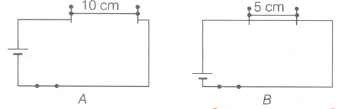
Paheli took a wire of length 10 cm. Boojho took a wire of 5 cm of the same material and thickness both of them connected with wires as shown in the circuit given in figure. The current flowing in both the circuits is the same.
(a) Will the heat produced in both the cases be equal? Explain.
(b) Will the heat produced be the same, if the wires taken by them are of equal lengths but of different thickness? Explain.
44.
Which is the bad conductor of heat?
45.
What is a battery?
46.
What are indicators?
47.
How many kinds of teeth do you find?
48.
What are Nutrients?
1.
(b)
Radiation
2.
(c)
Thermometer
3.
(a)
A form of energy
4.
(a)
Heating
5.
(b)
Two more cells
6.
(c)
Antacid
7.
(a)
Tartaric acid
8.
(c)
One acid and one base
9.
(d)
Excretion
10.
(b)
Sugar
11.
(c)
saprophytic
12.
(c)
Autotroph
13.
In first case, eyes of student are in level of the thermometer, so it is correct way to measure temperature using clinical thermometer
14.
(d)
element
15.
(b)
from a hotter object to a colder object
16.
(b)
Carbon dioxide
17.
(a)
saprophyte
18.
(a)
villi
19.
(b)
starch into simple sugars
20.
(a) All indicators do not change colour with acids as well as bases, e.g. turmeric changes its colour to pink with the base but it remains yellow with acid.
Therefore, statement (i) is incorrect. There are some indicators which change colour with both acid and base, e.g. methyl orange, litmus, thus statement (ii) and (iii) are also incorrect. Statement (iv) is the correct conclusion about indicators.
21.
The handles of most utensils are made of plastic and wood because plastic and wood are poor conductors of heat. We can easily hold the handle with bare hands even if the utensils are hot. This helps us to remove hot utensils from the flame.
22.
There are following two reasons of excessive currents in our houses:
(i) Direct touching of wires : This may happen if the insulation on the wires has come off due to wear and tear. This may cause a short circuit.
(ii) Connection of many devices to a single socket. This may overload in the circuit
23.
A long tube along the neck and the chest is called a food pipe or oesophagus. The swallowed food passes into the food pipe. Food is pushed down by the movement of the wall of the food pipe. It pushed the food towards stomach.
24.
Two commonly used bases in the laboratory are ammonium hydroxide (NH4OH) and sodium hydroxide (NaOH)
25.
Some organisms live together and share shelter and nutrients, Such relationship is called symbiotic relationship.
Example: Lichens
26.
Radiation is the mode of transfer of heat in which medium is not required.
27.
(a) Litmus (blue litmus paper)
(b) Turmeric
28.
The citric acid in lemon juice and oxalic acid in tomato.
29.
30.
Take a rectangular box with a glass front. Make a small window on one of its sides and a hole on the top. Fix a paper pipe into the hole of the top to form a chimney. Now keep a candle in the box below the chimney. Keep your hand above the chimney. It will be observed that hot air is coming out of chimney. Now put a lighted incense stick near the window. Soon you will notice that incense smoke comes out of the window. This happens due to the convection current set up inside the box.
31.
The air near the heat source gets hot and rises. The cold air from sides takes its place. In this way, air gets heated. This gives interesting phenomenon in coastal regions.
(i) During the day, land gets heated faster than water. The air over the land becomes hotter and rises up. The cooler air from sea rushes in towards the land to take its place. The warm air from land moves towards sea to complete the cycle. The air from sea is cool and is called sea breeze.
(ii) At night, it is exactly the reverse. The water cools down more slowly than land. So, the cool air from land moves towards sea. This is called land breeze.
32.
Electric heater and ironwork on the basis of heating effect of electricity. When an electric current passes through the wires they become hot. Electric heater or iron contains a coil of wire. This coil of wire is called an element. When these appliances are switched on after connecting to the electric supply, their elements become red hot and give out heat.
33.
Carbohydrates are complex substances. These complex substances cannot be utilised as such as we eat. They are broken down into simpler substances like glucose. This process is called digestion of carbohydrates.
34.
(i) It helps in talking.
(ii) It helps to mix saliva with the food.
(iii)It also helps in swallowing food.
35.
| Indicator | Colour in Acidic Medium | Colour in Basic Medium |
|---|---|---|
| (i) Blue litmus (ii) Turmeric (iii) China rose (iv)Methyl orange (v)Phenolphthalein (vi)Red litmus |
Red |
Blue Reddish brown Green Yellow Pink Blue |
36.
Add a drop of phenolphthalein separately in liquids A, B and C. The one which turns pink is sodium hydroxide, let it be A. Divide this into two parts. Now add a few drops of other solutions in the above solution taken into parts. The solution which again turns solution A colourless is hydrochloric acid. Let it be B. Then solution left is sugar.
37.
As a fact that warm air is much lighter than the cold air, so being heavier the cold air from air conditioner moves downwards while the hot air moves upwards at the lower level and gets cooled and come downwards once again. So, due to this convection of heat are set in the air and room gets warmer faster.
38.
Nepenthes or pitcher plant modifies its leaf axis into a long tubular pitcher to form a pitfall trap. Inside the pitcher sticky liquid is present. When any insect comes in contact with the leaf, the lid present on it is closed and insect is trapped. The liquid contains digestive enzymes which slowly digest the trapped insects.
39.
The swallowed food moves downwards in the alimentary canal because of the alternate relaxation contraction movement of muscles in the wall of foodpipe called peristalsis.
40.
41.
When the ingest food in our mouth, salivary glands of the mouth secrete saliva which moistens the food. It also converts the starch into sugar. The tongue helps in chewing by moving the food in various directions. Saliva contains enzyme called salivary amylase which converts starch into sugar.
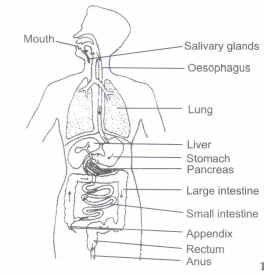
From mouth, food goes into food pipe called oesophagus. As food enters into the food pipe, muscles of its wall starts contraction and relaxation movement. This movement is called peristaltic movement that pushes the food into the stomach. The peristaltic movement occurs throughout the alimentary canal. The oesophagus leads the food to a saclike structure called stomach. The food is churned and partly digested in the stomach. The semi-solid food passes from the stomach to much coiled tube-like structure called the small intestine. The small intestine serves two purposes-digestion and absorption of the digested food. It is about 20 feet long. The inner surface of the small intestine has a large number of finger-like projections called villi. The villi increase the surface area for the absorption of digested food. The absorbed food enters into the blood stream and carried away to various parts of the body for assimilation. The undigested food moves from the small intestine to the large intestine where mainly absorption of water from the undigestion takes place. From the large intestine, the undigested food passes to the rectum which pushes it out of the body through the opening called the anus as faeces.
42.
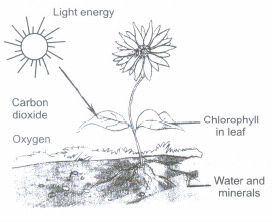
(b) Carbohydrates and oxygen.
(c) Liberated-oxygen, Utilised-carbon dioxide.
(d) All plants cannot do photosynthesis, only green plants can do photosynthesis.
43.
(a) No, the amount of heat produced in both the wires will be different because amount of heat produced in a wire on passing electric current depends on the length of wire and here length is different for both the wires.
(b) No, the amount of heat produced in the wire of same length but different thickness cannot be same because amount of heat produced in a wire also depends on the thickness of the wire.
44.
()
Wood is a bad conductor of heat.
45.
()
When two or more cells are joined together, then it is called battery
46.
()
Indicators are the substances that are used to test the acidity or basicity of a substance
47.
()
Four.
48.
()
The compounds or components of food which are necessary for our body are called nutrients.

7th Standard CBSE Syllabus & Materials
7th Standard CBSE
CBSE 7th Social Science Theme B - New Beginnings : Cities and States - New Sample Question Papers Study Material - QB365 Set A
NEW7th Standard CBSE
CBSE 7th Social Science Theme A - Climates of India - New Sample Question Papers Study Material - QB365 Set A
NEW7th Standard CBSE
CBSE 7th Social Science Theme A - Geographical Diversity of India - New Sample Question Papers Study Material - QB365 Set A
NEW7th Standard CBSE
CBSE 7th Science Earth, Moon and the Sun - New Sample Question Papers Study Material - QB365 Set A



NCERT Books

Syllabus

Exam Pattern

Sample Question Papers

Previous year Question Papers

Important Notes

MCQ Practice test

NCERT Exemplers

Case study Questions

Image Based Questions

Passage based Questions

HOT Questions

Value Based Questions

Model Questions Papers
NCERT ( Book Back ) Questions

Assertion and Reason
Important Questions And Answers

CBSE 7th Standard CBSE Subjects
CBSE Standards


