
 100% FREE ACCESS
7th Standard CBSE Syllabus & Materials
7th Standard CBSE
CBSE 7th Social Science Theme E - Understanding Market - New Sample Question Papers Study Material - QB365 Set A
NEW7th Standard CBSE
CBSE 7th Social Science Theme E - From Barter to Money - New Sample Question Papers Study Material - QB365 Set A
NEW7th Standard CBSE
CBSE 7th Social Science Theme D - The Constitution of India- An Introduction - New Sample Question Papers Study Material - QB365 Set A
NEW7th Standard CBSE
CBSE 7th Social Science Theme D - From the Rulers to the Ruled : Types of Governments - New Sample Question Papers Study Material - QB365 Set A
NEW7th Standard CBSE
CBSE 7th Social Science Theme B - The Age of Reorganisation - New Sample Question Papers Study Material - QB365 Set A
NEW7th Standard CBSE
CBSE 7th Social Science Theme B - The Rise of Empires - New Sample Question Papers Study Material - QB365 Set A

Published on: 31/10/2025
Download CBSE Class 7th Standard CBSE Science question papers, sample papers, important questions, and previous year solved papers in PDF format. Get free study materials, NCERT solutions, and exam preparation resources for Class 7th Standard CBSE Science
Questions + Answers key
Take MCQ Science Test
1.
Name four insulators.
2.
What is Cocoon?
3.
What is Bile?
4.
Which acid is called "King of Chemicals"?
5.
Which teeth do you use for biting and cutting?
6.
Given an example of a parasitic plant.
7.
Write the equation of photosynthesis
8.
Name the following the pores through which leaves exchange gases.
9.
In the process of obtained wool from fleece, sorting is done after scouring.
10.
In all cases, heat flows from a hotter object to a colder object.
11.
The rearing of silkworms for obtaining silk is called silviculture.
12.
Iron and rust are the same substances.
13.
Sodium hydroxide turns blue litmus to red.
14.
The ruminants bring back swallowed grass into their mouth and chew it for some time.
15.
Solar energy is converted into chemical energy during photosynthesis.
16.
Which of the following changes are reversible or irreversible and physical or chemical?
(i) Chalk stick.___________chalk pieces.
(ii) Water _______steam.
(iii) Magnesium ribbon___________ burnt magnesium ribbon.
(iv) Unripe mango________ ripe mango.
(v) Wood log_________ saw dust
(vi) Plant__________tree.
17.
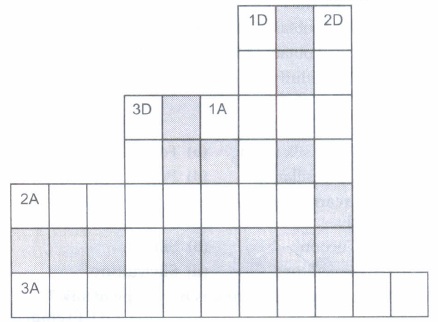
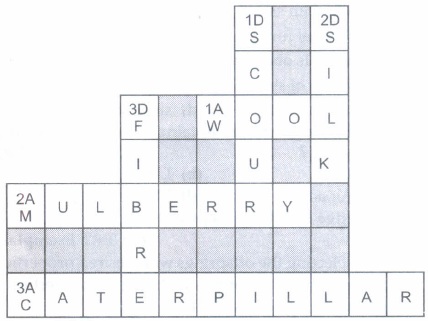
Given below is a crossword puzzle based on this lesson. Use hints to fill in the blank spaces with letters that complete the words.
| Down | Across |
|---|---|
| 1: Through washing | 1: Keeps warm |
| 2: Animal fibre | 2: Its leaves are eaten by silkworms |
| 3: long thread like structure | 3: Hatches from egg of moth |
18.
Describe the effects of heat.
19.
Steps for the production of silk are given below in a jumbled order. Arrange them in their proper sequence.
(a) Eggs are warmed to a suitable temperature for the larvae to hatch from eggs.
(b) Fibres are taken out from the cocoon.
(c) After 25 to 30 days, the caterpillars stop eating and start spinning cocoons.
(d) The larvae/caterpillars or silkworms are kept in clean trays along with freshly chopped mulberry leaves.
(e) Female silk moths lay eggs.
(f) Cocoons are kept under the sun or boiled in water.
20.
Sunlight, Chlorophyll, carbon dioxide, water and minerals are raw materials essential for photosynthesis. Do you know where they are available? Fill in the blanks with the appropriate raw materials.
(a) Available in the plant: __________
(b) Available in the soil: ___________
(c) Available in the air: __________
(d) Available during day: __________
21.
Choose the odd one out from each group and give reasons.
(a) liver, salivary gland, starch, gall bladder
(b) stomach, liver, pancreas, salivary gland
(c) tongue, absorption, taste, swallow
(d) oesophagus, small intestine, large intestine, rectum.
22.
Explain why
(a) an antacid tablet is taken when you suffer from acidity?
(b) calamine solution is applied on the skin when an ant bites?
(c) Is factory waste neutralised before disposing it into the water bodies?
23.
Look at following figure.
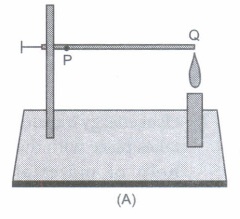
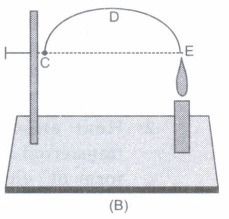
The length of wire PQ in case of A is equal to the diameter of the semicircle formed by the wire CDE, in case B. One pin is attached to each wire with the help of wax as shown in figure. Which pin will fall first? Explain
24.
Explain the following:
(a) Lime water turns milky on passing carbon dioxide gas into it.
(b) Bubbles are produced when acetic acid is added to a solution of sodium hydrogen carbonate.
25.
Why does a doctor put a glucose drip to a patient who has just been operated?
26.
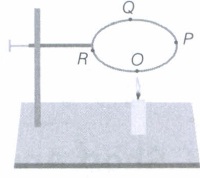
A circular metal loop is heated at point O as shown in figure.
(a) In which direction, would heat flow in the loop.
(b) In which order, the pins at points P, Q and R fixed with the help of wax fall if points , P, Q and R are equidistant from each other?
27.
How do the hair of certain animals help in keeping their bodies warm?
28.
Except plants, why can't other living organisms prepare their food using CO2, water and minerals?
29.
(a) Name one indicator which turns red on adding an acid.
(b) Name one indicator which turns red on adding a base.
30.
Name the parts of the alimentary canal where
(a) water gets absorbed from undigested food
(b) digested food gets absorbed
(c) taste of the food is perceived
(d) bile juice is produced
31.
Explain the working of a thermo flask.
32.
What is rusting? How do we prevent it ?
33.
Rohan's uncle works as a technical advisor in a renowned fabric company of our country. Rohan came to know that different kinds of fibres are the raw materials for fabric industry and put forward the following questions to his uncle when he came home.
Answer the following questions based on the situation described above.
(i) What can we obtain the fibres like wool, cotton, silk?
(ii) What are the different steps by which woollen fibres are converted into the yarn?
(iii) What is the use of yarn?
(iv) Name the animals from which we obtain different quality of wools other than sheep.
(v) How can the special characters like softness in the woollen fibre be obtained?
(vi) What values are displayed by Rohan?
34.
(a) Draw a schematic diagram showing photosynthesis.
(b) What are the products of photosynthesis?
(c) Name the gases utilized and liberated in photosynthesis.
(d) Can all plants do photosynthesis?
35.
Read the following passage carefully and answer the questions that follow it.
Bile juice is stored in a sac called, gall bladder, located near its organ of secretion, liver. The gall bladder releases the bile juice into the small intestine whenever food reaches there. Though bile juice is devoid of any digestive enzymes, it is required for the digestion of fats. The fats cannot be digested easily because they are insoluble in water and are present as large globules. Bile juice breaks down big fat droplets into smaller droplets. These are then easily digested by the enzymes released from the pancreas.
(a) Which organ secretes the bile juice?
(b) Why is digestion of fats difficult as compared to that of other nutrients?
(c) How does bile juice help in digestion of that of other mutrients?
(d) Where is the digestion of fat completed?
(e) Does bile juice digest fat completely?
36.
Harish went to visit his grandfather in village where he saw that his grandfather's field of wheat are infected with fungus but no one is aware of this. Harish rushed to his grandfather's side and told him that the field have been infected with fungi. He should use an antifungal agent in his fields to stop this infection.
(a) What is fungus?
(b) Can fungus only cause diseases or can it be helpful also?
(c) What values are shown by Harish?
37.
You are provided with three test tubes A, B and C as shown in the figure with different liquids.
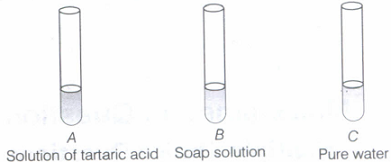
What will you observe when you put
(a) a piece of blue litmus paper in each test tube?
(b) a piece of red litmus paper in each test tube?
(c) a few drops of phenolphthalein solution to each test tube?
38.
Which one of the following is a poor conductor of heat?
Silver
Aluminium
Glass
Brass
39.
What is the formula of rust?
Fe3O4
Fe2O3
FeO
None of these
40.
Stomach secretes:
HCl
H2SO4
CH3COOH
NaOH
41.
Given below from (i) to (iv) are some food items.
(i) Boiled and mashed potato
(ii) Glucose solution
(iii) A slice of bread
(iv) Mustard oil
Which of the above will give blue-black colour when tested with iodine?
(i) and (ii)
(i) and (iii)
(ii) and (iii)
(iii) and (iv)
42.
The tissue responsible for the transportation of food in plants:
Xylem
Phloem
Stomata
Root hair
43.
Boojho has three thermometers as shown in figure. He wants to measure the temperature of his body and that of boiling water. Which thermometer(s) should he choose?
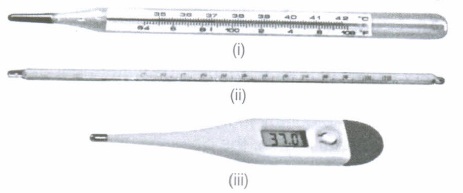
Thermometers (i) and (iii) for measuring body temperature and (ii) for measuring the temperature of boiling water
Thermometer (i) for measuring temperature of both
Thermometer (ii) for measuring temperature of both
Thermometer (iii) for measuring temperature of both
44.
Reeling of silk is
a process of making silk reels
spinning of silk fibres
weaving of silk cloth
the process of taking silk threads from cocoon
45.
Which of the following statements is incorrect for a chemical reaction?
Heat may be given out but never absorbed
Sound may be produced
A colour change may take place
A gas may be evolved
46.
Read the following statements with reference to the villi of small intestine.
(i) They have very thin walls.
(ii) They have a network of thin and small blood vessels close to the surface.
(iii) They have small pores through which food can easily pass.
(iv) They are finger-like projections. Identify those statements which- enable the villi to absorb digested food.
(i), (ii) and (iv)
(ii), (iii) and (iv)
(iii) and (iv)
(i) and (iv)
47.
The finger-like outgrowths of Amoeba helps to ingest food. However, the finger-like outgrowths of human intestine helps to
digest the fatty food substances
make the food soluble
absorb the digested food
absorb the undigested food
48.
Organisms which prepare food for themselves using simple naturally available raw materials are referred to as
heterotrophs
autotrophs
parasites
saprophytes
49.
The correct way of making a solution of acid in water is to
add water to acid
add acid to water
mix acid and water simultaneously
add water to acid in a shallow container
50.
All hot bodies radiate _______
51.
_______ is the largest producer of silk.
52.
Grinding of wheat grain changes its size. It is a __________ change
53.
Cuscuta is a ___________ plant.
54.
Amoeba digests its food inside _____
55.
Lemon juice and vinegar taste _________ because they contain __________
1.
()
Wool, plastic, cotton, glass.
2.
()
The covering of silk fibres inside which the caterpillar covers itself is called cocoon.
3.
()
Bileis a secretion secreted by liver.
4.
()
Sulphuric acid is called 'King of chemicals'.
5.
()
The incisors
6.
()
Cuscuta (Amarbel).
7.
()
Carbon dioxide + Water \(\overset { Sunlight }{ \underset { Chlorophyll }{ \xrightarrow{} } } \) Carbohydrate + Oxygen
CO2 + H2O \(\overset { Sunlight }{ \underset { Chlorophyll }{ \xrightarrow{} } } \) C6H12O6 + O2
8.
()
Stomata
9.
(a)
10.
(a)
11.
(b)
12.
(b)
13.
(b)
14.
(a)
15.
(a)
16.
(i) Physical, reversible
(ii) Physical, reversible
(iii) Chemical, irreversible
(iv) Chemical, irreversible
(v) Physical, irreversible
(vi) Chemical, irreversible
17.
| Down | Across |
|---|---|
| 1: Through washing | 1: Keeps warm |
| 2: Animal fibre | 2: Its leaves are eaten by silkworms |
| 3: long thread like structure | 3: Hatches from egg of moth |
18.
The effects of heat are
(i) When an object is heated, then it becomes hotter and may get expand. So, in this heat may change the state of the body like ice can also get change into the water.
(ii) Heat sometimes acts as a catalyst to speed up the chemical reaction.
(iii) Heat can even kill the bacteria as well.
19.
The correct order is
(e) Female silk moths lay eggs.
(a) Eggs are warmed to a suitable temperature for the larvae to hatch from eggs.
(d) The larvae/caterpillars or silkworms are kept in clean trays along with freshly chopped mulberry leaves.
(c) After 25 to 30 days, the caterpillers stop eating and start spinning Cocoons.
(f) Cocoons are kept under the sun or boiled in water.
(b) Fibres are taken out from the Cocoon.
20.
(a) Available in the plant: chlorophyll
(b) Available in the soil: water, minerals
(c) Available in the air: carbon dioxide
(d) Available during day: sunlight
21.
(a) Starch, because rest all are glands and starch is a type of carbohydrate.
(b) Stomach, because rest all are digestive glands and stomach is a digestive organ.
(c) Tongue, because rest all are digestive processes and tongue is a part of digestive system.
(d) Small intestine, because it carriers the process of digestion and rest are not involved in digestion.
22.
(a) We take an antacid tablet such as milk of magnesia to neutralises the excessive acid released in the stomach.
(b) When an ant bites, it injects the formic acid into the skin. The effect of acid can be neutralised by applying calamine solution that contains zinc carbonate.
(c) The factory wastes contain acids if they are allowed to flow into the water bodies, the acid will kill fishes and other organisms. The factory wastes are thus neutralised by adding basic substances.
23.
The pin on the wire in case A will fall first as heat will reach to it before it reaches the pin in case B.
24.
(a) White coloured insoluble calcium carbonate is formed.
(b) Carbon dioxide is evolved due to the chemical reaction between acetic acid and sodium hydrocarbonate.
25.
This is because the patient cannot digest the food and glucose needs no digestion.
26.
(a) Heat will flow in both the directions from O to P and from O to R.
(b) First of all pin at P and R will fall simultaneously after that pin at Q will fall.
27.
Hair traps a lot of air which is a poor conductor of heat resulting their body warm.
28.
Our body does not contain chlorophyll for absorbing solar energy which is necessary for preparing food using air, water, etc.
29.
(a) Litmus (blue litmus paper)
(b) Turmeric
30.
(a) large intestine
(b) small intestine
(c) tongue
(d) liver
31.
Thermo flask is a special kind of flask for keeping liquids. It prevents loss or gain of heat by any of the three methods. It keeps liquid warm or cold for a long time. It was invented by Sir James Dewan in 1893.
It consists of a double-walled glass-cylinder. A vacuum is created in the space between the double walls. The two inner surfaces of glass walls are silvered. The flask is placed on a spring within a non-conducting cylindrical case to protect it from jerks and breakages. The gaps between flask and outer casing is packed with felt pads. The mouth of the flask is finally closed with a cork.
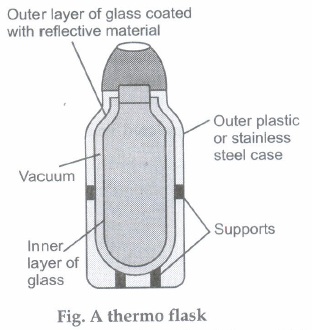
Since the container is made of glass which is a bad conductor of heat and therefore, the loss or gain of heat due to conduction is prevented. As there is vacuum between the double walls, it prevents transmission of heat by convection. Due to silvering of the inner surfaces, the heat loss by radiation is prevented. The cork and the felt pads also help to preserve the heat inside the flask. So, the hot liquids like tea, coffee, etc., remain hot and cold liquids like water, juice, etc., remain cold for a long time.
32.
If we leave a piece of iron in the open for some time, it acquires a coating of brownish substances. This substance is called rust and the process of its formation is called rusting. This is the change that effects iron articles and slowly destroys them. Since iron is used in making bridges, ships, cars, truck bodies and many other articles. The monetary loss due to rusting is huge. For rusting the presence of both oxygen and water (or water vapour) is essential. Infact, if the moisture content in air is high which means if it is more humid, rusting becomes faster.
Methods of preventing rust formation: Rusting of an iron object can be prevented or reduced by not allowing air and moisture to come in contact with the surface of iron objects. Following are the methods of prevention form rusting.
(i) Putting oil or paint over the surface of iron implements.
(ii) Galvanization: In this method, surface of iron is covered with a layer of more active metal like zinc. Zinc metal looses electrons in preference to iron and hence, prevents the rusting of iron.
(iii) By tin-plating
(iv) Use of anti-rust solutions: Alkaline chromate and alkaline phosphate solution act as anti-rust solutions. When iron objects are dipped into a boiling and strongly alkaline solution of sodium phosphate, a protective insoluble film of iron phosphate is formed on them. This film protects the article form rusting.
33.
(i) We obtain wool from the fleece (hair) of sheep, cotton from cotton plant and silk from cocoons of siIk moth.
(ii) Step I - Shearing, Step II - Scouring, Step III - Sorting, Step IV - Fluffy fibres called burrs are picked out from hair, Step V- Dyeing of fibres, Step VI- Fibres are straightened, combed and rolled into yarn.
(iii) Yarns are used to knit sweaters.
(iv) Yak, Alpace, Llama, Angora goat, camel.
(v)By 'selective breeding' we can obtain the special characters is the woollen fibre.
(vi)Awareness regarding those animals who are used by human being for different types of clothing.
34.
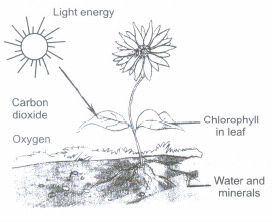
(b) Carbohydrates and oxygen.
(c) Liberated-oxygen, Utilised-carbon dioxide.
(d) All plants cannot do photosynthesis, only green plants can do photosynthesis.
35.
(a) Bile juice is secreted by liver.
(b) Digestion of fats is difficult as compared to that of other nutrients because of insolubility of fat in water.
(c) Bile juice helps in digestion of fat by breaking down big fat droplets into smaller droplet.
(d) Digestion of fat is completed in small intestine.
(e) No, fat is not completely digested by bile juice.
36.
(a) Fungus are saprophytic organisms usually present as spores in atmosphere which can germinate on any substrate in optimal conditions.
(b) Fungus are also useful in that they produce many antibiotics which can cure different types of infections like penicillin.
(c) Harish is sincere, curious and knowledgeable with a keen sense of applying it where necessary.
37.
| Test tube | Effect on blue litmus paper | Effect on red litmus paper | Effect on phenolphthalein solution |
| A | Turns red | Remains red | Colourless |
| B | Remains blue | Turns blue | Pink colour |
| C | Remains blue | Remains red | Colourless |
38.
(c)
Glass
39.
(b)
Fe2O3
40.
(a)
HCl
41.
(b)
(i) and (iii)
42.
(b)
Phloem
43.
(a)
Thermometers (i) and (iii) for measuring body temperature and (ii) for measuring the temperature of boiling water
44.
(d)
the process of taking silk threads from cocoon
45.
(a)
Heat may be given out but never absorbed
46.
(c)
(iii) and (iv)
47.
(c)
absorb the digested food
48.
(b)
autotrophs
49.
(b)
add acid to water
50.
()
heat
51.
()
China
52.
()
physical
53.
()
parasitic
54.
()
food vacuole
55.
()
sour, acids

7th Standard CBSE Syllabus & Materials
7th Standard CBSE
CBSE 7th Social Science Theme B - New Beginnings : Cities and States - New Sample Question Papers Study Material - QB365 Set A
NEW7th Standard CBSE
CBSE 7th Social Science Theme A - Climates of India - New Sample Question Papers Study Material - QB365 Set A
NEW7th Standard CBSE
CBSE 7th Social Science Theme A - Geographical Diversity of India - New Sample Question Papers Study Material - QB365 Set A
NEW7th Standard CBSE
CBSE 7th Science Earth, Moon and the Sun - New Sample Question Papers Study Material - QB365 Set A



NCERT Books

Syllabus

Exam Pattern

Sample Question Papers

Previous year Question Papers

Important Notes

MCQ Practice test

NCERT Exemplers

Case study Questions

Image Based Questions

Passage based Questions

HOT Questions

Value Based Questions

Model Questions Papers
NCERT ( Book Back ) Questions

Assertion and Reason
Important Questions And Answers

CBSE 7th Standard CBSE Subjects
CBSE Standards


