
 100% FREE ACCESS
7th Standard CBSE Syllabus & Materials
7th Standard CBSE
CBSE 7th Social Science Theme E - Understanding Market - New Sample Question Papers Study Material - QB365 Set A
NEW7th Standard CBSE
CBSE 7th Social Science Theme E - From Barter to Money - New Sample Question Papers Study Material - QB365 Set A
NEW7th Standard CBSE
CBSE 7th Social Science Theme D - The Constitution of India- An Introduction - New Sample Question Papers Study Material - QB365 Set A
NEW7th Standard CBSE
CBSE 7th Social Science Theme D - From the Rulers to the Ruled : Types of Governments - New Sample Question Papers Study Material - QB365 Set A
NEW7th Standard CBSE
CBSE 7th Social Science Theme B - The Age of Reorganisation - New Sample Question Papers Study Material - QB365 Set A
NEW7th Standard CBSE
CBSE 7th Social Science Theme B - The Rise of Empires - New Sample Question Papers Study Material - QB365 Set A

Published on: 31/10/2025
Download CBSE Class 7th Standard CBSE Science question papers, sample papers, important questions, and previous year solved papers in PDF format. Get free study materials, NCERT solutions, and exam preparation resources for Class 7th Standard CBSE Science
Questions + Answers key
Take MCQ Science Test
1.
Trypsin acts on proteins to convert them in the .................
2.
The normal temperature of human body is ______ 0C.
3.
Silkworms are ______ of silk moth.
4.
Grinding of wheat grain changes its size. It is a __________ change
5.
_____ teeth replaces the milk teeth.
6.
Acid + Base \(\longrightarrow\) _____________ + Water
7.
In photosynthesis solar energy is captured by the pigment called ______________
8.
Which one is animal fibre?
Cotton
Silk
Polyester
Jute
9.
Choose the correct order of terms that describes the process of nutrition in ruminants.
swallowing \(\rightarrow \) partial digestion \(\rightarrow \) chewing of cud \(\rightarrow \) complete digestion
chewing of cud \(\rightarrow\) swallowing \(\rightarrow\) partial digestion \(\rightarrow\) complete digestion
chewing of cud \(\rightarrow\) swallowing \(\rightarrow\) mixing with digestive juices \(\rightarrow\) digestion
swallowing \(\rightarrow\) chewing and mixing \(\rightarrow\) partial digestion \(\rightarrow\) complete digestion
10.
Which one of the following is parasite?
Lichens
Algae
Cuscuta
Fungus
11.
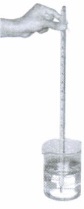
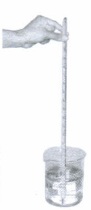
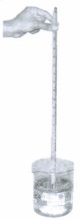
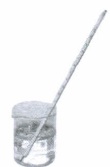
Four arrangements to measure temperature of ice in beaker with laboratory thermometer are shown in figure (a, b, c, d). Which one of them shows the correct arrangement for accurate measurement of temperature?
12.
A marble tile would feel cold as compared to a wooden tile on a winter morning because the marble tile
is a better conductor of heat than the wooden tile
is polished while wooden tile is not polished
reflects more heat than wooden tile
is a poor conductor of heat than the wooden tile
13.
The general process that takes place at a sheep shearing shed is
removal of fleece
separating hair of different textures
washing of sheep fibre to remove grease
rolling of sheep fibre into yarn
14.
The rearing of silkworms for obtaining silk is called
cocoon
silk
sericulture
silviculture
15.
A man painted his main gate made up of iron, to
(i) and (ii)
(ii) and (iii)
Only (ii)
(i) and (iii)
16.
The ultimate source of food on earth is
plants
sunlight
animals
proteins
17.
If, by chance food particles enter the windpipe, we feel
hiccups and cough
yawning
sleep
None of these
18.
Read the following statements with reference to the villi of small intestine.
(i) They have very thin walls.
(ii) They have a network of thin and small blood vessels close to the surface.
(iii) They have small pores through which food can easily pass.
(iv) They are finger-like projections. Identify those statements which- enable the villi to absorb digested food.
(i), (ii) and (iv)
(ii), (iii) and (iv)
(iii) and (iv)
(i) and (iv)
19.
The acid present in the stomach
kills the harmful bacteria that may enter along with the food
protects the stomach lining from harmful substances
digests starch into simpler sugars
makes the medium alkaline
20.
Which of the following statements is/are correct?
(i) All green plants can prepare their own food.
(ii) Most animals are autotrophs.
(iii) Carbon dioxide is not required for photosynthesis.
(iv) Oxygen is liberated during photosynthesis.
Choose the correct answer from the options below:
(i) and (iv)
only (ii)
(ii) and (iii)
(i) and (ii)
21.
A solution changes the colour of turmeric indicator from yellow to red. The solution is
basic
acidic
neutral
either neutral or acidic
22.
Products of a neutralisation reaction are always
an acid and a base
an acid and a salt
a salt and water
a salt and a base
23.
The plant which traps and feeds on insects is
Cuscuta
China rose
pitcher plant
rose
24.
Write the three components and their functions of juice secreted by the inner wall of the stomach
25.
Distinguish between the following:
(i) Acid and alkali
(ii) Base and alkali
(iii) Organic acid and mineral acid.
26.
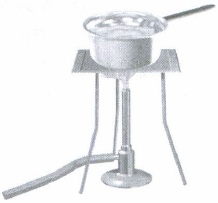
Look at the figure, mark where the heat is being transferred by conduction, by convection and by radiation.
27.
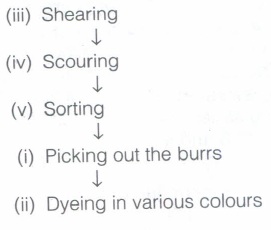
Various steps involved to obtain wool from fleece are given here.
(i) Picking out the burrs
(ii) Dyeing in various colours
(iii) Shearing
(iv) Scouring
(v) Sorting
Write the above steps in the correct sequence in which they are carried out.
28.
Explain why burning of wood and cutting it into small pieces are considered as two different types of changes.
29.
Sunlight, Chlorophyll, carbon dioxide, water and minerals are raw materials essential for photosynthesis. Do you know where they are available? Fill in the blanks with the appropriate raw materials.
(a) Available in the plant: __________
(b) Available in the soil: ___________
(c) Available in the air: __________
(d) Available during day: __________
30.
Complete the following table, from the options given below:
(Scraping, chewing, siphoning, capturing and swallowing, sponging, sucking, etc.)
| Name of animal | Kind of food | Mode of feeding |
| Snail | ||
| Ant | ||
| Eagle | ||
| Humming bird | ||
| Lice | ||
| Mosquito | ||
| Butterfly | ||
| Housefly |
31.
Explain why
(a) an antacid tablet is taken when you suffer from acidity?
(b) calamine solution is applied on the skin when an ant bites?
(c) Is factory waste neutralised before disposing it into the water bodies?
32.
Kelvin
33.
Conductors
34.
Camel
35.
Dissolving common salt in water
36.
Bacteria Rhizobium
37.
Stomach
38.
Yak hair are not used to make woollen fabric.
39.
All heterotrophs have a similar basic process of nutrition.
40.
The angora rabbit yields best variety of wool
41.
Stretching of rubber band is not a physical change.
42.
Cutting a log of wood into pieces is a chemical change.
43.
Ruminant can digest cellulose (carbohydrate).
44.
Chlorophyll is present in an animal cell.
45.
Sodium hydroxide turns blue litmus to red.
46.
Some words related with silk are jumbled up. Write them in their correct form.
(a) TURECULRISE
(b) WILSMORK
(c) BELMURRY
(d) RING LEE
47.
What is large intestine? Write its function.
48.
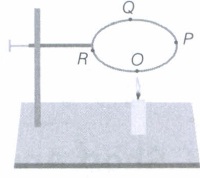
A circular metal loop is heated at point O as shown in figure.
(a) In which direction, would heat flow in the loop.
(b) In which order, the pins at points P, Q and R fixed with the help of wax fall if points , P, Q and R are equidistant from each other?
49.
Shopkeepers selling ice blocks usually cover them with jute sacks. Explain why.
50.
Two fibres are made up of proteins. Name them.
51.
A goat eats away all the leaves of a small plant (balsam). However, in a few days, new leaves could be seen sprouting in the plant again. How did the plant survive without leaves?
52.
What is the test for acids and bases using litmus paper?
53.
Name the parts of the alimentary canal where
(a) water gets absorbed from undigested food
(b) digested food gets absorbed
(c) taste of the food is perceived
(d) bile juice is produced
54.
Define parasites.
55.
A chemical change may occur by one of the following changes :
(i) Evolution of gas
(ii) Change of colour
(iii) Formation of precipitate
(iv) Absorption or evolution of heat and light
(v) Change of smell
Give an example of each case.
56.
Explain the differences between heat and temperature.
57.
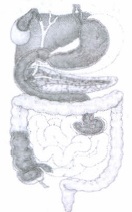
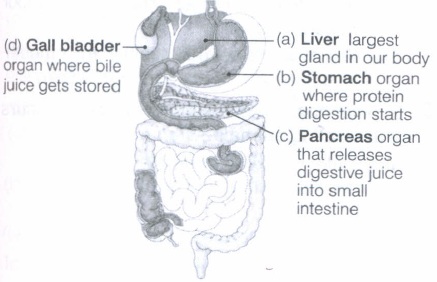
Label the following parts of above figure and name them.
(a) The largest gland in our body.
(b) The organ where protein digestion starts.
(c) The organ that releases digestive juice into the small intestine.
(d) The organ where bile juice gets stored.
58.
Harish went to visit his grandfather in village where he saw that his grandfather's field of wheat are infected with fungus but no one is aware of this. Harish rushed to his grandfather's side and told him that the field have been infected with fungi. He should use an antifungal agent in his fields to stop this infection.
(a) What is fungus?
(b) Can fungus only cause diseases or can it be helpful also?
(c) What values are shown by Harish?
59.
You are provided with three test tubes A, B and C as shown in the figure with different liquids.
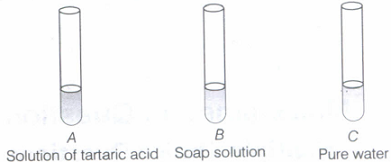
What will you observe when you put
(a) a piece of blue litmus paper in each test tube?
(b) a piece of red litmus paper in each test tube?
(c) a few drops of phenolphthalein solution to each test tube?
60.
Do all liquids expand on heating?
61.
Why do we wear woollen clothes during winter?
62.
Give two examples of physical change
63.
Name the three types of fibres.
64.
What is Villi?
65.
How is salt formed?
66.
The symbiotic relationship between algae and fungi is called ................
67.
Algae are .........
1.
()
Aminoacids
2.
()
37
3.
()
larvae
4.
()
physical
5.
()
Permanent
6.
()
salt
7.
()
chlorophyll
8.
(b)
Silk
9.
(a)
swallowing \(\rightarrow \) partial digestion \(\rightarrow \) chewing of cud \(\rightarrow \) complete digestion
10.
(c)
Cuscuta
11.
(a)
12.
(a)
is a better conductor of heat than the wooden tile
13.
(a)
removal of fleece
14.
(c)
sericulture
15.
(d)
(i) and (iii)
16.
(a)
plants
17.
(a)
hiccups and cough
18.
(c)
(iii) and (iv)
19.
(a)
kills the harmful bacteria that may enter along with the food
20.
(a)
(i) and (iv)
21.
(a)
basic
22.
(c)
a salt and water
23.
(c)
pitcher plant
24.
The inner lining of stomach secretes the following
component:
(i) Mucous: It protects the lining of stomach.
(ii) Hydrochloric acid: It kills the germs and makes the food acidic.
(iii) Digestive juices: They help to break the proteins into simple substances.
25.
(i) An acid is the compound formed by the reaction of acidic oxide with water. e.g., HCl, whereas alkali is the hydroxide of metals dissolved in water. e.g., KOH.
(ii) A base is a substance containing hydroxide group. e.g., NH4OH, whereas alkali is the base which is soluble in water. e.g.,NaOH.
(iii) Organic acid is a weak acid derived from plants or animals. e.g., acetic acid. Mineral acid is a strong acid derived from earth minerals. e.g., HCl.
26.
(i) Heat is being transferred in the steel vessel by conduction.
(ii) Heat is being transferred from vessel to water by convection.
(iii) Heat is being transferred from vessel to surroundings by radiation.
27.
Correct sequence is
28.
Burning of wood is a chemical change while cutting of wood is a physical change because, during burning, new substances are formed. After burning, we cannot get original substance (i.e. wood) back. Cutting of wood into small pieces is a physical change because no new substance is formed.
29.
(a) Available in the plant: chlorophyll
(b) Available in the soil: water, minerals
(c) Available in the air: carbon dioxide
(d) Available during day: sunlight
30.
The complete table is
| Name of animal | Kind of food | Mode of feeding |
| Snail | Leaves and insects | Scraping |
| Ant | Food particles | Chewing |
| Eagle | Small animals | Capturing and swallowing |
| Humming bird | Nectar of flower | Sucking |
| Lice | Blood | Sucking |
| Mosquito | Blood | Sucking |
| Butterfly | Nactar of flower | Siphoning |
| Housefly | All most everything | Sponging |
31.
(a) We take an antacid tablet such as milk of magnesia to neutralises the excessive acid released in the stomach.
(b) When an ant bites, it injects the formic acid into the skin. The effect of acid can be neutralised by applying calamine solution that contains zinc carbonate.
(c) The factory wastes contain acids if they are allowed to flow into the water bodies, the acid will kill fishes and other organisms. The factory wastes are thus neutralised by adding basic substances.
32.
()
SI unit of temperature
33.
()
Metals
34.
()
Fur
35.
()
Physical change
36.
()
N2-fixing
37.
()
Acid release
38.
(b)
39.
(a)
40.
(a)
41.
(b)
42.
(b)
43.
(a)
44.
(b)
45.
(b)
46.
(a) Sericulture
(b) Silkworm
(c) Mulberry
(d) Reeling
47.
Large intestine is the part of a alimentary canal which is wider and shorter than small intestine. Its main function is to absorb water and some salts from the undigested food. It also helps in the egestion of undigested food.
48.
(a) Heat will flow in both the directions from O to P and from O to R.
(b) First of all pin at P and R will fall simultaneously after that pin at Q will fall.
49.
As we know that jute sacks is thermal insulators, it helps ice not to be melt immediately. So, shopkeepers used to cover ice blocks with jute sacks.
50.
Silk and wool are two fibres which are made up of proteins.
51.
The plant of balsam survived on the food stored in the stem and roots.
52.
Acids turn blue litmus paper red while bases turn red litmus paper blue.
53.
(a) large intestine
(b) small intestine
(c) tongue
(d) liver
54.
Parasites they are those organisms which grow on other plants or animals for their food, e.g. Cuscuta.
55.
(a) Solid calcium carbonate on heating gives carbon dioxide gas. If this gas is passed through lime water, it turns milky.
CaCO3 \(\overset{Heat}{\xrightarrow{}}\) CaO + CO2
Calcium Carbonate Calcium oxide Carbon dioxide
(b) When white lead nitrate Pb(N03h is heated, reddish coloured nitrogen dioxide (N02) is evolved and yellow coloured lead monoxide (PbO) is left behind.
2Pb(NO3)2 \(\rightarrow\) 2PbO + 4NO2 + O2
(c) When colourless solutions of silver nitrate (AgNO3) and sodium bromide (NaBr) are mixed, yellow coloured silver bromide (AgBr) gets precipitated
AgNO3 (aq) + NaBr (aq) \(\rightarrow\) AgBr + NaNO3 (aq)
(d) When water is added to quick lime (CaO), heat energy is evolved with the formation of calcium hydroxide, Ca(OH)2.
CaO + H2O ⟶ Ca (OH)2 + Heat
(e) When cooked food containing oils and fats is kept in the open for long, pleasant smell changes into foul smell and the food gets spoiled.
56.
The differences between heat and temperature are given as below
| Heat | Temperature |
|---|---|
| It is a form of energy which flows from one body to another when there is a difference in temperature between the objects. | It is the thermal condition of a body that indicates whether or not and in which direction, heat will flow from one body to the other. |
| It is equal to the sum of internal energies of the molecules of a body. | It is proportional to average kinetic energy of the molecules of the body. |
| As a heat between two bodies, total amount of heat of two bodies remains unchanged. | As a conclusion of exchange of heat between two bodies sum of their temperatures before and after exchange is not same. |
| SI unit of heat is joule (J). | SI unit of temperature is kelvin (K). |
57.
58.
(a) Fungus are saprophytic organisms usually present as spores in atmosphere which can germinate on any substrate in optimal conditions.
(b) Fungus are also useful in that they produce many antibiotics which can cure different types of infections like penicillin.
(c) Harish is sincere, curious and knowledgeable with a keen sense of applying it where necessary.
59.
| Test tube | Effect on blue litmus paper | Effect on red litmus paper | Effect on phenolphthalein solution |
| A | Turns red | Remains red | Colourless |
| B | Remains blue | Turns blue | Pink colour |
| C | Remains blue | Remains red | Colourless |
60.
()
All liquids expand on heating except water which contracts when heated below 4°C.
61.
()
The wool is a poor conductor of heat. So, woollen cloths keeps us warm during winter.
62.
()
(i) Melting of ice (ii) Boiling of water
63.
()
(i) Plant fibre
(ii) Animal fibre
(iii) Synthetic fibre
64.
()
The finger like outgrowth in the inner walls of small intestine are called villi
65.
()
A salt is formed when acid reacts with a base.
66.
()
Lichens.
67.
()
Autotrophs

7th Standard CBSE Syllabus & Materials
7th Standard CBSE
CBSE 7th Social Science Theme B - New Beginnings : Cities and States - New Sample Question Papers Study Material - QB365 Set A
NEW7th Standard CBSE
CBSE 7th Social Science Theme A - Climates of India - New Sample Question Papers Study Material - QB365 Set A
NEW7th Standard CBSE
CBSE 7th Social Science Theme A - Geographical Diversity of India - New Sample Question Papers Study Material - QB365 Set A
NEW7th Standard CBSE
CBSE 7th Science Earth, Moon and the Sun - New Sample Question Papers Study Material - QB365 Set A



NCERT Books

Syllabus

Exam Pattern

Sample Question Papers

Previous year Question Papers

Important Notes

MCQ Practice test

NCERT Exemplers

Case study Questions

Image Based Questions

Passage based Questions

HOT Questions

Value Based Questions

Model Questions Papers
NCERT ( Book Back ) Questions

Assertion and Reason
Important Questions And Answers

CBSE 7th Standard CBSE Subjects
CBSE Standards


