
 100% FREE ACCESS
7th Standard CBSE Syllabus & Materials
7th Standard CBSE
CBSE 7th Social Science Theme E - Understanding Market - New Sample Question Papers Study Material - QB365 Set A
NEW7th Standard CBSE
CBSE 7th Social Science Theme E - From Barter to Money - New Sample Question Papers Study Material - QB365 Set A
NEW7th Standard CBSE
CBSE 7th Social Science Theme D - The Constitution of India- An Introduction - New Sample Question Papers Study Material - QB365 Set A
NEW7th Standard CBSE
CBSE 7th Social Science Theme D - From the Rulers to the Ruled : Types of Governments - New Sample Question Papers Study Material - QB365 Set A
NEW7th Standard CBSE
CBSE 7th Social Science Theme B - The Age of Reorganisation - New Sample Question Papers Study Material - QB365 Set A
NEW7th Standard CBSE
CBSE 7th Social Science Theme B - The Rise of Empires - New Sample Question Papers Study Material - QB365 Set A

Published on: 31/10/2025
Download CBSE Class 7th Standard CBSE Science question papers, sample papers, important questions, and previous year solved papers in PDF format. Get free study materials, NCERT solutions, and exam preparation resources for Class 7th Standard CBSE Science
Questions + Answers key
Take MCQ Science Test
1.
Ashish went to visit his grandfather in his village. He told her grandfather to plant crops like pulses, gram, beans, etc. for a year then follow with regular crops. It will increase the crop productivity.
(a) What will you name the process suggested by Ashish?
(b) What are noted benefits of this process?
(c) What values are shown by Ashish ?
2.
Vivek went to visit his grandfather in village where he saw that his grandfather's field of wheat is infected with fungus but no one is aware of this. Vivek told him that he should use an antifungal agent in his fields to stop this infection?
(a) What is fungus?
(b) Can fungus only cause disease or can it be helpful also?
(c) What values are shown by Vivek?
3.
1. (a) Identify the following figure and label the parts marked as A and B.
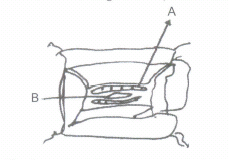
(b) Which position of stomata-open or closed, has been shown in the figure?
4.
In the absence of photosynthesis, life would be impossible on earth. Is it true or false?
5.
Some plants have deep red, violet or brown coloured leaves. Can these leaves perform the photosynthesis process?
6.
Water and minerals are absorbed by the roots and then transported to leaves. How?
7.
Nitrogen is an essential nutrient for plants growth. But farmers who cultivate pulses as crops like green gram, bengal gram, black gram, etc., do not apply nitrogenous fertilisers during cultivation. Why?
8.
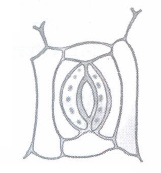
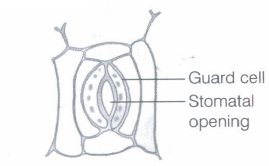
Observe the given figure and label the following terms given in the box. Stomatal opening, guard cell
9.
Wheat dough if left in the open, after a few days, starts to emit a foul smell and becomes unfit for use. Give reason.
10.
Plants are considered an essential part of earth as they keep a check on lot of process occurring all over. What would happen if all the green plants are wiped from earth?
11.
Different modes of nutrition has been observed in plants. What are they? Give example of each.
12.
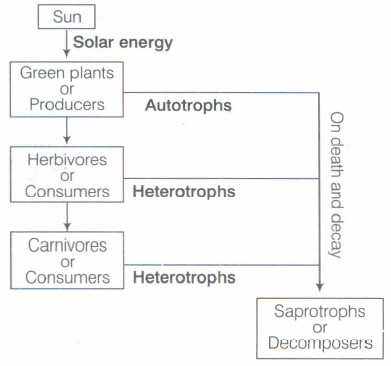
Show with the help of a sketch that the plants are the ultimate source of food.
13.
How would you test the presence of starch in leaves?
14.
Distinguish between a parasite and a saprotroph.
15.
Why do organisms need to take food?
1.
(a) This process is called crop-rotation.
(b) Mineral content of soil will be restored.
(c) Ashish is sincere, observant and interested in applying his knowledge to situations.
2.
(a) Fungus are non-green plants that grow on dead and decaying matter for their food.
(b) Fungus are also useful as it can cure different type of infections.
(c) Vivek is sincere, curious and knowledge with a keen sense of applying it where necessary.
3.
(a) The figure is of the stomata on a leaf.
(A)Guard cell
(B)Stomata
(b) The position showed in the figure is of closed stomata.
4.
True, because photosynthesis is important for the existence of life on the earth. Photosynthesis is important process as it is provides food to all living organisms and maintains CO2 - O2 balance of nature.
5.
Yes, plants having deep red, violet or brown coloured leaves can also carry out photosynthesis because they contain chlorophyll. But their green o colour of chlorophyll is masked by the large amount of all other coloured pigments.
6.
Water and minerals are transported to the leaves by the vessels which run like pipes throughout the root, stem, branches and the leaves. These vessels are xylem and phloem, forming a continuous path or passage for the nutrients to make them reach the leaf.
7.
Roots of pulses (leguminous plants) have a symbiotic association with a bacterium called Rhizobium. This bacteria convert gaseous nitrogen of air into water soluble nitrogen compounds and give them to the leguminous plants for their growth. Hence, farmers need not use nitrogenous tertilisers.
8.
Labelled figure is given below:
9.
Carbohydrates in wheat dough encourage the growth of yeast and other saprophytic fungi which breakdown carbohydrates into simpler compounds like CO2 and alcohol and emit a foul smell.
10.
Green plants are the source of energy for all the living organisms so that they can perform their normal functions. If all green plants and trees disappear, all the organism depending on them for food and shelter will also die.
The lack of gaseous exchange will lead to increase in amount of CO2, causing death in humans and other animals also. The cycle of life will gradually disappear.
11.
Plants show two major modes of nutrition, i.e.
(i) Autotrophs are those which can synthesise their own food.
(ii) Heterotrophs are those which are dependent on other plants and animals for their food.
They are of following types:
(a) Parasites, e.g. Cuscuta
(b) Saprotrophs, e.g. fungi
12.
The following sketch shows that the plants are the ultimate source of food.
13.
The presence of starch, a carbohydrate in leaves can be tested by iodine test. Iodine turns starch solution into blue-black colour. Pour few drops of dilute iodine solution on a boiled leaf. The leaf becomes blue-black in colour which proves the presence of starch in it.
14.
Differences between parasites and saprotrophs
| Parasites | Saprotrophs |
|---|---|
| These are the organisms that live inside the body of another organism (host) and derive the food from it. | These are the organisms that feed on dead and decaying organic matter. They do not require any host |
| They harm the body of the host. | They are cleaning agents. |
| e.g. Cuscuta | e.g. Fungi |
15.
The organisms need to take food to build their bodies, to grow, to repair damaged part of their bodies and to obtain the energy to carry out life processes. Food provide resistance to fight against diseases and protection from different infections.

7th Standard CBSE Syllabus & Materials
7th Standard CBSE
CBSE 7th Social Science Theme B - New Beginnings : Cities and States - New Sample Question Papers Study Material - QB365 Set A
NEW7th Standard CBSE
CBSE 7th Social Science Theme A - Climates of India - New Sample Question Papers Study Material - QB365 Set A
NEW7th Standard CBSE
CBSE 7th Social Science Theme A - Geographical Diversity of India - New Sample Question Papers Study Material - QB365 Set A
NEW7th Standard CBSE
CBSE 7th Science Earth, Moon and the Sun - New Sample Question Papers Study Material - QB365 Set A



NCERT Books

Syllabus

Exam Pattern

Sample Question Papers

Previous year Question Papers

Important Notes

MCQ Practice test

NCERT Exemplers

Case study Questions

Image Based Questions

Passage based Questions

HOT Questions

Value Based Questions

Model Questions Papers
NCERT ( Book Back ) Questions

Assertion and Reason
Important Questions And Answers

CBSE 7th Standard CBSE Subjects
CBSE Standards


