
 100% FREE ACCESS
7th Standard CBSE Syllabus & Materials
7th Standard CBSE
CBSE 7th Social Science Theme E - Understanding Market - New Sample Question Papers Study Material - QB365 Set A
NEW7th Standard CBSE
CBSE 7th Social Science Theme E - From Barter to Money - New Sample Question Papers Study Material - QB365 Set A
NEW7th Standard CBSE
CBSE 7th Social Science Theme D - The Constitution of India- An Introduction - New Sample Question Papers Study Material - QB365 Set A
NEW7th Standard CBSE
CBSE 7th Social Science Theme D - From the Rulers to the Ruled : Types of Governments - New Sample Question Papers Study Material - QB365 Set A
NEW7th Standard CBSE
CBSE 7th Social Science Theme B - The Age of Reorganisation - New Sample Question Papers Study Material - QB365 Set A
NEW7th Standard CBSE
CBSE 7th Social Science Theme B - The Rise of Empires - New Sample Question Papers Study Material - QB365 Set A

Published on: 31/10/2025
Download CBSE Class 7th Standard CBSE Science question papers, sample papers, important questions, and previous year solved papers in PDF format. Get free study materials, NCERT solutions, and exam preparation resources for Class 7th Standard CBSE Science
Questions + Answers key
Take MCQ Science Test
1.
The whole ______ of India is vulnerable to cyclone.
2.
A virtual image is always _________.
3.
A tubewell draws underground water contained in an _________________
4.
A ______ is a long continuous thread.
5.
Green plants are called _____________ since they synthesise their own food.
6.
Do you know the functions of the tongue?
7.
Respiration is a continous process. What is the need for it to be continuous rather than being like photosynthesis?
8.
Sanitation can be improved. Explain, what step should be taken to improve it.
9.
An erect and enlarged image of an object is formed on a screen. Explain how this could be possible.
10.
There is shimmering of air just above the soil during hot summer day. What does the term shimmering indicate?
11.
A series of eating and being eaten is called:
Food chain
Food web
Food series
Food hub
12.
Removal of metabolic waste from body is termed as:
Ingestion
Egestion
Excretion
Elimination
13.
Which factor influence soil formation?
Climate
Vegetation
Parent rock
All of these
14.
The colour of light which is deviated the least by prism in the spectrum of white light is
violet
green
yellow
red
15.
Which of the following cannot be used for the measurement of time?
A leaking tap
Simple pendulum
Shadow of an object during the day
Blinking of eyes
16.
Paheli wanted to buy a gift made of animal fibre obtained without killing the animal. Which of the following would be the right gift for her to buy?
Woollen shawl
Silk scarf
Animal fur cap
Leather jacket
17.
Orissa was hit by a cyclone with wind speed of 200 km/h on which date
18Oct, 1998
18 Oct, 1999
18 Oct, 2001
18 Oct, 2000
18.
During exhalation, the ribs
move outwards
move downwards
move upwards
do not move at all
19.
Organisms which prepare food for themselves using simple naturally available raw materials are referred to as
heterotrophs
autotrophs
parasites
saprophytes
20.
Choose the odd one from the following options.
Thick layer of fat under the skin
White fur
Long grasping tail
Wide and large feet with sharp claws
21.
Explain the working of a thermo flask.
22.
A jug placed facing a plane mirror. Draw the position or image of jug.
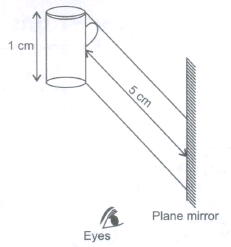
Answer the following questions:
(i) What is the size of the image of the jug?
(ii) What is the distance between image of jug and mirror?
23.
List some animals around you. Now group them as follows:
(a) Animals that can breathe only through skin.
(b) The animal that can breathe through skin as well as through lungs.
(c) The animal that can breathe through lungs.
(d) Animals that can breathe through gills.
(e) Animals that can breathe through spiracle and tracheae?
24.
A snake charmer came to the society and smelled the presence of a cobra near the guardroom. The head of the society agreed to allow the man to search, catch and take away the snake with him. Little Krishi who was seeing all this disagreed. He explained the people that it might disturb the food chain in the environment. Now, answer the following questions
(a) Describe food chain.
(b) Construct a food chain involving snake at one of its level.
(c) What are the values shown by Krishi?
25.
(a) Soil has various important component. Write them.
(b) Arrange the following rock particles which occur in soil in the increasing order. Silt, clay, gravel, sand.
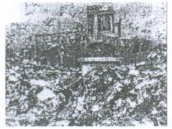
(c) Observe the following figure. What does this figure show?
26.
Write the three components and their functions of juice secreted by the inner wall of the stomach.
27.
Name any two effects of electric current.
28.
Life would be impossible without plants. Explain, how.
29.
The internal structure of heart has four chambers.
(a) Name the upper chambers of heart.
(b) Name the lower chambers of heart.
30.
Explain why burning of wood and cutting it into small pieces are considered as two different types of changes.
31.
The symbols of all units are written in singular.
32.
Poor sanitation and contaminated drinking water is the cause of a large number of diseases.
33.
Insects have spiracles on the lower surface of the body.
34.
Both moisture and air are essential for rusting.
35.
Diarrhoea can be treated by only giving water to the patient.
36.
Crab
37.
Lentil
38.
Earthworm
39.
Silt
40.
Soil
41.
Why do we wear light coloured clothes when it is hot?
42.
How can we make water clean?
43.
How does air move from one region to the other with respect to pressure?
44.
What do you mean by ground water? What are the sources of water which are fead by ground water.
45.
What is the pulse rate of a normal person?
46.
Explain crystallization
47.
What do you understand by soil texture?
48.
What is meant by rectilinear propagation of light?
49.
Give one word substitute for the areas with hot and dry climate.
50.
State whether food is made in all parts of plants or only in certain parts.
1.
()
Coastline
2.
()
Erect
3.
()
aquifer
4.
()
yarn
5.
autotrophs
6.
We use our tongue for talking and taste. Besides, it mixes saliva with the food during chewing and aids in swallowing food. We also taste food with our tongue. It has taste buds that detect different tastes of food.
7.
Process of respiration yields energy which is required to perform a variety of routine activities. Thus, it needs to be a continuous process
8.
Low cost onsite sewage disposal system must be encouraged to improve sanitation.
9.
An erect and enlarged image of an object is formed only by the concave mirror or convex lens when object is inverted and placed between F and 2F
10.
The term shimmering means that the air shines with a slightly shaking light.
11.
(a)
Food chain
12.
(c)
Excretion
13.
(d)
All of these
14.
(a)
violet
15.
(d)
Blinking of eyes
16.
(a)
Woollen shawl
17.
(b)
18 Oct, 1999
18.
Move downwards During exhalation the ribs moves downwards causing a decrease in area of chest cavity forcing the air out.
19.
(b)
autotrophs
20.
(c)
Long grasping tail
21.
Thermo flask is a special kind of flask for keeping liquids. It prevents loss or gain of heat by any of the three methods. It keeps liquid warm or cold for a long time. It was invented by Sir James Dewan in 1893.
It consists of a double-walled glass-cylinder. A vacuum is created in the space between the double walls. The two inner surfaces of glass walls are silvered. The flask is placed on a spring within a non-conducting cylindrical case to protect it from jerks and breakages. The gaps between flask and outer casing is packed with felt pads. The mouth of the flask is finally closed with a cork.
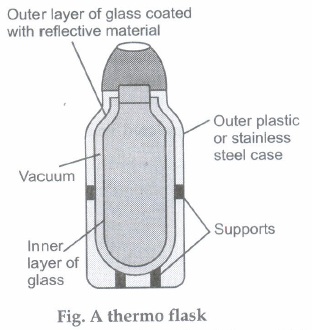
Since the container is made of glass which is a bad conductor of heat and therefore, the loss or gain of heat due to conduction is prevented. As there is vacuum between the double walls, it prevents transmission of heat by convection. Due to silvering of the inner surfaces, the heat loss by radiation is prevented. The cork and the felt pads also help to preserve the heat inside the flask. So, the hot liquids like tea, coffee, etc., remain hot and cold liquids like water, juice, etc., remain cold for a long time.
22.
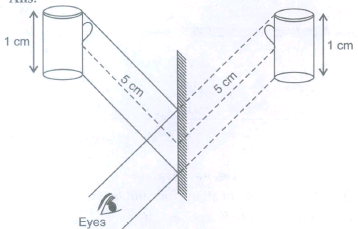
(i) Size of image of jug is 1cm.
(ii) Distance between image of jug and mirror is 5 cm.
23.
(a) Animals that can breathe only through skin are earthworm and leech.
(b) Animals that can breathe through skin as well as through lungs are frogs.
(c) Animals that can breathe through lungs are buffaloes, human, and dolphins.
(d) Animals that can breathe through gills are tadpole and fish.
(e) Animals that can breathe through spiracles and tracheae are grasshopper, cockroaches, ants, housefly and mosquito.
24.
(a) The sequence of living organisms in which one organism eats another is called a food chain.
(b) \(\underset { (Procedur) }{ Grass } \longrightarrow \underset { (Herbivore) }{ Insect } \longrightarrow \underset { (Carnivore) }{ Frog } \longrightarrow \underset { (Large\quad carnivore) }{ Snake } \longrightarrow \underset { (Top\quad carnivore) }{ Eagle } \)
(c)Scientific attitude, Obligation to maintain the ecosystem of nature.
25.
(a) The various important component of soil are air, water, rock particles, minerals,
humus and living organisms like bacteria fungi, worms (earthworm), rodents, insects (ant and beetle), etc.
(b) The increasing order of rock particles are
Clay \(\rightarrow\) Silt \(\rightarrow\) Sand \(\rightarrow\) Gravel
(c) The figure shows waste rnaterial like polythene bags, plastics, glass and metal objects are dumped which causes soil pollution.
26.
The inner lining of stomach secretes the following component:
(i) Mucous: It protects the lining of stomach.
(ii) Hydrochloric acid: It kills the germs and makes the food acidic.
(iii) Digestive juices: They help to break the proteins into simple substances.
27.
The two effects of electric current are
(i) Heating effect
(ii) Magnetic effect
28.
All green plants are producers. They make food by the process of photosynthesis using water CO2 and sunlight. All forms of animals depend on plants for food. So, if there no plants, no food will be there. Plants are give oxygen also during photosynthesis, and there would be no oxygen in absence of plant. These two basic needs make plants important for us and we cannot think of life without plants.
29.
The vertical section of heart shows that heart is divided into four compartments called as chambers.
(a) The upper two chambers of heart are called atria or atrium.
(b) The lower two chambers of heart are called ventricles.
30.
Burning of wood is a chemical change while cutting of wood is a physical change because, during burning, new substances are formed. After burning, we cannot get original substance (i.e. wood) back. Cutting of wood into small pieces is a physical change because no new substance is formed.
31.
(a)
32.
(a)
33.
(b)
34.
(a)
35.
(b)
36.
()
sand and beaches
37.
()
Loamy soil
38.
()
A-horizon of moist soils
39.
()
Deposited at river beds
40.
()
Blackish-brown in colour
41.
()
Light coloured clothes of cotton give us a feeling of coldness by reflecting heat.
42.
()
We can clean water by removing pollutants.
43.
()
The air moves from high pressure region to low pressure region.
44.
()
The water found below the water table is called ground water. The sources of ground water are well lake, pond, spring, hunt, pump etc.
45.
()
Between 72 and 80 beats per min.
46.
()
The process by which pure crystals of a substance are obtained from solution of its crude sample in water is called crystallization.
47.
()
The soil texture is determined by the relative proportion of particles of different size.
48.
()
It means that beam of light always travels in straight line.
49.
()
Desert.
50.
()
The food is made mainly in leaves and some green parts of the plants.

7th Standard CBSE Syllabus & Materials
7th Standard CBSE
CBSE 7th Social Science Theme B - New Beginnings : Cities and States - New Sample Question Papers Study Material - QB365 Set A
NEW7th Standard CBSE
CBSE 7th Social Science Theme A - Climates of India - New Sample Question Papers Study Material - QB365 Set A
NEW7th Standard CBSE
CBSE 7th Social Science Theme A - Geographical Diversity of India - New Sample Question Papers Study Material - QB365 Set A
NEW7th Standard CBSE
CBSE 7th Science Earth, Moon and the Sun - New Sample Question Papers Study Material - QB365 Set A



NCERT Books

Syllabus

Exam Pattern

Sample Question Papers

Previous year Question Papers

Important Notes

MCQ Practice test

NCERT Exemplers

Case study Questions

Image Based Questions

Passage based Questions

HOT Questions

Value Based Questions

Model Questions Papers
NCERT ( Book Back ) Questions

Assertion and Reason
Important Questions And Answers

CBSE 7th Standard CBSE Subjects
CBSE Standards


