
 100% FREE ACCESS
7th Standard CBSE Syllabus & Materials
7th Standard CBSE
CBSE 7th Social Science Theme E - Understanding Market - New Sample Question Papers Study Material - QB365 Set A
NEW7th Standard CBSE
CBSE 7th Social Science Theme E - From Barter to Money - New Sample Question Papers Study Material - QB365 Set A
NEW7th Standard CBSE
CBSE 7th Social Science Theme D - The Constitution of India- An Introduction - New Sample Question Papers Study Material - QB365 Set A
NEW7th Standard CBSE
CBSE 7th Social Science Theme D - From the Rulers to the Ruled : Types of Governments - New Sample Question Papers Study Material - QB365 Set A
NEW7th Standard CBSE
CBSE 7th Social Science Theme B - The Age of Reorganisation - New Sample Question Papers Study Material - QB365 Set A
NEW7th Standard CBSE
CBSE 7th Social Science Theme B - The Rise of Empires - New Sample Question Papers Study Material - QB365 Set A

Published on: 31/10/2025
Download CBSE Class 7th Standard CBSE Science question papers, sample papers, important questions, and previous year solved papers in PDF format. Get free study materials, NCERT solutions, and exam preparation resources for Class 7th Standard CBSE Science
Questions + Answers key
Take MCQ Science Test
1.
A chemical change may occur by one of the following changes :
(i) Evolution of gas
(ii) Change of colour
(iii) Formation of precipitate
(iv) Absorption or evolution of heat and light
(v) Change of smell
Give an example of each case.
2.
What is rusting? How do we prevent it ?
3.
Explain that carbon dioxide is an acidic oxide with the help of an activity.
4.
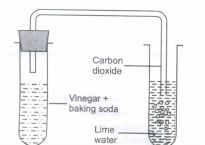
Which gas is released when vinegar and baking soda are mixed ? What happens when this gas is passed through lime water?
5.
If you leave a piece of iron in the open for a few days, it acquires a film of brownish substance, called rust.
(a) Do you think rust is different from iron?
(b) Can you change rust back into iron by some simple method?
(c) Do you think the formation of rust on iron is a chemical change?
(d) Give two other examples of a similar type of change.
6.
In the summer holidays, Karan went to Rann of Kutch in Gujarat with his parents. Karan was aware that in the coastal regions of India especially in the Rann of Kutch common salt is obtained from seawater. Karan was very excited to see that place. He requested his father that he wants to see the process of obtaining salt from the sea. His father helped him and they went to see the place where common salt was collecting. And he also explained the whole process. Karan was very happy to see the process. Now, answer the following questions.
(a) How is common salt obtained from sea water?
(b) Name the process by which salt is collected from seawater
(c) What values are shown by Karan?
7.
Rahul was a student of Class VII. His father purchased a new bicycle for him on his birthday. After few months, he found that the cycle chain and even the handle gets rusted. His father advised him to apply a coating of paint to the cycle and not to keep it in the open in future. Now, answer the following questions:
(a) Why his cycle gets rusted?
(b) What do you mean by rusting of iron?
(c) What values are shown py Rahul's father?
8.
Give an example of a chemical reaction for each of the following situations:
(a) A change in colour is observed.
(b) A gas is evolved.
(c) Sound is produced.
1.
(a) Solid calcium carbonate on heating gives carbon dioxide gas. If this gas is passed through lime water, it turns milky.
CaCO3 \(\overset{Heat}{\xrightarrow{}}\) CaO + CO2
Calcium Carbonate Calcium oxide Carbon dioxide
(b) When white lead nitrate Pb(N03h is heated, reddish coloured nitrogen dioxide (N02) is evolved and yellow coloured lead monoxide (PbO) is left behind.
2Pb(NO3)2 \(\rightarrow\) 2PbO + 4NO2 + O2
(c) When colourless solutions of silver nitrate (AgNO3) and sodium bromide (NaBr) are mixed, yellow coloured silver bromide (AgBr) gets precipitated
AgNO3 (aq) + NaBr (aq) \(\rightarrow\) AgBr + NaNO3 (aq)
(d) When water is added to quick lime (CaO), heat energy is evolved with the formation of calcium hydroxide, Ca(OH)2.
CaO + H2O ⟶ Ca (OH)2 + Heat
(e) When cooked food containing oils and fats is kept in the open for long, pleasant smell changes into foul smell and the food gets spoiled.
2.
If we leave a piece of iron in the open for some time, it acquires a coating of brownish substances. This substance is called rust and the process of its formation is called rusting. This is the change that effects iron articles and slowly destroys them. Since iron is used in making bridges, ships, cars, truck bodies and many other articles. The monetary loss due to rusting is huge. For rusting the presence of both oxygen and water (or water vapour) is essential. Infact, if the moisture content in air is high which means if it is more humid, rusting becomes faster.
Methods of preventing rust formation: Rusting of an iron object can be prevented or reduced by not allowing air and moisture to come in contact with the surface of iron objects. Following are the methods of prevention form rusting.
(i) Putting oil or paint over the surface of iron implements.
(ii) Galvanization: In this method, surface of iron is covered with a layer of more active metal like zinc. Zinc metal looses electrons in preference to iron and hence, prevents the rusting of iron.
(iii) By tin-plating
(iv) Use of anti-rust solutions: Alkaline chromate and alkaline phosphate solution act as anti-rust solutions. When iron objects are dipped into a boiling and strongly alkaline solution of sodium phosphate, a protective insoluble film of iron phosphate is formed on them. This film protects the article form rusting.
3.
Bum a piece of soft coke in hard glass test tube and pass the gas produced in water.
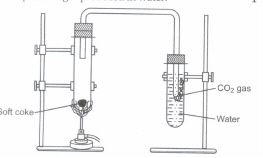
Then add blue litmus solution (to test the formation of acid) to the test-tube in which carbon dioxide gas is dissolved. The colour of the solution turns red. The following chemical reactions are going on during this experiment.
(i) C + O2 ⟶CO2 (Carbon dioxide)
(ii) CO2 + H2O ➝H2CO3 (Carbonic acid)
4.
When baking soda and vinegar are mixed with each other then carbon dioxide gas is released. When carbon dioxide is passed through lime water, then calcium carbonate is formed. Calcium carbonate makes lime water appear milky. The turning of lime water into milky solution is a standard test of carbon dioxide. The following reactions take place
(i) Vinegar + Baking soda ⟶Carbon dioxide + other substances
(ii) Carbon dioxide (CO2) + lime water Ca(OH)2⟶Calcium carbonate (CaCO3) + water (H2O)
5.
(a) Yes, rust is iron oxide (Fe2O3). Thus, rust and iron are not the same substance.
(b) No, rusting of iron is a chemical change because in this reaction, a new substance, rust (iron oxide) is formed. It cannot be reversed by any method.
(c) Yes, rusting of iron is a chemical change. During the rusting of iron, it combines with the oxygen in the presence of water (moisture) to form a new compound 'iron oxide'. This iron oxide is a rust.
Iron + Oxygen + Water \(\longrightarrow\) Iron oxide
(From damp air) (Rust)
It is a permanent change which cannot be reversed back. So, rusting of iron is a chemical change.
(d) Two other examples are
(i) Setting of curd from milk.
(ii) Burning of magnesium ribbon to form magnesium oxide.
6.
(a) Seawater is collected in shallow pits. It is then allowed to evaporate in the sun. As the water evaporates, the salt solution becomes supersaturated (concentrated). This supersaturated solution cannot hold the excess salt. Thus, it separates out in the form of salt crystals. These salt crystals are collected and are redissolved in water and filtered to remove insoluble impurities. The clear solution is again evaporated to obtain the crystals of pure salt.
(b) Salt is obtained from sea water by the process of evaporation.
(c) The values shown by Karan are curious, aware and intelligence
7.
(a) Rahul's cycle was kept in the open for a longer time. As air contains both oxygen and moisture. Thus, in the presence of oxygen and water, his cycle slowly gets rusted. Iron(Fe)+ Oxygen + Water \(\longrightarrow\) Rust (Iron oxide)
(b) If iron objects are left in humid conditions for a longer time, they get covered with reddish brown ferric oxide (Fe2O3) layer. This is called rusting of iron.
(c) Rahul's father is caring, aware and intelligent.
8.
(a) Chemical reaction between copper sulphate solution and iron metal. In this reaction, blue colour of copper sulphate solution changes to light green colour due to the formation of iron sulphate.
Copper sulphate + Iron \(\longrightarrow\) Iron sulphate + Copper
(Blue) (Grey) (Light green) (Brown)
(b) When baking soda and vinegar are mixed together then a chemical change takes place and bubbles of carbon dioxide gas are formed along with some other substances.
Baking soda + Vinegar \(\longrightarrow\) Sodium acetate + Carbon dioxide + Water
(Sodium hydrogen carbonate) (Acetic acid)
(c) Explosion of a firework produces heat, light, sound and unpleasant gases. Explosion of a firework is a chemical change.

7th Standard CBSE Syllabus & Materials
7th Standard CBSE
CBSE 7th Social Science Theme B - New Beginnings : Cities and States - New Sample Question Papers Study Material - QB365 Set A
NEW7th Standard CBSE
CBSE 7th Social Science Theme A - Climates of India - New Sample Question Papers Study Material - QB365 Set A
NEW7th Standard CBSE
CBSE 7th Social Science Theme A - Geographical Diversity of India - New Sample Question Papers Study Material - QB365 Set A
NEW7th Standard CBSE
CBSE 7th Science Earth, Moon and the Sun - New Sample Question Papers Study Material - QB365 Set A



NCERT Books

Syllabus

Exam Pattern

Sample Question Papers

Previous year Question Papers

Important Notes

MCQ Practice test

NCERT Exemplers

Case study Questions

Image Based Questions

Passage based Questions

HOT Questions

Value Based Questions

Model Questions Papers
NCERT ( Book Back ) Questions

Assertion and Reason
Important Questions And Answers

CBSE 7th Standard CBSE Subjects
CBSE Standards


