
 100% FREE ACCESS
7th Standard CBSE Syllabus & Materials
7th Standard CBSE
CBSE 7th Social Science Theme E - Understanding Market - New Sample Question Papers Study Material - QB365 Set A
NEW7th Standard CBSE
CBSE 7th Social Science Theme E - From Barter to Money - New Sample Question Papers Study Material - QB365 Set A
NEW7th Standard CBSE
CBSE 7th Social Science Theme D - The Constitution of India- An Introduction - New Sample Question Papers Study Material - QB365 Set A
NEW7th Standard CBSE
CBSE 7th Social Science Theme D - From the Rulers to the Ruled : Types of Governments - New Sample Question Papers Study Material - QB365 Set A
NEW7th Standard CBSE
CBSE 7th Social Science Theme B - The Age of Reorganisation - New Sample Question Papers Study Material - QB365 Set A
NEW7th Standard CBSE
CBSE 7th Social Science Theme B - The Rise of Empires - New Sample Question Papers Study Material - QB365 Set A

Published on: 31/10/2025
Download CBSE Class 7th Standard CBSE Science question papers, sample papers, important questions, and previous year solved papers in PDF format. Get free study materials, NCERT solutions, and exam preparation resources for Class 7th Standard CBSE Science
Questions + Answers key
Take MCQ Science Test
1.
When a candle burns, both physical and chemical changes occur. Explain.
2.
A magnesium strip is burnt. The ash obtained is dissolved in water. What kind of changes are these? Write word equations for these.
3.
Ice, water and steam have similar chemical properties. In what respect to these differ?
4.
State the difference between physical and chemical changes.
5.
What happens when an iron blade of a knife is dipped in a copper sulphate solution? What kind of change takes place?
6.
Why cannot a chemical change be normally reversed?
7.
Which type of change takes place in the following and state whether the energy is evolved or absorbed during the change?
Burning of a candle, lightning of a bulb, preparation of food by green plants, volcanic eruption, evaporation of petrol, burning of LPG.
8.
How ozone layer acts as a protective shield?
9.
The process of digestion is a chemical change. Explain why.
10.
Plants prepare their food by a process called photosynthesis. Can we call photosynthesis is a chemical change? Explain.
11.
Write the differences between physical and chemical changes.
12.
Is cloud formation a physical change or chemical change? Explain.
13.
Anaerobic bacteria digest animal waste and produce biogas (change A). The biogas is then burnt as fuel (change B). The following statements pertain to these changes. Choose the correct one.
(a) Process A is a chemical change
(b) Process B is a chemical change
(c) Both processes A and B are chemical changes
(d) None of the above processes is a chemical change
14.
Describe how crystals of copper sulphate are prepared.
15.
Explain why burning of wood and cutting it into small pieces are considered as two different types of changes.
1.
It is true that when a candle burns, both physical and chemical changes occur. initially, candle burns to produce heat and light. It is a chemical change because candle burns with the formation of gases. Due to the heat produced, some candles simultaneously melts. This is a physical change as the molten candle wax behaves like original candle.
2.
These are chemical changes :
Magnesium + Oxygen⟶ Magnesium oxide
Magnesium oxide + Water ⟶ Magnesium hydroxide
3.
Differences between ice, water and steam:
| Ice | Water | Steam |
|---|---|---|
| 1.Incompressible. | Can be compressed to some extent | Highly |
| 2.Does not flow | Flows from higher level to lower level | Flow in all directions. |
| 3. Has definite shape and volume. | Has a definite volume but no definite shape. | Has neither definite shape nor a definite volume |
| 4. Solid state | Liquid state | Gaseous state |
4.
Difference between physical and chemical changes.
| Chemical changes | Physical changes |
|---|---|
| 1. It is irreversible. | It is mostly reversible |
| 2. The composition of substances changes | No change in the composition of the substance |
| 3. It is a permanent change. | Change in temporary. |
| 4. A new substance is formed. | No new substance is formed. |
5.
When an iron blade of a knife is dipped in a copper sulphate solution, then iron blade is coated with reddish brown deposits of copper.
And the blue colour of copper sulphate solution changes to light green due to the formation of iron sulphate. So, it is a chemical change.
6.
In a chemical change, the products are quite different from the reactants. Therefore, a chemical change cannot be normally reversed.
7.
(i) Burning of a candle Chemical change as well as physical change and energy evolved.
(ii) Lightning of a bulb Physical change, energy evolved.
(iii) Preparation of food by green plants Chemical change, energy absorbed.
(iv) Volcanic eruption Chemical change, energy evolved.
(v) Evaporation of petrol Physical change as no new chemical substance is formed, energy absorbed.
(vi) Burning of LPG Chemical change because LPG on burning form CO2 and H2O, energy absorbed.
8.
The ozone layer protects us from the harmful ultraviolet radiations which come from the sun. Ozone absorbs ultraviolet radiations coming from the sun and breaks down to form oxygen.
In this way, ozone layer absorbs harmful ultraviolet radiations.
9.
In the process of digestion, the various food materials break down to form new substances which can be absorbed by the body. So, the process of digestion is a chemical change.
10.
During photosynthesis, the plants intake carbon dioxide and water in the presence of chlorophyll and sunlight to form two new substances, i.e. glucose (food) and oxygen gas. So, photosynthesis is a chemical change.
11.
Differences between physical and chemical changes are
| Physical change | Chemical change |
| No new substance is formed. | New substance is formed. |
| It is a temporary change | It is a permanent change |
| Physical change is easily reversible. | Chemical change is irreversible. |
| Very little energy (heat, etc) is absorbed or given out in a physical change. | A lot of energy (in the form of heat, light, sound etc) is absorbed or given out in a chemical change. |
12.
Formation of clouds is a physical change. Clouds are formed by the condensation of water vapours present in the atmosphere. When rainwater goes back on the earth, no new product is formed. Therefore, it is a physical change.
13.
(c) Both processes A and B are chemical changes. Bacteria act on waste and converts it to biogas (change A). Hence, it is a chemical change. During biogas production, it works as fuel(change Bl, and produces CO2 and heat. Hence, A and B both are chemical changes.
14.
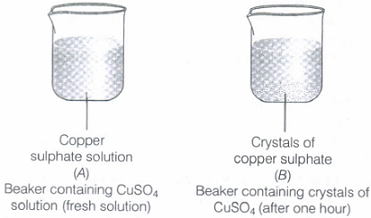
Crystals of copper sulphate are prepared in the following manner:
(i) Take a cup full of water in a beaker.
(ii) Add a few drops of dilute sulphuric acid.
[Caution Never add water to the acid as the acid may splash on you].
(iii) Heat the water.
(iv) When it starts boiling, add copper sulphate powder slowly with constant stirring.
(v) Continue adding copper sulphate powder till no more powder can be dissolved.
(vi) Filter the solution.
(vii) Allow it to cool.
(viii) Do not disturb the solution, when it is cooling.
(ix) Look at the solution after some time and wait till it changes into crystals.
15.
Burning of wood is a chemical change while cutting of wood is a physical change because, during burning, new substances are formed. After burning, we cannot get original substance (i.e. wood) back. Cutting of wood into small pieces is a physical change because no new substance is formed.

7th Standard CBSE Syllabus & Materials
7th Standard CBSE
CBSE 7th Social Science Theme B - New Beginnings : Cities and States - New Sample Question Papers Study Material - QB365 Set A
NEW7th Standard CBSE
CBSE 7th Social Science Theme A - Climates of India - New Sample Question Papers Study Material - QB365 Set A
NEW7th Standard CBSE
CBSE 7th Social Science Theme A - Geographical Diversity of India - New Sample Question Papers Study Material - QB365 Set A
NEW7th Standard CBSE
CBSE 7th Science Earth, Moon and the Sun - New Sample Question Papers Study Material - QB365 Set A



NCERT Books

Syllabus

Exam Pattern

Sample Question Papers

Previous year Question Papers

Important Notes

MCQ Practice test

NCERT Exemplers

Case study Questions

Image Based Questions

Passage based Questions

HOT Questions

Value Based Questions

Model Questions Papers
NCERT ( Book Back ) Questions

Assertion and Reason
Important Questions And Answers

CBSE 7th Standard CBSE Subjects
CBSE Standards


