
 100% FREE ACCESS
7th Standard CBSE Syllabus & Materials
7th Standard CBSE
CBSE 7th Social Science Theme E - Understanding Market - New Sample Question Papers Study Material - QB365 Set A
NEW7th Standard CBSE
CBSE 7th Social Science Theme E - From Barter to Money - New Sample Question Papers Study Material - QB365 Set A
NEW7th Standard CBSE
CBSE 7th Social Science Theme D - The Constitution of India- An Introduction - New Sample Question Papers Study Material - QB365 Set A
NEW7th Standard CBSE
CBSE 7th Social Science Theme D - From the Rulers to the Ruled : Types of Governments - New Sample Question Papers Study Material - QB365 Set A
NEW7th Standard CBSE
CBSE 7th Social Science Theme B - The Age of Reorganisation - New Sample Question Papers Study Material - QB365 Set A
NEW7th Standard CBSE
CBSE 7th Social Science Theme B - The Rise of Empires - New Sample Question Papers Study Material - QB365 Set A

Published on: 31/10/2025
Download CBSE Class 7th Standard CBSE Science question papers, sample papers, important questions, and previous year solved papers in PDF format. Get free study materials, NCERT solutions, and exam preparation resources for Class 7th Standard CBSE Science
Questions + Answers key
Take MCQ Science Test
1.
Insects and leaves of a plant have pores through which they exchange gases with the. atmosphere. Can you write two points of differences between these pores with respect to their position, number and extension into the body?
2.
Pick the odd one out from each of the groups given below on the basis of respiratory organs. Give reason for your answer.
(a) Cockroach, grasshopper, snail, ant
(b) Lizard, cow, earthworm, snake
(c) Crocodile, whale, dolphin, fish
(d) Snake, tadpole, crow, goat
3.
Take three test tubes. Fill 3/4th of each with water. Label them A, B and C. Keep a snail in test tube A, a water-plant in test tube B and in C, keep snail and plant both. Which test tube would have the highest concentration of CO2?
4.
Why do we often sneeze when we inhale a lot of dust-laden air?
5.
List the similarities and differences between aerobic and anaerobic respiration
6.
Why does an athlete breathe faster and deeper than usual after finishing the race?
7.
The mountaineers carry oxygen with them because
at an altitude of more than 5 km, there is no air
the amount of air available to a person is less than that available on the ground
the temperature of air is higher than that on the ground
the pressure of air is higher than that on the ground
8.
During exhalation, the ribs
move outwards
move downwards
move upwards
do not move at all
9.
Normal range of breathing rate per minute in an average adult person at rest is
9-12
15-18
21-24
30-33
10.
During heavy exercise, we get cramps in the legs due to the accumulation of
carbon dioxide
lactic acid
alcohol
water
11.
In cockroaches, air enters the body through
lungs
gills
spiracles
skin
12.
Our nostrils has hair and mucous. What is the need to have them in our nasal cavity?
13.
Give the name of respiratory organs in following animals.
(a) Fish (b) Human being
14.
In some animals, exchange of gases takes place through its thin and moist skin. Name one such animal.
15.
Name the end products of anaerobic respiration in yeast.
16.
The cellular respiration process takes place in which cell organelle?
17.
What are the end products of aerobic respiration.
18.
Paheli participated in a 400 m race competition held at her school and won the race. When she came home she had mixed feelings of joy and pain as she had cramps in her leg muscles. After a massage, she was relieved of the pain. Answer the following questions related to the situation.
(a) What can be the possible reasons for the pain in her legs?
(b) Why did she fell comfortable after a massage?
19.
(a) Plants lack a specialised respiratory system. How do they carry out respiratory process? Explain.
(b) The plant roots being underground respire by using which mechanism?
20.
A food stall owner was preparing dough for making bhaturas. He added a pinch of yeast and sugar to the dough and left it in a warm place. After few hours, the dough had risen. There was a sour smell too.
(a) Why did the dough rise?
(b) Why did the dough smell sour?
(c) Why was sugar added to the dough?
(d) What would have happened if the dough was kept in the refrigerator, soon after it was prepared?
1.
Pores present on the sides of insects are called spiracles while pores present on the surface of leaves are called stomata. These structures are responsible for the exchange of gases with the atmosphere. Differences between these two are as follows
(i) Spiracles are fewer in number as compared to stomata.
(ii) Spiracles lead to an extensive network of tracheal system which is absent in the leaves
2.
(a) Snail, as it does not breathe by means of trachea.
(b) Earthworm, because it breathes through its skin and it (does not have lungs.
(c) Fish as most fish breathe through their gills and do not have lungs.
(d) Tadpole, as it breathes through hills and do not have lungs.
3.
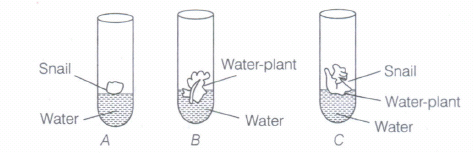
Test tube A will have higher concentration of CO2, This experiment shows the relationship between plants and animals. During breathing, snail inhales dissolved oxygen from water and releases CO2.
Water-plant along with respiration performs another important function called photosynthesis. During photosynthesis, water-plant absorbs CO2, prepares food and releases oxygen.
Therefore, test tube Band C have less amount of CO2 concentration as compared to test tube A.
4.
When we inhale dust-laden air, dirt-particles are captured within the nostrils. Sometimes, they get past the nostril hair in the nasal cavity and irritate the lining of the cavity, as a result, we sneeze. Sneezing expels these foreign particles from the inhaled air and a dust free, clean air enters in our body
5.
Differences between aerobic and anaerobic respiration are as follows
| Aerobic respiration | Anaerobic respiration |
| It uses oxygen | It takes place in the absence of oxygen |
| Glucose is completely broken down into Co2 and water along with release of high amount of energy | Glucose is broken into ethyl alcohol or lactic acid CO2 and energy produced is in low amount |
| It occurs in all living organisms like mammals | It occurs in lower organisms like yeast, fungi and bacteria |
| Glucose + O2 \(\rightarrow\) co2 + H2O2 + Energy | Glucose \(\rightarrow\) ethyl alcohol + Co2 + Energy |
Similarities between aerobic and anaerobic respiration are as follows
(i) Both break down the glucose.
(ii) Release of energy takes place in both.
(iii) CO2 is the common product in both.
6.
Our body needs energy for all activitie, while doing heavy exercises like running and there is a larger demand of energy to perform these activities. Hence, more oxygen is required to meet extra demand of energy. Therefore, an athlete breathes faster and deeper than usual after finishing the race
7.
(b)
the amount of air available to a person is less than that available on the ground
8.
Move downwards During exhalation the ribs moves downwards causing a decrease in area of chest cavity forcing the air out.
9.
15-18 Normal range of breathing rate is 15-18 breaths per minute, in an average adult person at rest.
10.
Lactic acid It is produced during heavy exercise as sufficient oxygen is not available to muscles.
11.
Spiracles In cockroaches, air for respiration enters through small tubes/holes present on then body called spiracles.
12.
Our nostrils possess hairs and mucous lining. These help in preventing dirt, dust and germs from entering our respiratory system.
13.
The respiratory organ of the following animals are as follows
(a) Fish - Gills (b) Human being - lungs
14.
Earthworm is an animal where exchange of gases during breathing or respiration takes place through its thin and moist skin
15.
The end product formed during anaerobic respiration in yeast are
(i) Ethyl alcohol
(ii) Carbon dioxide
(iii) Energy
16.
Cellular respiration takes place in the mitochondria of the cell
17.
During aerobic respiration, carbon dioxide and water are released along with a large amount of energy.
\(glucose\overset { { O }_{ 2 } }{ \longrightarrow } { O }_{ 2 }+water+Energy\)
18.
(a) Paheli had cramps in her leg muscles after running. She felt pain in her legs because of accumulation of lactic acid in the leg muscles. Lactic acid is formed due to anaerobic respiration in the muscle cells after heavy exercise or running. After heavy exercise, we require large amount of energy.
To produce more energy to meet the oxygen requirement of muscles, muscle cells perform anaerobic respiration for a short duration. Lactic acid is formed due to partial breakup of glucose. It gets accumulated in the muscle cells and causes pain and muscle cramps.
(b) The massage or hot water bath gives the relief from muscle cramp or pain, because it improves the circulation of blood leading to increase supply of oxygen to the muscle cells . It helps in complete breakdown of lactic acid into carbon dioxide and water
19.
(a) The plants do not possess any respiratory system still plants respire. The various parts of the plants like leaves, roots, etc., carry out respiration independently.
These parts take in oxygen from air in different manner and utilise it to obtain energy and give out CO2, The leaves of plants possess tiny pores on their surface which is called as stomata. The gaseous exchange during respiration takes place through their stomata.
(b) Roots of the plants respire under the ground. Root cells get oxygen from the air present in the space between the soil particles.
There are several root hairs present on the roots of a plant.
The oxygen from the air (between soil particle) diffuses into root hair and reaches to the cells of the roots. This oxygen is utilised for respiration.
20.
(a) The dough rises due to the release of carbon dioxide during anaerobic respiration by yeast cell.
(b) Yeast, during anaerobic respiration also produces alcohol which results in the sour smell of dough.
(c) Sugar is added into the dough, because it acts as a food for yeast. Yeast upon incomplete breakdown of sugar or food produces CO2, alcohol and energy (in less amount).
(d) If the dough is kept in the refrigerators after it was prepared, then dough will neither raise nor become sour. Yeast requires high temperature to grow, multiply and to respire. At low temperature, the yeast will not respire to produce the byproducts of anaerobic respiration.

7th Standard CBSE Syllabus & Materials
7th Standard CBSE
CBSE 7th Social Science Theme B - New Beginnings : Cities and States - New Sample Question Papers Study Material - QB365 Set A
NEW7th Standard CBSE
CBSE 7th Social Science Theme A - Climates of India - New Sample Question Papers Study Material - QB365 Set A
NEW7th Standard CBSE
CBSE 7th Social Science Theme A - Geographical Diversity of India - New Sample Question Papers Study Material - QB365 Set A
NEW7th Standard CBSE
CBSE 7th Science Earth, Moon and the Sun - New Sample Question Papers Study Material - QB365 Set A



NCERT Books

Syllabus

Exam Pattern

Sample Question Papers

Previous year Question Papers

Important Notes

MCQ Practice test

NCERT Exemplers

Case study Questions

Image Based Questions

Passage based Questions

HOT Questions

Value Based Questions

Model Questions Papers
NCERT ( Book Back ) Questions

Assertion and Reason
Important Questions And Answers

CBSE 7th Standard CBSE Subjects
CBSE Standards


