
 100% FREE ACCESS
7th Standard CBSE Syllabus & Materials
7th Standard CBSE
CBSE 7th Social Science Theme E - Understanding Market - New Sample Question Papers Study Material - QB365 Set A
NEW7th Standard CBSE
CBSE 7th Social Science Theme E - From Barter to Money - New Sample Question Papers Study Material - QB365 Set A
NEW7th Standard CBSE
CBSE 7th Social Science Theme D - The Constitution of India- An Introduction - New Sample Question Papers Study Material - QB365 Set A
NEW7th Standard CBSE
CBSE 7th Social Science Theme D - From the Rulers to the Ruled : Types of Governments - New Sample Question Papers Study Material - QB365 Set A
NEW7th Standard CBSE
CBSE 7th Social Science Theme B - The Age of Reorganisation - New Sample Question Papers Study Material - QB365 Set A
NEW7th Standard CBSE
CBSE 7th Social Science Theme B - The Rise of Empires - New Sample Question Papers Study Material - QB365 Set A

Published on: 31/10/2025
Download CBSE Class 7th Standard CBSE Science question papers, sample papers, important questions, and previous year solved papers in PDF format. Get free study materials, NCERT solutions, and exam preparation resources for Class 7th Standard CBSE Science
Questions + Answers key
Take MCQ Science Test
1.
Earthworms and frogs breathe through their skin because of which the skin of both the organisms is
moist and rough
dry and rough
dry and slimy
moist and slimy
2.
Fish breathe with the help of gills which are richly supplied with blood vessels. The gills help the fish to
take in oxygen from air
take in oxygen dissolved in water
absorb nutrients present in water
release waste substances in water
3.
Yeast is used in wine and beer industries because it respires
aerobically producing oxygen
aerobically producing alcohol
anaerobically producing alcohol
anaerobically producing CO2
4.
Sometimes when we do heavy exercise, anaerobic respiration takes place in our muscle cells. What is produced during this process?
Alcohol and lactic acid
Alcohol and CO2
Lactic acid and CO2
Lactic acid only
5.
In cockroaches, air enters the body through
lungs
gills
spiracles
skin
6.
Oxygen breaks down glucose outside the cells of organisms.
7.
The size of the chest cavity increases during inhalation.
8.
The fishes have lungs for respiration.
9.
Frogs breathe through their skins as well as their lungs.
10.
During heavy exercise, the breathing rate of a person slows down.
11.
Certain small pores are present on the surface of plant through which gaseous exchange occurs. Identify these pores?
12.
Name the respiratory organs in frogs.
13.
In the experiment, where we exhale into lime water containing glass. What changes were observed by you?
14.
What changes are observed in diaphragm during inhalation?
15.
Sometimes we see that farmers loosen the soil. What is the reason behind it?
16.
A girl was suffering from cold and was sneezing continuously. She joined her family at dinner and suddenly started sneezing without covering her nose, thus sending particles all over the place. On realising her mistake, said sorry and next time covered her nose.
(a) During sneezing, what are the precautionary steps to be followed?
(b) Can infections be passed from one person to another via sneezing?
(c) Is sneezing a respiration process?
(d) What values do we pick from this situation?
17.
There are three animals named A, B and C. Among them A can stay on land as well as in water. When it stays at land is respire through lungs but when it goes into water, it respires through its moist skin. Animal B has specific organs to respire in the water which is not found in any other water animal. While animal C is a water animal which respires through nostrils and lungs. Now give the name of animal A, B and C.
18.
After we work hard or perform physical activity, we feel hungry. Explain why
19.
Frogs are amphibians. They survive on land and water, do they have any respiratory issue? How does frog breathe when they are in water? Do they possess lungs? Explain the role of lungs in frogs.
20.
Insects and leaves of a plant have pores through which they exchange gases with the. atmosphere. Can you write two points of differences between these pores with respect to their position, number and extension into the body?
21.
Observe the figures carefully and answer the following questions.
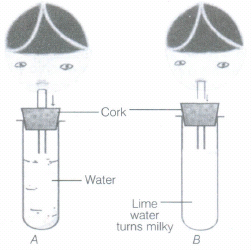
(a) Which process is being tested in the activity?
(b) What is the result of the activity? Give reasons.
22.
Paheli participated in a 400 m race competition held at her school and won the race. When she came home she had mixed feelings of joy and pain as she had cramps in her leg muscles. After a massage, she was relieved of the pain. Answer the following questions related to the situation.
(a) What can be the possible reasons for the pain in her legs?
(b) Why did she fell comfortable after a massage?
23.
Lungs are very..............organ
24.
Unwanted particles like smoke, dust, pollen, etc., are called................
25.
Breathing rate of a person is not always ______
26.
Taking in of air rich in O2 inside the body is called _____
27.
During aerobic respiration, the food is broken down into_____ and _____ and releases a lot of ______
1.
(d)
moist and slimy
2.
(b)
take in oxygen dissolved in water
3.
(c)
anaerobically producing alcohol
4.
(d)
Lactic acid only
5.
Spiracles In cockroaches, air for respiration enters through small tubes/holes present on then body called spiracles.
6.
(b)
7.
(a)
8.
(b)
9.
(a)
10.
(b)
11.
Stomata are the tiny pores that are present on the surface of plant through which gaseous exchange occurs.
12.
Frogs respire through their moist skin as well as through a pair of lungs
13.
When we exhale into lime water its colour changes, into slightly milky white because exhaled air contains CO2,
14.
During the process of inhalation diaphragm contracts and moves downwards.
15.
The farmers sometimes loosen the soil. This helps the root to respire through the air present in the space between soil particles.
16.
(a) When sneezing, you should cover your nose so that the particles expelled by you would not be inhaled by others.
(b) Yes.
(c) No, it is process to remove/clear the particles harmful for us resulting in clean, fresh air to enter the lungs.
(d) Cleanliness and hygiene maintenance.
17.
Animal A can live on land as well as in water and can respire through lungs as well as moist skin. The animal is frog.
Animal B lives in water and respires through a specific organ called gills. These are found in the tadpoles besides fishes.
The animal B is a fish. Animal C is also an aquatic animal which lives in sea water and respires through nostrils and lungs not by the gills. The animal is whale.
18.
When we work hard or perform physical activity (like running, swimming, cycling), we need more energy. To fulfil the energy requirement, we breathe faster. Fast breathing helps in supply of more oxygen to our cells. Due to this, rate of breakdown of food increases and more energy is released. The rapid breakdown of food makes us to feel more hungry.
19.
Frog breathe by their moist skin and through lungs also. So, they do not have any, respiratory issue.
When frog enters into water, the skin of frog helps in respiration.
The oxygen rich air enters through the skin. When the frog is on land, a pair of lungs helps in respiration.
The lungs take the oxygen-rich air through the nostrils from where the oxygen is absorbed by the blood and carried throughout the body. The carbon dioxide from the blood is diffused back through the skin and lungs into the atmosphere.
20.
Pores present on the sides of insects are called spiracles while pores present on the surface of leaves are called stomata. These structures are responsible for the exchange of gases with the atmosphere. Differences between these two are as follows
(i) Spiracles are fewer in number as compared to stomata.
(ii) Spiracles lead to an extensive network of tracheal system which is absent in the leaves
21.
(a) Exhalation process of respiration is being tested in the activity.
(b) The lime water in test tube B turns milky but water in test tube A remains unchanqed Because CO2 is present in the exhaled air, it mixes with lime water in test tube B and turns it milky.
22.
(a) Paheli had cramps in her leg muscles after running. She felt pain in her legs because of accumulation of lactic acid in the leg muscles. Lactic acid is formed due to anaerobic respiration in the muscle cells after heavy exercise or running. After heavy exercise, we require large amount of energy.
To produce more energy to meet the oxygen requirement of muscles, muscle cells perform anaerobic respiration for a short duration. Lactic acid is formed due to partial breakup of glucose. It gets accumulated in the muscle cells and causes pain and muscle cramps.
(b) The massage or hot water bath gives the relief from muscle cramp or pain, because it improves the circulation of blood leading to increase supply of oxygen to the muscle cells . It helps in complete breakdown of lactic acid into carbon dioxide and water
23.
()
delicate
24.
()
allergen
25.
()
constant
26.
()
inhalation
27.
()
Carbon dioxide, water, energy

7th Standard CBSE Syllabus & Materials
7th Standard CBSE
CBSE 7th Social Science Theme B - New Beginnings : Cities and States - New Sample Question Papers Study Material - QB365 Set A
NEW7th Standard CBSE
CBSE 7th Social Science Theme A - Climates of India - New Sample Question Papers Study Material - QB365 Set A
NEW7th Standard CBSE
CBSE 7th Social Science Theme A - Geographical Diversity of India - New Sample Question Papers Study Material - QB365 Set A
NEW7th Standard CBSE
CBSE 7th Science Earth, Moon and the Sun - New Sample Question Papers Study Material - QB365 Set A



NCERT Books

Syllabus

Exam Pattern

Sample Question Papers

Previous year Question Papers

Important Notes

MCQ Practice test

NCERT Exemplers

Case study Questions

Image Based Questions

Passage based Questions

HOT Questions

Value Based Questions

Model Questions Papers
NCERT ( Book Back ) Questions

Assertion and Reason
Important Questions And Answers

CBSE 7th Standard CBSE Subjects
CBSE Standards


