
 100% FREE ACCESS
7th Standard CBSE Syllabus & Materials
7th Standard CBSE
CBSE 7th Social Science Theme E - Understanding Market - New Sample Question Papers Study Material - QB365 Set A
NEW7th Standard CBSE
CBSE 7th Social Science Theme E - From Barter to Money - New Sample Question Papers Study Material - QB365 Set A
NEW7th Standard CBSE
CBSE 7th Social Science Theme D - The Constitution of India- An Introduction - New Sample Question Papers Study Material - QB365 Set A
NEW7th Standard CBSE
CBSE 7th Social Science Theme D - From the Rulers to the Ruled : Types of Governments - New Sample Question Papers Study Material - QB365 Set A
NEW7th Standard CBSE
CBSE 7th Social Science Theme B - The Age of Reorganisation - New Sample Question Papers Study Material - QB365 Set A
NEW7th Standard CBSE
CBSE 7th Social Science Theme B - The Rise of Empires - New Sample Question Papers Study Material - QB365 Set A

Published on: 31/10/2025
Download CBSE Class 7th Standard CBSE Science question papers, sample papers, important questions, and previous year solved papers in PDF format. Get free study materials, NCERT solutions, and exam preparation resources for Class 7th Standard CBSE Science
Questions + Answers key
Take MCQ Science Test
1.
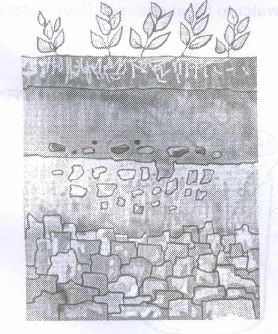
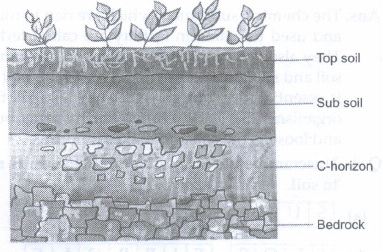
Locate the following zones given as boxed items in Figure, which shows a diagram of soil profile. Top soil, Sub soil, C-horizon, Bedrock
2.
Which of the following situations - 'A' or 'B' is advantageous for absorption of water and minerals? Why?
Situation 'A': Growth and branching of roots in the C-horizon.
Situation 'B': Growth and branching of roots in A and B-horizons.
3.
Which soil is considered to be best for growing plants and why? Give reason
4.
What are the various components of soil?
5.
What makes soil a shelter for many living organisms?
6.
Explain that "Soil is an inseparable part of our life."
7.
Why on a hot summer day the soil seems to shimmer?
8.
Name the various factors which affect the nature of soil
9.
What is the basis of classifying soil and into how many types it is classified accordingly?
10.
Why is horse dung mixed in soil which is used for making matkas and surahis?
11.
Soil is very important for the living beings? Justify.
12.
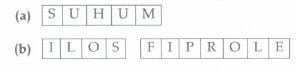
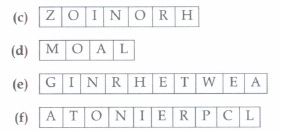
Unscramble the following jumbled words related to soil
13.
What are chemical fertilizers? Write their harmful effects
14.
Show that dry soil also contains some amount of water
15.
Describe in brief the steps followed in making earthen pots.
16.
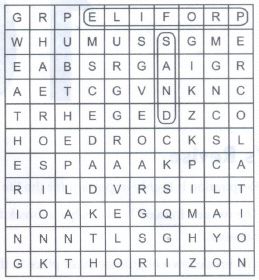
Several terms related to soil are hidden in the squares given as Figure. Spot them and make a list. Two examples are given for you.
17.
Continuously water-logged soils are disadvantages for plant growth. Why?
18.
Explain the water absorbing capacity of soil with the help of an activity.
19.
Explain the soil profile
20.
What is meant by soil erosion? What are its various causes and harms? How it can be checked? In which areas soil erosion is more severe?
1.
2.
Situation 'B' is advantageous to plants because A-and B- horizons are rich in water, minerals and humus.
3.
Loamy soil is considered best because it contains humus and has right amount of water holding capacity for proper growth of plants.
4.
There are two types of components of soil:
(i) Organic Components: Organic wastes, dead animals, plants and decomposition products.
(ii) Inorganic Components: Minerals which are derived from fragmentation and weathering of rocks. The pore spaces formed between the mineral particles of soil are filled with water and gases.
5.
Soil contains organic materials such as starch, cellulose, fats and proteins and remains of dead organisms. These give energy to the living organisms. Air, water and minerals present in soil also give enough energy to living organisms to sustain their lines.
6.
(i) Soil is the most important natural resource. It supports the growth of plants by holding the roots firmly.
(ii) It helps in supplying water and nutrients to plants
(iii) It is the home of many organisms
(iv) It is essential for agriculture, which provides food, clothing and shelter for all. Soil is thus an inseparable part of our life.
7.
On a hot summer day, the vapour coming out of the soil reflect the sunlight and the air above the soil seems to shimmer.
8.
The nature of any soil depends upon the rocks from which it has been formed and the type of vegetation that grows on it.
9.
The soil is classified on the basis of the proportion, of particles of various sizes. If soil contains greater proportions of big particles, it is called sandy soil. If it has fine particle, it is called clayey soil. If the amount of large and fine particle is about the same that it is called loamy soil.
10.
When surahis and matkas are baked, the burnt horse dung open up the pores in the soil. So that water percolates out of the matkas or surahis, evaporate and cools the water inside the matka.
11.
Soil is one of the most important natural resources because
(a) It supports the growth of plants by holding the roots firmly and supplying water and nutrients.
(b) It is the home for many organisms.
(c) Soil is essential for agriculture. Agriculture provides food, clothing and shelter for all.
(d) Soil is thus an inseparable part of our life
12.
(a) Humus
(b) Soil Profile
(c) Horizon
(d) Loam
(e) Weathering
(f) Percolation
13.
The chemical substances which are rich in nutrients and used to maintain fertility are called fertilizers. They also produce harmful effects. They ramain in soil and spoil the porous structure of the soil which is essential for plant growth. They also kill the soil organisms like earthworms. Earthworms burrows and loosens the soil and makes it porous.
14.
Take a boiling tube. Take some amount of soil in it. Now heat tube on a flame and observe. On heating, water in the soil evaporates, moves up and condenses on the cooler inner walls of the upper part of the boiling tube. This activity shows that dry soil also contains water.
15.
For making earthen pots, following steps are followed:
(i) Soil is collected from barren lands and place in a tank. It is cleared of all pebbles etc., and soaked for about 8 hours.
(ii) The soil is then kneaded after mixing horse dung in it.
(iii) The kneaded soil is given appropriate shape by placing on the wheel. Then the final shape is given by hand.
(iv) The items are coloured after three days of drying. Then all the items are baked in high temperature.
16.
Humus, Sand, Water, Clay, Gravel, Weathering, Horizon, Percolation, Mineral, Plant, Erosion, Profile

17.
Roots, although underground, possess living cells that require oxygen for respiration and production of energy. They absorb oxygen that is present in the spaces between soil particles. But in waterlogged soils, water occupies the spaces between soil particles and pushes the oxygen out into the atmosphere. Thus, roots are deprived of oxygen and this affects root and plant growth.
18.
Take a funnel. Take a filter paper, fold and place it as shown in the figure. Weigh 50 gm of dry, powdered soil and pour it into the funnel. Measure a certain amount of water in a measuring cylinder and pour it drop by drop on the soil. Do not allow the water to fall at one spot. Pour water all over the soil.
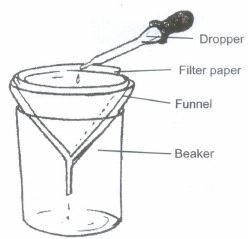
Keep pouring water till it starts dipping. Subtract the amount of water left in the measuring cylinder from the amount you started with. This is the amount of water retained by soil.
Record it in this manner:
Weight of soil = 50 mg
Initial volume of water = U mL
Final volume of water = V mL
Volume absorbed by the soil = (U- V) mL
Weight of water absorbed by the soil = (U - V) gm
because weight of 1 mL of water = 1 gm
Percentage of water absorbed = \(\frac { U-V }{ 50 } \times 100\)
Repeat this activity with different samples of soil. You observe that different soils have different absorbing capacity of water.
19.
The upper crust of the earth, which is capable of supporting vegetation is called soil. We usually see the surface of the soil. The sides of trench sides of a hill or steep river banks are clearly visible different zones or layers. The side-view of soil zones or layer is known as soil profile.
The upper most layer of the soil is called the A-horizon or top soil. It absorbs maximum water. The top soil consists of soil particles, minerals, water and humus. The decomposed organic matter (decayed plant and animal) remains forms a spongy and brownish or blackish material known as humus. The humus makes the soil very fertile. It also increases water holding capacity of the soil. Worms, insects, algae and fungi are found in the top soil. You will also find roots of plants in this layer. Plants get essential nutrients from the top through roots.
The second layer, called B-horizon, is more compact and harder than the top soil. It consists of sand, silt and clay. This layer contains very little organic matter. It is rich in soluble minerals and iron oxides.
The third zone, called C-horizon, consists of weathered rock. It is made up of small lumps of rocks with cracks and crevices. Below the C-horizon is found the bedrock.
20.
The removal of land surface or the top soilby water, wind or ice is known as soil erosion.
Plant roots firmly bind the soil. In the absence of plants, soil become loose. So it can be easily moved by wind and flowing water.
For preventing soil erosion, deforestation and cutting of trees should be prevented and efforts should be made to increase the green area. Erosion of soil is more severe in areas of little or no surface vegetation, such as deserts or barren lands.

7th Standard CBSE Syllabus & Materials
7th Standard CBSE
CBSE 7th Social Science Theme B - New Beginnings : Cities and States - New Sample Question Papers Study Material - QB365 Set A
NEW7th Standard CBSE
CBSE 7th Social Science Theme A - Climates of India - New Sample Question Papers Study Material - QB365 Set A
NEW7th Standard CBSE
CBSE 7th Social Science Theme A - Geographical Diversity of India - New Sample Question Papers Study Material - QB365 Set A
NEW7th Standard CBSE
CBSE 7th Science Earth, Moon and the Sun - New Sample Question Papers Study Material - QB365 Set A



NCERT Books

Syllabus

Exam Pattern

Sample Question Papers

Previous year Question Papers

Important Notes

MCQ Practice test

NCERT Exemplers

Case study Questions

Image Based Questions

Passage based Questions

HOT Questions

Value Based Questions

Model Questions Papers
NCERT ( Book Back ) Questions

Assertion and Reason
Important Questions And Answers

CBSE 7th Standard CBSE Subjects
CBSE Standards


