
 100% FREE ACCESS
7th Standard CBSE Syllabus & Materials
7th Standard CBSE
CBSE 7th Social Science Theme E - Understanding Market - New Sample Question Papers Study Material - QB365 Set A
NEW7th Standard CBSE
CBSE 7th Social Science Theme E - From Barter to Money - New Sample Question Papers Study Material - QB365 Set A
NEW7th Standard CBSE
CBSE 7th Social Science Theme D - The Constitution of India- An Introduction - New Sample Question Papers Study Material - QB365 Set A
NEW7th Standard CBSE
CBSE 7th Social Science Theme D - From the Rulers to the Ruled : Types of Governments - New Sample Question Papers Study Material - QB365 Set A
NEW7th Standard CBSE
CBSE 7th Social Science Theme B - The Age of Reorganisation - New Sample Question Papers Study Material - QB365 Set A
NEW7th Standard CBSE
CBSE 7th Social Science Theme B - The Rise of Empires - New Sample Question Papers Study Material - QB365 Set A

Published on: 31/10/2025
Download CBSE Class 7th Standard CBSE Science question papers, sample papers, important questions, and previous year solved papers in PDF format. Get free study materials, NCERT solutions, and exam preparation resources for Class 7th Standard CBSE Science
Questions + Answers key
Take MCQ Science Test
1.
Availability of water and minerals in the soil for maximum absorption by roots is in the
B-horizon
C-horizon
A-horizon
Surface of soil
2.
Humus helps in making soil
thick
hard
porous
dead
3.
The microorganisms present in the soil require moisture (water) and nutrients for growth and survival. Choose from the options below, the habitat (place) where the soil has plenty of water and nutrients.
Desert
Forest
Open field
Cricket ground
4.
B-horizon is also called as
topsoil
subsoil
parent rock
substratum
5.
The water holding capacity is the highest in
sandy soil
clayey soil
loamy soil
mixture of sand and loam
6.
Explain how soil pollution and soil erosion could be prevented.
7.
Razia conducted an experiment in the field related to the rate of percolation. She observed that it took 40 mins for 200 mL of water to percolate through the soil sample. Calculate the rate of percolation.
8.
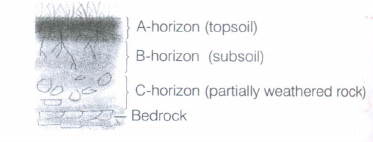
Sketch the cross-section of soil and label the various layers.
9.
List the differences between clayey soil and sandy soil.
10.
How is clayey soil useful for crops?
11.
Explain how soil is formed.
12.
What is weathering?
13.
When we add some dry soil to the water in a glass and stir it, bubbles are observed from the soil. What causes these bubbles to raise?
14.
Give the formula to calculate the absorption percentage.
15.
Which type of soil absorbs more water but allows less water to percolate?
16.
Which soil is considered to be the most fertile and used for growing crops?
17.
In how many groups the soil has been categorised? Name them.
18.
A soil sample having mass of 200 g was taken from garden.This soil was dried completely in the oven and again weight. The weight of the soil now was found to be 170 g. Calculate the percentage of water or moisture content present in the sample soil.
19.
The raw and baked soil differs from each other. How they are different? How can you prepare matkas from soil?
20.
Soil erosion does not occur easily where the land is covered by vegetation. Do you agree? Explain.
1.
(c)
A-horizon
2.
(a)
thick
3.
(b)
Forest
4.
(b)
subsoil
5.
The water holding capacity is the highest in clayey soil
6.
Preventions of soil pollution can be done by
(i) using manures instead of synthetic fertilisers.
(ii) using natural pesticides.
(iii) avoiding dumping of polythene and plastics in soil.
(iv) treating industrial waste before releasing it in the soil.
Preventions of soil erosion can be done by
(i) afforestation that is large scale planting in placee cut down forests.
(ii) avoiding overgrazing of grasslands.
(iii) terrace farming and other better farming methods in hilly areas.
7.
Given, Time = 40 mins
Volume of water = 200 mL
So, rate of percolation
\(\frac { amount\quad of\quad water(mL) }{ percolation\quad time(min) } =\frac { 200 }{ 40 } =5mL/min\)
Therefore, percolation rate of water = 5 mL/min
8.
Labelled sketch of the cross-section of soil is
9.
Differences between clayey soil and sandy soil are
| Clayey soil | Sandy soil |
|---|---|
| Particles are of very small size | Particles are of quite large size |
| Particles are tightly packed together | Particles are not closely packed. |
| No air is present between particles | Well-aerated |
| It can retain water for long time | It cannot hold water |
| Water does not drain easily | Water drains easily |
| It is fertile | It is not fertile |
10.
Clayey soil has an important characteristic. It can retain water and moisture and are rich in humus. Therefore, it is suitable for growing cereals like wheat, gram and paddy.
11.
Soil formation is a slow process which occurs in following two steps
(i) Weathering of rocks is the breakdown of rocks into small particles by the action of air, wind and water.
(ii) These small particles mix with humus (organic matter) and form soil.
12.
Weathering is a natural process by which huge rock is broken down into tiny particles but at a very slow rate.
13.
When dry soil is added in the water in a glass and stir it, bubbles appear. These bubbles are caused due to the air present in between the soil particles
14.
The absorption percentage of water can be calculated by the formula given below
Percentage of water absorb
\(\frac { amount\quad of\quad water\quad absorted(in\quad ml) }{ amount\quad of\quad soil(in\quad gm) } x100\)
15.
Clayey soil absorbs more water but allows less water to percolate
16.
Loamy soil is the most fertile soil and used for growing crops.
17.
The soil has been categorised into four major groups, i.e.
(i) clay
(ii) silt
(iii) sand
(iv) gravel
18.
The moisture content of the soil can be calculated by the formula as follows
= \(\frac { mass\quad of\quad water\quad in\quad soil }{ original\quad mass\quad of\quad soil } \times 100\)
Given, Original mass of soil = 200 g
Mass of soil after drying = 170 g
Then mass of water in soil will
= 200 - 170 = 30 g
The percentage of water in soil will be
\(\frac { 30g }{ 200g } \times 100=15%\)
19.
Raw soil differs from baked soil. The raw soil is white or dull blackish coloured soil. It contains water and air in it and can be moulded.
Baked soil is the heated raw soil which lost its water molecule due to heating and becomes red. Once the soil gets heated, it cannot be moulded into other form. Clay soil is used for making matkas, toys, pots, etc. The soil is kneaded along with horse dung to make best quality of raw clay soil. This kneaded soil is then placed on the wheel and appropriate shape is given. The final shape of the material is given with hands. The pots and matkas are then kept for drying for three days. These items are baked at high temperature after drying in air and then coloured.
20.
Ans. Yes, soil erosion does not occur easily where the land is covered by vegetation (trees and other plants). It occurs easily in those areas of land which are not covered by vegetation (trees and other plants) or have very little vegetation. If there is vegetation on land,
(i) then the roots of vegetation growing in the soil bind the particles of topsoil firmly. Due to this, the blowing wind and flowing rainwater are not able to carry away topsoil and hence soil erosion does not occur.
(ii) then much of the falling rain hits the trees and plants before it hits the soil. In this way, the cover of vegetation softens the effect of heavy rains on the soil

7th Standard CBSE Syllabus & Materials
7th Standard CBSE
CBSE 7th Social Science Theme B - New Beginnings : Cities and States - New Sample Question Papers Study Material - QB365 Set A
NEW7th Standard CBSE
CBSE 7th Social Science Theme A - Climates of India - New Sample Question Papers Study Material - QB365 Set A
NEW7th Standard CBSE
CBSE 7th Social Science Theme A - Geographical Diversity of India - New Sample Question Papers Study Material - QB365 Set A
NEW7th Standard CBSE
CBSE 7th Science Earth, Moon and the Sun - New Sample Question Papers Study Material - QB365 Set A



NCERT Books

Syllabus

Exam Pattern

Sample Question Papers

Previous year Question Papers

Important Notes

MCQ Practice test

NCERT Exemplers

Case study Questions

Image Based Questions

Passage based Questions

HOT Questions

Value Based Questions

Model Questions Papers
NCERT ( Book Back ) Questions

Assertion and Reason
Important Questions And Answers

CBSE 7th Standard CBSE Subjects
CBSE Standards


