
 100% FREE ACCESS
7th Standard CBSE Syllabus & Materials
7th Standard CBSE
CBSE 7th Social Science Theme E - Understanding Market - New Sample Question Papers Study Material - QB365 Set A
NEW7th Standard CBSE
CBSE 7th Social Science Theme E - From Barter to Money - New Sample Question Papers Study Material - QB365 Set A
NEW7th Standard CBSE
CBSE 7th Social Science Theme D - The Constitution of India- An Introduction - New Sample Question Papers Study Material - QB365 Set A
NEW7th Standard CBSE
CBSE 7th Social Science Theme D - From the Rulers to the Ruled : Types of Governments - New Sample Question Papers Study Material - QB365 Set A
NEW7th Standard CBSE
CBSE 7th Social Science Theme B - The Age of Reorganisation - New Sample Question Papers Study Material - QB365 Set A
NEW7th Standard CBSE
CBSE 7th Social Science Theme B - The Rise of Empires - New Sample Question Papers Study Material - QB365 Set A

Published on: 31/10/2025
Download CBSE Class 7th Standard CBSE Science question papers, sample papers, important questions, and previous year solved papers in PDF format. Get free study materials, NCERT solutions, and exam preparation resources for Class 7th Standard CBSE Science
Questions + Answers key
Take MCQ Science Test
1.
Gardeners gently dig up the soil around the roots of garden herbs (plants) frequently. Give reasons
2.
Write the difference between rate of percolation and the amount of water retained
3.
Describe how clayey soil is useful for crops?
4.
List the differences between clayey soil and sandy soil.
5.
Explain how soil is formed.
6.
How can a farmer convert acidic soil into neutral soil?
7.
Explain the term humus that is generally found in the uppermost layer of soil.
8.
Name two soil types used for cultivation.
9.
What is weathering?
10.
Which type of soil absorbs more water but allows less water to percolate?
11.
During a field trip, some students visited an agricultural farm and saw a few birds eating earthworms. They enjoyed the scene and then they also started picking and killing the earthworms for pleasure. Seeing the crowd of students in a corner, the teacher rushed to them to see the matter and objected to their action. Anshul, one of the student asked the reason.
Teacher smiled and explained him that an earthworm living in the soil is very beneficial for farmers. Anshul wondered whether there were other organisms also in the soil. The teacher appreciated him and explained.
(a) Mention the importance of earthworm.
(b) List some organisms living in soil.
(c) What are the values shown by Anshul?
12.
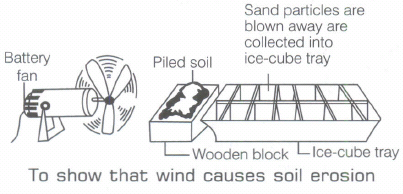
Design an activity to show the soil erosion on a barren land.
13.
The plants that grow on the surface of earth are called
vegetation
fertile land
crop
greenary
14.
Percolation rate is measured in unit
mL/min
min/mL
lit/min
mL/sec
15.
The soil that can be moulded into any shape is
silt
sandy
loamy
clayey
16.
B-horizon is also called as
topsoil
subsoil
parent rock
substratum
17.
Paddy requires.............soil to grow.
18.
Clay is a the..........rock particle.
19.
Weathering is a very............. process
20.
Substance like................ and................. pollute the agricultural soil
21.
Soil contains..........,................ and countless............ organisms.
22.
A-horizon is also known as subsoil.
23.
Silt is somewhat bigger rock particles than clay.
24.
Erosion of soil is more severe in the barren land.
25.
Sandy soil is used for making toys.
26.
The removal of upper surface of soil is called soil pollution.
1.
A gardener often gently digs up the soil around the roots of garden plants or herbs for following reasons
(i) It enables easy root growth.
(ii) For easier percolation of water.
(iii) For aerating the soil enabling air to get into deeper layers of soil.
(iv) For removing the weeds.
2.
Percolation property of any material is linked to its porosity. Different soils have different porosity. Therefore, water percolates differently through different soil.
Percolation rate of water in the soil = \(\frac { volume\quad of\quad water\quad percolated }{ time\quad taken\quad for\quad percolation } \)
Whereas water retaining capacity of a soil is described in terms of the amount of water absorbed by a particular type of soil. High water retaining capacity means higer water absorption.
3.
Clayey soil is useful for the crops because
(i) it has good water retaining capacity.
(ii) it is rich in humus.
(iii) it is fertile in nature.
Crops like wheat and rice can be easily grown in clayey soil.
4.
Differences between clayey soil and sandy soil are
| Clayey soil | Sandy soil |
|---|---|
| Particles are of very small size | Particles are of quite large size |
| Particles are tightly packed together | Particles are not closely packed. |
| No air is present between particles | Well-aerated |
| It can retain water for long time | It cannot hold water |
| Water does not drain easily | Water drains easily |
| It is fertile | It is not fertile |
5.
Soil formation is a slow process which occurs in following two steps
(i) Weathering of rocks is the breakdown of rocks into small particles by the action of air, wind and water.
(ii) These small particles mix with humus (organic matter) and form soil.
6.
The farmer can convert acidic soil into neutral soil by adding a small quantity of quicklime or slaked lime solution to the soil
7.
The rotting dead matter in the soil is called humus.
8.
Clayey soil and loamy soil are rich in humus and are suitable for growing plants like wheat and gram.
9.
Weathering is a natural process by which huge rock is broken down into tiny particles but at a very slow rate.
10.
Clayey soil absorbs more water but allows less water to percolate
11.
(a) An earthworm helps in making the rich humus in soil.
(b) Ant, earthworm, termites, milipede, centipede, etc.
(c) Curiosity to learn and scientific attitude
12.
Strong wind and rain can cause soil erosion from the barren land. This can be shown by performing an activity.
Take a wooden block and place some soil or sand on it. Keep an ice-cube tray at one end of the wooden black. Take a small battery-operated fan or hair dryer and hold it at the other end of the black near sand so that it blows the sand into the tray.
We will observe that when the fan blows it causes sand or soil particles to move and these get land in the various compartment of the ice-cube tray. This activity shows that the wind blows the soil on a barren land and may cause soil erosion.
13.
(a)
vegetation
14.
(a)
mL/min
15.
(a)
silt
16.
(b)
subsoil
17.
()
clayey
18.
()
Smallest
19.
()
Slow
20.
()
Chemicals, pesticides
21.
()
Air, water, living
22.
(b)
23.
(a)
24.
(a)
25.
(b)
26.
(b)

7th Standard CBSE Syllabus & Materials
7th Standard CBSE
CBSE 7th Social Science Theme B - New Beginnings : Cities and States - New Sample Question Papers Study Material - QB365 Set A
NEW7th Standard CBSE
CBSE 7th Social Science Theme A - Climates of India - New Sample Question Papers Study Material - QB365 Set A
NEW7th Standard CBSE
CBSE 7th Social Science Theme A - Geographical Diversity of India - New Sample Question Papers Study Material - QB365 Set A
NEW7th Standard CBSE
CBSE 7th Science Earth, Moon and the Sun - New Sample Question Papers Study Material - QB365 Set A



NCERT Books

Syllabus

Exam Pattern

Sample Question Papers

Previous year Question Papers

Important Notes

MCQ Practice test

NCERT Exemplers

Case study Questions

Image Based Questions

Passage based Questions

HOT Questions

Value Based Questions

Model Questions Papers
NCERT ( Book Back ) Questions

Assertion and Reason
Important Questions And Answers

CBSE 7th Standard CBSE Subjects
CBSE Standards


