
 100% FREE ACCESS
7th Standard CBSE Syllabus & Materials
7th Standard CBSE
CBSE 7th Social Science Theme E - Understanding Market - New Sample Question Papers Study Material - QB365 Set A
NEW7th Standard CBSE
CBSE 7th Social Science Theme E - From Barter to Money - New Sample Question Papers Study Material - QB365 Set A
NEW7th Standard CBSE
CBSE 7th Social Science Theme D - The Constitution of India- An Introduction - New Sample Question Papers Study Material - QB365 Set A
NEW7th Standard CBSE
CBSE 7th Social Science Theme D - From the Rulers to the Ruled : Types of Governments - New Sample Question Papers Study Material - QB365 Set A
NEW7th Standard CBSE
CBSE 7th Social Science Theme B - The Age of Reorganisation - New Sample Question Papers Study Material - QB365 Set A
NEW7th Standard CBSE
CBSE 7th Social Science Theme B - The Rise of Empires - New Sample Question Papers Study Material - QB365 Set A

Published on: 31/10/2025
Download CBSE Class 7th Standard CBSE Science question papers, sample papers, important questions, and previous year solved papers in PDF format. Get free study materials, NCERT solutions, and exam preparation resources for Class 7th Standard CBSE Science
Questions + Answers key
Take MCQ Science Test
1.
Soil is very important for the living beings? Justify.
2.
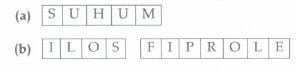
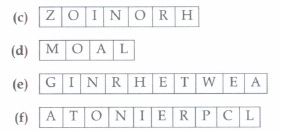
Unscramble the following jumbled words related to soil
3.
Describe in brief the steps followed in making earthen pots.
4.
Gardeners gently dig up the soil around the roots of garden herbs (plants) frequently. Give reasons
5.
Write the difference between rate of percolation and the amount of water retained
6.
During the summer vacations, Gaurav visited his native village. He observed that farmers were using pesticides in their field. He contacted the village head and explained him the effects of such substances in causing soil pollution. Next day, the. village head called a meeting of all the villagers and convinced the villagers not to use chemicals and pesticides.
(a) Why is there a ban to demand the polythene bags and plastics.
(b) List some substances which pollute the soil.
(c) What are the values shown by Gaurav?
7.
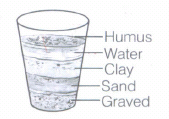
Observe the following figure and answer the following questions.
(a) Which is the heaviest rock material?
(b) Which is the lightest soil component?
(c) Why are different layers of soil component formed?
8.
A man digging a pit found that he could dig with ease initially but digging became difficult as he went deeper. He could not big beyond a depth 5 feet. Provide a suitable scientific explanations
9.
Describe the different type of soil
10.
Describe how clayey soil is useful for crops?
11.
Suppose certain sample takes 120 min for 960 mL water to percolate into the soil. Calculate the rate of percolation of water.
12.
Explain how soil pollution and soil erosion could be prevented.
13.
List the differences between clayey soil and sandy soil.
14.
How is clayey soil useful for crops?
15.
Explain how soil is formed.
1.
Soil is one of the most important natural resources because
(a) It supports the growth of plants by holding the roots firmly and supplying water and nutrients.
(b) It is the home for many organisms.
(c) Soil is essential for agriculture. Agriculture provides food, clothing and shelter for all.
(d) Soil is thus an inseparable part of our life
2.
(a) Humus
(b) Soil Profile
(c) Horizon
(d) Loam
(e) Weathering
(f) Percolation
3.
For making earthen pots, following steps are followed:
(i) Soil is collected from barren lands and place in a tank. It is cleared of all pebbles etc., and soaked for about 8 hours.
(ii) The soil is then kneaded after mixing horse dung in it.
(iii) The kneaded soil is given appropriate shape by placing on the wheel. Then the final shape is given by hand.
(iv) The items are coloured after three days of drying. Then all the items are baked in high temperature.
4.
A gardener often gently digs up the soil around the roots of garden plants or herbs for following reasons
(i) It enables easy root growth.
(ii) For easier percolation of water.
(iii) For aerating the soil enabling air to get into deeper layers of soil.
(iv) For removing the weeds.
5.
Percolation property of any material is linked to its porosity. Different soils have different porosity. Therefore, water percolates differently through different soil.
Percolation rate of water in the soil = \(\frac { volume\quad of\quad water\quad percolated }{ time\quad taken\quad for\quad percolation } \)
Whereas water retaining capacity of a soil is described in terms of the amount of water absorbed by a particular type of soil. High water retaining capacity means higer water absorption.
6.
(a) It is because these substances pollute the soil. They also kill the organisms living in the soil.
(b) Substances which pollute the soil are a number of waste products, chemicals, pesticides, polythene bags and plastics.
(c) Alertness, responsibility and ecofriendly nature
7.
(a) Gravel is the heaviest rock material.
(b) Humus is the lightest soil component which floats on the water surface.
(c) The soil component forms various layer one above the other according to the size of soil particle
8.
The man digging a pit could dig with ease initially because of th~\presence of topsoil and subsoil (mainly comprising of humus and nutrients). But as he digs deeper, he finds it difficult to dig beyond a depth of 5 feet as lower layers are made up of small partially weathered rocks with cracks, crevices and with bedrock which make it hard to dig.
9.
There are three different types of soil
(i) Sandy soil containing sand particles in them.
(ii) Clayey soil contains clay particles with small amount of humus in it. It is a fertile soil.
(iii) Loamy soil is a mixture of sand, clay silt and humus. It is a fertile soil
10.
Clayey soil is useful for the crops because
(i) it has good water retaining capacity.
(ii) it is rich in humus.
(iii) it is fertile in nature.
Crops like wheat and rice can be easily grown in clayey soil.
11.
Given, amount of water = 960 mL
Time taken to percolate = 120 min
The rate of percolation will be
= \(\frac { amount\quad of\quad water(in\quad ml) }{ Percolationtime(inmin) } =\frac { 960ml }{ 120min } =8mL/min\)
Percolation rate = 8 mL/min
12.
Preventions of soil pollution can be done by
(i) using manures instead of synthetic fertilisers.
(ii) using natural pesticides.
(iii) avoiding dumping of polythene and plastics in soil.
(iv) treating industrial waste before releasing it in the soil.
Preventions of soil erosion can be done by
(i) afforestation that is large scale planting in placee cut down forests.
(ii) avoiding overgrazing of grasslands.
(iii) terrace farming and other better farming methods in hilly areas.
13.
Differences between clayey soil and sandy soil are
| Clayey soil | Sandy soil |
|---|---|
| Particles are of very small size | Particles are of quite large size |
| Particles are tightly packed together | Particles are not closely packed. |
| No air is present between particles | Well-aerated |
| It can retain water for long time | It cannot hold water |
| Water does not drain easily | Water drains easily |
| It is fertile | It is not fertile |
14.
Clayey soil has an important characteristic. It can retain water and moisture and are rich in humus. Therefore, it is suitable for growing cereals like wheat, gram and paddy.
15.
Soil formation is a slow process which occurs in following two steps
(i) Weathering of rocks is the breakdown of rocks into small particles by the action of air, wind and water.
(ii) These small particles mix with humus (organic matter) and form soil.

7th Standard CBSE Syllabus & Materials
7th Standard CBSE
CBSE 7th Social Science Theme B - New Beginnings : Cities and States - New Sample Question Papers Study Material - QB365 Set A
NEW7th Standard CBSE
CBSE 7th Social Science Theme A - Climates of India - New Sample Question Papers Study Material - QB365 Set A
NEW7th Standard CBSE
CBSE 7th Social Science Theme A - Geographical Diversity of India - New Sample Question Papers Study Material - QB365 Set A
NEW7th Standard CBSE
CBSE 7th Science Earth, Moon and the Sun - New Sample Question Papers Study Material - QB365 Set A



NCERT Books

Syllabus

Exam Pattern

Sample Question Papers

Previous year Question Papers

Important Notes

MCQ Practice test

NCERT Exemplers

Case study Questions

Image Based Questions

Passage based Questions

HOT Questions

Value Based Questions

Model Questions Papers
NCERT ( Book Back ) Questions

Assertion and Reason
Important Questions And Answers

CBSE 7th Standard CBSE Subjects
CBSE Standards


