
 100% FREE ACCESS
7th Standard CBSE Syllabus & Materials
7th Standard CBSE
CBSE 7th Social Science Theme E - Understanding Market - New Sample Question Papers Study Material - QB365 Set A
NEW7th Standard CBSE
CBSE 7th Social Science Theme E - From Barter to Money - New Sample Question Papers Study Material - QB365 Set A
NEW7th Standard CBSE
CBSE 7th Social Science Theme D - The Constitution of India- An Introduction - New Sample Question Papers Study Material - QB365 Set A
NEW7th Standard CBSE
CBSE 7th Social Science Theme D - From the Rulers to the Ruled : Types of Governments - New Sample Question Papers Study Material - QB365 Set A
NEW7th Standard CBSE
CBSE 7th Social Science Theme B - The Age of Reorganisation - New Sample Question Papers Study Material - QB365 Set A
NEW7th Standard CBSE
CBSE 7th Social Science Theme B - The Rise of Empires - New Sample Question Papers Study Material - QB365 Set A

Published on: 31/10/2025
Download CBSE Class 7th Standard CBSE Science question papers, sample papers, important questions, and previous year solved papers in PDF format. Get free study materials, NCERT solutions, and exam preparation resources for Class 7th Standard CBSE Science
Questions + Answers key
Take MCQ Science Test
1.
William Harvey
2.
Veins
3.
Pulmonary veins
4.
Root hairs
5.
Stomata
6.
Veins carry the blood rich in________.
7.
Blood is a__________which flows in the____________.
8.
Heart has four _________ called as chambers.
9.
Heart is located in the ___________.
10.
_________ and _______ are removed along with water as sweat.
11.
The rhythmic expansion and contraction of the heart is called ____________.
12.
The colour of blood is red due to the presence of:
Chlorophyll
Haemoglobin
Oxygen
Carbon dioxide
13.
The filtration of blood is done by
heart
kidney
blood
urethra
14.
The organ which controls the blood circulation in body is
Liver
Lungs
Heart
Kidney
15.
In plants, water is transported through
xylem
phloem
stomata
root hair
16.
What is the special feature present in a human heart which does not allow mixing of blood when oxygen-rich and carbon dioxide-rich blood reach the heart?
17.
Look at figure and draw another figure of the same set up as would be observed after a few hours.
.png)
18.
What makes the blood look red?
19.
What will happen if there are no platelets in the blood?
20.
Human excretory system is depicted in the figure.
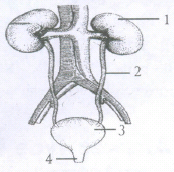
(a) Label the part 1, 2, 3 and 4
(b) Write the function of 1 & 3.
21.
What is the purpose of using stethoscope by doctors?
22.
State the function of valves?
23.
Name the organ which is located in the chest cavity with its lower tip slightly tilted towards the left.
24.
Name some useful products or materials that are carried by blood.
25.
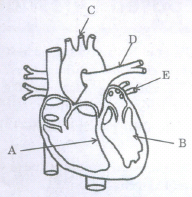
Label five parts (A to E) of heart and state their functions.
26.
While riding a bike, Mason fell from it due to loss of balance. He got up and realised that he was bleeding from several wounds badly. He panicked and started to run but Mansi who was looking at him, stopped him and told him to clean his wound with a clean cloth and that blood will stop coming in a while. Mason noticed that he has stopped bleeding after sometime and a hard covering was appearing on his wounds.
(a) Why did the bleeding stop after a while?
(b) What is blood and what type of cells are responsible for clotting?
(c) What of values do you think Mansi have?
27.
Sweat is secreted by sweat glands, present in our skin.
28.
WBC protects the body from diseases.
29.
Kidney is a rounded structure used to filter the blood.
30.
Haemoglobin is the red colour pigment present in blood.
31.
The vascular tissue for the transport of food in plants is called xylem.
32.
Expand ECG.
33.
What are the components of blood?
34.
Do you hear a regular thumping sound?
35.
Why do you think there; is throbbing?
36.
Do you see the heart and the blood vessels?
1.
()
Circulation of blood
2.
()
Deoxygenated blood
3.
()
Bring oxygenated blood from lungs to the heart.
4.
()
Absorption of water
5.
6.
()
Carbon dioxide
7.
()
Fluid, blood vessels
8.
()
compartments
9.
()
chest cavity
10.
()
Salt, urea
11.
()
heartbeats
12.
(b)
Haemoglobin
13.
(b)
kidney
14.
(c)
Heart
15.
In plants, water is transported through xylem.
16.
In human, the heart has four chambers. The two upper chambers are called the atria and the two lower chambers are called the ventricles. The partition between the chambers helps to avoid mixing up of blood rich in oxygen with the blood rich in carbon dioxide.
17.
After the few hours, the figure will be shown as follows
.png)
This figure shows that there will be an increase in the level of sugar solution in the potato piece. This increase in the level of sugar solution rises due to water that passes through the wall of potato and goes inside it.
18.
The red pigment (haemoglobin) present in the red blood cells of the blood makes the blood look red. The haemoglobin carries oxygen and transports it to all the parts of the body.
19.
The blood clot is formed due to the presence of the cells called platelets in the blood. If there were no platelets in the blood, then bleeding caused by a cut from an injury would not stop. This may cause loss of too much blood from the body of a person leading to death.
20.
(a) Part 1: Kidney
Part 2: Ureter
Part 3: Urinary Bladder
Part 4: Urethra
(b) Function of 1 (Kidney): Helps in filtration of blood. Function of 3 (Urinary Bladder): Receives and collects urine from kidneys.
21.
A stethoscope reads heartbeats as diaphragm amplies the rounds of heartbeat when placed on specific areas.
22.
Valves prevent the backflow of blood between chambers of heart.
23.
The heart is located in the chest cavity with its lower tip slightly tilted towards the left.
24.
Food, water and oxygen are the products that are carried by blood to every part of the body.
25.
A-Septum between right and left side of heart. It prevents mixing of oxygenated and deoxygenated blood.
B-Left ventricle,which pumps oxygenated blood to body parts.
C-Aorta is the main artery emerging from left ventricle. It gives rise to other arteries which carry blood to different body parts.
D-Left auricles, which receives oxygenated blood from lungs and pushes it into left ventricle.
E-Pulmonary vein brings oxygenated blood from lungs to left auricle.
26.
(a) Bleeding stops after some time because some specialised cells start forming a hard covering called clot at the site of wound.
(b) Bleeding is a fluid connective tissue present in all parts of the body. Platelets are responsible for formation of clot.
(c) Mansi is helpful, knowledgeable and interested in science subject.
27.
(a)
28.
(a)
29.
(b)
30.
(a)
31.
(b)
32.
()
Electrocardio Graph.
33.
()
Red blood cells, white blood cells, platelets and plasma.
34.
()
Yes.
35.
()
Because blood vessel in there.
36.
()
No, we have seen these only in the picture.

7th Standard CBSE Syllabus & Materials
7th Standard CBSE
CBSE 7th Social Science Theme B - New Beginnings : Cities and States - New Sample Question Papers Study Material - QB365 Set A
NEW7th Standard CBSE
CBSE 7th Social Science Theme A - Climates of India - New Sample Question Papers Study Material - QB365 Set A
NEW7th Standard CBSE
CBSE 7th Social Science Theme A - Geographical Diversity of India - New Sample Question Papers Study Material - QB365 Set A
NEW7th Standard CBSE
CBSE 7th Science Earth, Moon and the Sun - New Sample Question Papers Study Material - QB365 Set A



NCERT Books

Syllabus

Exam Pattern

Sample Question Papers

Previous year Question Papers

Important Notes

MCQ Practice test

NCERT Exemplers

Case study Questions

Image Based Questions

Passage based Questions

HOT Questions

Value Based Questions

Model Questions Papers
NCERT ( Book Back ) Questions

Assertion and Reason
Important Questions And Answers

CBSE 7th Standard CBSE Subjects
CBSE Standards


