
 100% FREE ACCESS
7th Standard CBSE Syllabus & Materials
7th Standard CBSE
CBSE 7th Social Science Theme E - Understanding Market - New Sample Question Papers Study Material - QB365 Set A
NEW7th Standard CBSE
CBSE 7th Social Science Theme E - From Barter to Money - New Sample Question Papers Study Material - QB365 Set A
NEW7th Standard CBSE
CBSE 7th Social Science Theme D - The Constitution of India- An Introduction - New Sample Question Papers Study Material - QB365 Set A
NEW7th Standard CBSE
CBSE 7th Social Science Theme D - From the Rulers to the Ruled : Types of Governments - New Sample Question Papers Study Material - QB365 Set A
NEW7th Standard CBSE
CBSE 7th Social Science Theme B - The Age of Reorganisation - New Sample Question Papers Study Material - QB365 Set A
NEW7th Standard CBSE
CBSE 7th Social Science Theme B - The Rise of Empires - New Sample Question Papers Study Material - QB365 Set A

Published on: 31/10/2025
Download CBSE Class 7th Standard CBSE Science question papers, sample papers, important questions, and previous year solved papers in PDF format. Get free study materials, NCERT solutions, and exam preparation resources for Class 7th Standard CBSE Science
Questions + Answers key
Take MCQ Science Test
1.
Describe the functions of blood.
2.
Describe the course of circulation of blood in our body with the help of a flow chart.
3.
What is transpiration? What is its significance?
4.
Describe in brief, how water is absorbed and transported in a tall tree.
5.
Name the three types of blood cells and give their functions.
6.
What is the special feature present in a human heart which does not allow mixing of blood when oxygen-rich and carbon dioxide-rich blood reach the heart?
7.
The major function of the arteries is to carry to oxygenated blood throughout the body and that of veins is to carry deoxygenated blood from body parts to heart for purification. There is one artery that carries deoxygenated blood and one vein that carries oxygenated blood. Name the artery and vein.
8.
Why plants absorb a large quantity of water from the soil, then give it off by transpiration?
9.
The given diagram is of human excretory system. Label the marked parts of it.
.png)
10.
Make a table depicting the function of all chambers of the human heart.
11.
How is transpiration and translocation different from each other.
12.
Give one function of each of the following organs.
(a) Blood vessels
(b) Kidney
(c) Blood platelets
(d) Heart.
13.
What is the relation between the rate of heartbeat and pulse rate? If a pulse rate of an athlete is 96/min, what will be the number of his heartbeat at the same time?
14.
(a) Name the only artery that carries carbon dioxide-rich blood.
(b) Why is it called an artery if it does not carry oxygen-rich blood?
15.
Name the tissues of a plant which carries
(a) water and minerals from roots to the leaves.
(b) food from the leaves to the other parts of the plant.
1.
(i) It transports the digested food from the small intestine to the other parts of the body.
(ii) It carries oxygen from the lungs to the other parts of the body.
(iii) Blood helps in removal of carbon dioxide and wastes from the cells.
2.
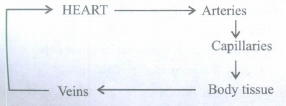
3.
Evaporation of water through stomata present on the leaves is called transpiration.
Significance :
(i) It keeps the plant cool.
(ii) It helps in upward movement of water in xylem as it creates a suction force.
4.
Plants absorb water and minerals by the roots. The roots have root hair. These are in contact with the water present between the soil particles. Once the water and minerals reach the xylem tissue of root. Xylem forms a continuous channel that connects roots to the leaves through the stem and branches. The xylem transports water and minerals upwards due to transpirational pull created by the process of transpiration.
5.
The three types of blood cells present in blood are :
(i) RBC (Red Blood Cells)-They contain a pigment haemoglobin which binds with oxygen and helps in the transport of oxygen.
(ii) WBC(White Blood Cells)-They help body to fight against germs. Hence, also called soldiers of body.
(iii) Platelets-They help in clotting of blood.
6.
In human, the heart has four chambers. The two upper chambers are called the atria and the two lower chambers are called the ventricles. The partition between the chambers helps to avoid mixing up of blood rich in oxygen with the blood rich in carbon dioxide.
7.
The artery which carries deoxygenated blood or blood rich in CO2 is pulmonary artery while the pulmonary vein is; one which carries oxygenated blood. The pulmonary artery carries deoxygenated blood from heart to lungs while pulmonary vein carries oxygenated blood from lungs to heart.
8.
Plants absorb a large quantity of water from the soil because they need nutrients which are dissolved in the water. The excess water evaporates through the stomata present on the leaf surface by the process of transpiration.
9.
The various parts of human excretory system are as follows
.png)
10.
The human heart is divided into four chambers, i.e. upper two atrium and lower two ventricles. The functions of these chambers can be tabulated as follows
| Chamber | Function |
| Left atrium | Receives oxygenated blood from lungs through pulmonary veins and pours it into left ventricle. |
| Right atrium | Receives deoxygenated blood from various body parts through superior and inferior vena cava and pours it into right ventricle. |
| Left ventricle | Pumps oxygenated blood to various parts of body through aorta. |
| Right ventricle | Pumps deoxygenated blood into lungs through pulmonary artery |
11.
The differences between transpiration and translocation are
| Transpiration | Translocation |
| The evaporation of water from the leaves of plant is called transpiration | The transport of soluble products of photosynthesis from leaves (from where they are formed) to the other parts, of plants, is called translocation. |
| It takes place through stomata present in the lower surface of leaf | It occurs in the part of the vascular tissue known as phloem. |
12.
The main function of the following organs are as follows:
(a) Blood vessels These run between the heart and the rest of the body. It helps in the transport of blood between heart and various organs of the body.
(b) Kidney It is called as the 'magic filters'. It helps in the removal of unwanted substances like urea from the blood.
(c) Blood platelets This component of blood helps in blood clotting and prevents the blood loss from the body.
(d) Heart It is a pumping organ which receives blood from the body through veins and pumps it with enough force into the arteries from where it is carried to the various body parts.
13.
The rhythmic contraction and relaxation of the muscles of the heart is called heartbeat.
Whereas, the rhythmical throbbing of the arteries as the blood is pushed forward through them is called pulse. It can be felt in the wrist, temples, etc. Pulse rate is the number of heartbeats per minutes.
The number of heart beat is equal to the number of pulse per minute.
Therefore, if a pulse rate of an athlete is 96/min then the number of his heartbeat at the same time will also be 96/min.
14.
(a) The only artery that carries carbon dioxide rich blood is pulmonary artery.
(b) The main function of artery is to carry blood away from heart. Also, arteries have thick wall and do not contain valves in them. Blood flow in arteries takes place at high pressure. All these characteristics are found in pulmonary artery. It carries deoxygenated blood from heart to lungs for oxygenation, therefore it is called artery.
15.
The tissue which carries
(a) water and minerals from roots to leaves is xylem.
(b) food from the leaves to the other parts of the plant is phloem.

7th Standard CBSE Syllabus & Materials
7th Standard CBSE
CBSE 7th Social Science Theme B - New Beginnings : Cities and States - New Sample Question Papers Study Material - QB365 Set A
NEW7th Standard CBSE
CBSE 7th Social Science Theme A - Climates of India - New Sample Question Papers Study Material - QB365 Set A
NEW7th Standard CBSE
CBSE 7th Social Science Theme A - Geographical Diversity of India - New Sample Question Papers Study Material - QB365 Set A
NEW7th Standard CBSE
CBSE 7th Science Earth, Moon and the Sun - New Sample Question Papers Study Material - QB365 Set A



NCERT Books

Syllabus

Exam Pattern

Sample Question Papers

Previous year Question Papers

Important Notes

MCQ Practice test

NCERT Exemplers

Case study Questions

Image Based Questions

Passage based Questions

HOT Questions

Value Based Questions

Model Questions Papers
NCERT ( Book Back ) Questions

Assertion and Reason
Important Questions And Answers

CBSE 7th Standard CBSE Subjects
CBSE Standards


