
 100% FREE ACCESS
7th Standard CBSE Syllabus & Materials
7th Standard CBSE
CBSE 7th Social Science Theme E - Understanding Market - New Sample Question Papers Study Material - QB365 Set A
NEW7th Standard CBSE
CBSE 7th Social Science Theme E - From Barter to Money - New Sample Question Papers Study Material - QB365 Set A
NEW7th Standard CBSE
CBSE 7th Social Science Theme D - The Constitution of India- An Introduction - New Sample Question Papers Study Material - QB365 Set A
NEW7th Standard CBSE
CBSE 7th Social Science Theme D - From the Rulers to the Ruled : Types of Governments - New Sample Question Papers Study Material - QB365 Set A
NEW7th Standard CBSE
CBSE 7th Social Science Theme B - The Age of Reorganisation - New Sample Question Papers Study Material - QB365 Set A
NEW7th Standard CBSE
CBSE 7th Social Science Theme B - The Rise of Empires - New Sample Question Papers Study Material - QB365 Set A

Published on: 31/10/2025
Download CBSE Class 7th Standard CBSE Science question papers, sample papers, important questions, and previous year solved papers in PDF format. Get free study materials, NCERT solutions, and exam preparation resources for Class 7th Standard CBSE Science
Questions + Answers key
Take MCQ Science Test
1.
Water found above the water table is called groundwater.
2.
Plants wilt-and ultimately dry up if they are not watered for few days.
3.
Year 2003 was observed as the International year of freshwater.
4.
Ice is solid, whereas snow is the semi-solid form of water.
5.
The freshwater stored in the ground is much more than that present in the rivers and lakes of the world.
6.
The amount of water recommended by the United Nations for drinking, washing, cooking and maintaining proper hygiene per person per day is a minimum of
5 L
15 L
30 L
50 L
7.
Renewable resources need to be conserved because
we should not use them faster than they are replenished by nature
they are slowly disappearing from the earth
if we overuse them, nature will stop replacing them
8.
Which of the following does not show water shortage?
Taps running dry
Long queues for getting water
Marches and protests for demand of water
A family gets three buckets of water per person per day
9.
The groundwater when collects between the layers of hard rocks is called
aquifer
water table
bawri
None of these
10.
Choose the correct option. The total water
in the lakes and rivers of the world remains constant
under the ground remains constant
in the seas and oceans of the world remains constant
of the world remains constant
11.
Water circulates through the water cycle in the three forms. Name them.
12.
If wells dug to get groundwater, then it dry up after sometime, what initiative should be taken to get water from it again?
13.
State the percentage of actual amount of water available for human use.
14.
State the consequences, if plants do not get enough water.
15.
Groundwater
16.
Gas
17.
Liquid
18.
Solid
19.
Leaking taps
20.
Buildings and roads reduce________________ of water by the soil.
21.
Using less water and preventing water from getting polluted is called ________________of water
22.
The process of ____________________ of water into the ground is called infiltration.
23.
Leaking__________________ is a source of huge water wastage.
24.
The rainwater can be used to____________________ the groundwater.
25.
Water is very precious for all the living beings. What will happen in future, if we do not save water now?
26.
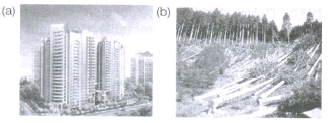
Two figures 'a' and 'b' are given below. Both are revealing two different human activities which are the cause of depletion of water table. Identify the two acts and explain how are these causing the depletion of water resource.
27.
Certain pattern of the rainfall in our country leads to scarcity of water. Explain that pattern. Which part of the country gets rainfall twice a year?
28.
Mention three causes of water scarcity in our country.
29.
Place the following statements in a proper order to form a meaningful paragraph.
(a) Which in turn decreases the seepage of rainwater into the ground.
(b) This decreases the open areas like parks and playgrounds.
(c) Increasing population create demand for construction of houses, shops, offices, roads and pavements.
(d) This results in depletion of water table and creates scarcity of more water.
30.
Planting trees help groundwater conservation. Explain how.
1.
(b)
2.
(a)
3.
(a)
4.
(b)
5.
(a)
6.
(d)
50 L
7.
(a)
we should not use them faster than they are replenished by nature
8.
(d)
A family gets three buckets of water per person per day
9.
(a)
aquifer
10.
(d)
of the world remains constant
11.
Water circulates through the water cycle in the three forms, i.e. solid, liquid and gas.
12.
In the above condition, the groundwater get recharged through the process of infiltration. It replenishes the groundwater.
13.
The actual amount of water available for human use is very little, i.e. approx 0.0006 % of all water found on the earth.
14.
The plants will wilt and ultimately dry up in lack of water
15.
()
Water under water table
16.
()
Water vapours
17.
()
Water in ponds, rivers, oceans
18.
()
Ice, snow
19.
()
Wastage of water
20.
()
absorption
21.
()
conservation
22.
()
seepage
23.
()
pipeline
24.
()
recharge
25.
Water is needed for various life activities. If we continue the misuse of water and do not conserve it, the groundwater level will be depleted. This may result into various consequences like
(i) Lowering of the water table Excessive pumping can lower the groundwater table.
(ii) Reduced surface water supply Groundwater and surface water are connected. When groundwater is overused, the lakes, streams and rivers connected to groundwater, can also have little supply.
(iii) Loss of plants from land We fully depend on the plants for food directly or indirectly. Plants need water to prepare their food. If there will be scarcity of water on earth, the plants will be unable to prepare their food. This inturn will lead to the end of the life because world without plants means no food, no oxygen, not enough rain and other innumerable problems. Therefore, it is true that water is a precious resource
26.
(a) Large scale construction (b) Deforestation.
Large scale construction It is main cause of water table lowering because it utilises large amount of water at the time of construction. Most of the time, it is digged water table.
Secondary, when ground surface becomes cemented. It does not allow seepage of rainwater into deeper layers, so rainwater goes waste as run off water and cannot replenish the water table of that particular place.
Deforestation Plants transfer huge amount of water in the form of water vapours. So, when forests are cut down, we interrupt in the process of water cycle of that area. So, no rain occurs at that place and it gradually turns into desert area.
27.
We face shortage of water mainly because water is not evenly distributed by the nature on the earth. Some places such as North East India get so much rains, so that it gets flooded almost every year.
On the other hand, Thar desert in Rajasthan may get rains rarely in the monsoon season. This uneven pattern of rains causes water scarcity in India at some places.
28.
The three causes of water scarcity in our country are
(i) Rapid urbanisation.
(ii) Increased number of industries.
(iii) Population explosion.
29.
Increasing population create demand for construction of houses, shops, offices, roads and pavements (c). This decreases the open areas like parks and playgrounds (b) which inturn decreases the seepage of rainwater into the ground (a). This results in depletion of water table and creates scarcity of more water (d).
30.
Plants lose water in the form of water vapour by the process of transpiration. So, forests contribute a lot of water vapours formation which make clouds.
Thus, plants help to revive water cycle.

7th Standard CBSE Syllabus & Materials
7th Standard CBSE
CBSE 7th Social Science Theme B - New Beginnings : Cities and States - New Sample Question Papers Study Material - QB365 Set A
NEW7th Standard CBSE
CBSE 7th Social Science Theme A - Climates of India - New Sample Question Papers Study Material - QB365 Set A
NEW7th Standard CBSE
CBSE 7th Social Science Theme A - Geographical Diversity of India - New Sample Question Papers Study Material - QB365 Set A
NEW7th Standard CBSE
CBSE 7th Science Earth, Moon and the Sun - New Sample Question Papers Study Material - QB365 Set A



NCERT Books

Syllabus

Exam Pattern

Sample Question Papers

Previous year Question Papers

Important Notes

MCQ Practice test

NCERT Exemplers

Case study Questions

Image Based Questions

Passage based Questions

HOT Questions

Value Based Questions

Model Questions Papers
NCERT ( Book Back ) Questions

Assertion and Reason
Important Questions And Answers

CBSE 7th Standard CBSE Subjects
CBSE Standards


